When you click on links to various merchants on this site and make a purchase, this can result in this site earning a commission. Affiliate programs and affiliations include, but are not limited to, the eBay Partner Network.
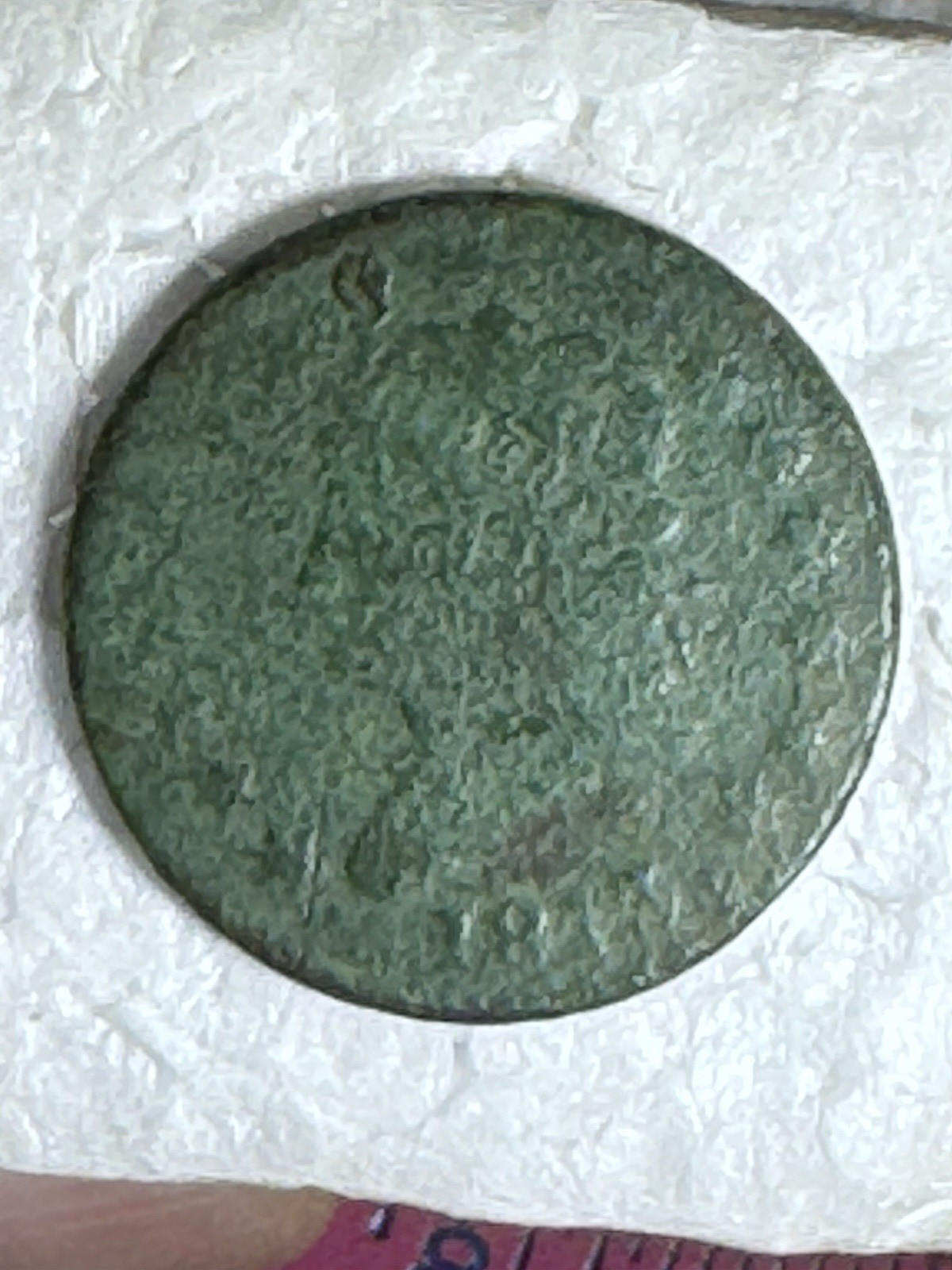
HI, THANKS FOR VISITING. Up for sale is a United States large cent of the Classic Head type (series of 1808–1814, designed by John Reich). A copper coin of large-cent size under a thick, even dark-green ground patina: the obverse retains a ghost of the left-facing Classic Head portrait, and the reverse retains the faint but readable ONE / CENT within the wreath — the diagnostic large-cent reverse. The coin is heavily worn and environmentally corroded, exactly as expected of a copper coin that spent two centuries in the soil.
Historical context:
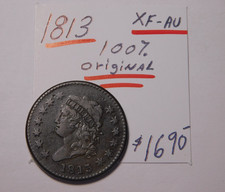
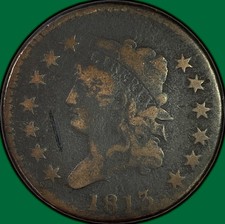
A coin of the war, found near the war's most famous fort. The 1813 cent was struck in the middle of the War of 1812 — and the war is written right into the coin itself. The U.S. Mint struck its cents on copper planchets (blanks) imported from England, and the British naval blockade choked off that supply. The Mint stretched its dwindling stock of blanks through 1813 and 1814, then ran out entirely — there are no U.S. cents dated 1815, the only date gap in the denomination's history. With a mintage of 418,000, the 1813 is the fourth lowest mintage date of the Classic Head series (1808-1814 designed by John Reich), with roughly 2,500 survivors estimated in all grades. A cent of 1813 is a cent struck from blockade-squeezed copper — that the blanks themselves came from the enemy's foundries is its own poetry.
Fort McHenry. In September 1814, one year after this coin was struck, the fort at Baltimore's harbor withstood 25 hours of British naval bombardment — the battle that kept Baltimore out of British hands and gave Francis Scott Key the sight of the flag that became "The Star-Spangled Banner." The land around the fort — the Locust Point peninsula and surrounding Baltimore neighborhoods — was thick with wartime activity: militia encampments, batteries, supply lines, and the daily commerce of a port city at war.
The honest framing of the find. This coin was dug on private property near Fort McHenry — not on the National Monument grounds. A cent of 1813 lost near the fort is period-perfect for the bombardment era, and that's the story: a coin of the war, from the soil of the neighborhood that saw the war's most famous night. Whether it fell from the pocket of a defender, a dockworker, or a Baltimorean of the 1820s can't be known, and the listing doesn't claim otherwise.
Condition (per the photos — plain and honest)
Heavily circulated and heavily environmentally affected: thick, even dark-green patina over both faces; devices mostly effaced, with a ghost of the Classic Head portrait on the obverse and faint ONE / CENT in the wreath on the reverse; scattered surface roughness and old scratches; rims present and even. Ungraded and, as a corroded ground find, it would come back "details" from any grading service — it should be priced and described as a relic, not a collector-grade coin. That said, the surfaces are stable and the patina is attractive as ground finds go.
- Coin: U.S. large cent, Classic Head type (1808–1814), John Reich design; date 1813
- Mintage: 418,000 (fourth lowest of the series); ~2,500 estimated survivors in all grades
- Condition: heavily circulated ground find; thick green patina; devices mostly effaced (portrait ghost and ONE CENT visible); ungraded; sold as-is as a relic
- Provenance: dug on private property near Fort McHenry, Baltimore, Maryland
- History: struck during the War of 1812 on blockade-constrained English copper; no cents were struck dated 1815
BEING SOLD IN "AS IS"/USED, GROUND FIND IN CIRCULATED AND UNGRADED CONDITION.PLEASE REFER TO PHOTOS FOR CONDITION.RETURNS ACCEPTED ON THIS ITEM WITHIN 30 DAYS.PAYMENT BY PAYPAL ONLY. PLEASE ASK ANY QUESTIONS IN ADVANCE.
SHIP WITHIN 4 BUSINESS DAYS OF PAYMENT.