When you click on links to various merchants on this site and make a purchase, this can result in this site earning a commission. Affiliate programs and affiliations include, but are not limited to, the eBay Partner Network.
His Story Treasures Presents
中華蘇維埃銅幣 一分
Chinese Soviet Republic 1 Fen Copper Coin
Republican China • Central Soviet Period
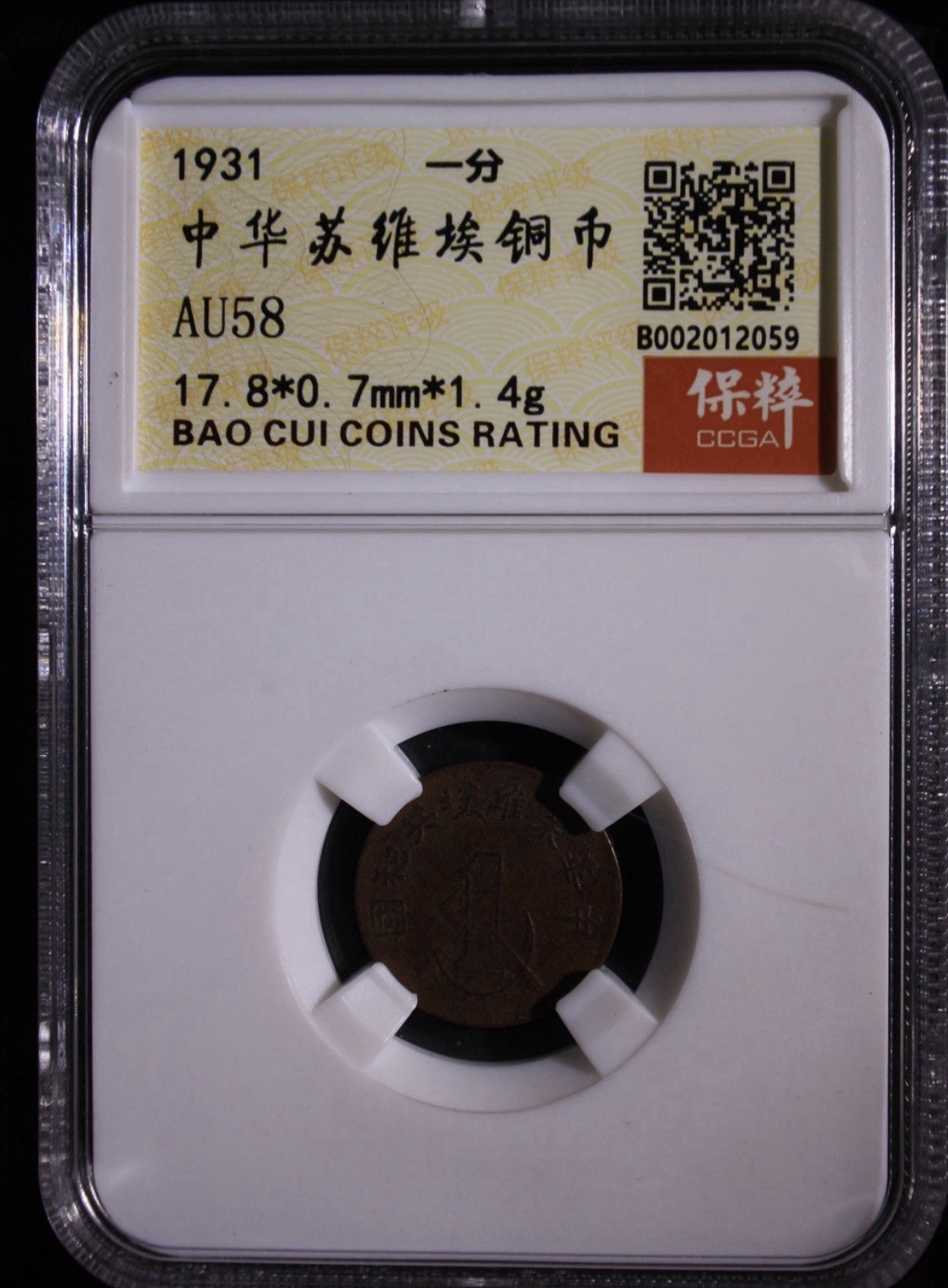
Bao Cui / CCGA Certified AU58
Holder Attribution: 1931
Money from a Revolution
⸻
The Story
Some coins are created by established governments whose authority has endured for generations.
Others are struck while history itself remains undecided.
This remarkable one-fen copper coin belongs to the second category.
Issued within the monetary world of the Chinese Soviet Republic during the turbulent early 1930s, it survives from an extraordinary chapter in modern Chinese history—when a revolutionary government established its own administrative institutions, organized a banking system, and created currency for the territories under its control.
Small enough to almost disappear between two fingers, this copper coin measures only 17.8 millimeters and weighs approximately 1.4 grams.
Yet the history behind it is enormous.
Its inscriptions connect it directly with the revolutionary base areas of southern China during the years immediately preceding the Long March.
It was not created as a commemorative.
It was money.
Money intended to circulate.
Money created for an economy operating under extraordinary political and military circumstances.
And more than nine decades later, this tiny copper coin survives as a tangible artifact of that world.
⸻
The Birth of a New Monetary System
In November 1931, the Chinese Soviet Republic was formally established at Ruijin in Jiangxi Province.
Creating a government required more than declarations and armies.
It required institutions.
Taxes had to be collected.
Goods had to be bought and sold.
Workers and soldiers needed to be paid.
Commerce needed a medium of exchange.
And a functioning economy needed money.
Toward the end of 1931, the former Jiangxi Soviet mint was transferred to the Ruijin area and developed into the Central Mint.
Then, on February 1, 1932, the Chinese Soviet Republic State Bank was formally established at Ruijin.
The new monetary institutions faced formidable challenges.
Equipment was limited.
Raw materials could be difficult to obtain.
The surrounding territories were affected by military conflict and economic blockade.
Nevertheless, a monetary system emerged.
Paper currency was produced in several denominations, while metallic currency included silver and copper issues.
Among the smallest denominations was the humble:
一分
One Fen.
The denomination represented only a tiny amount of purchasing power.
But economically, coins such as this were essential.
Large-denomination money could finance major transactions.
Small copper coins made everyday commerce possible.
⸻
A Coin Made to Circulate
Unlike a medal created to commemorate an event, this coin was designed for use.
Its purpose was practical.
It belonged in markets.
It could pass between merchants and customers.
It could participate in the countless small transactions from which an economy is built.
That distinction makes surviving examples particularly evocative.
This was not simply an official symbol placed in a cabinet.
It was part of an attempt to create an operating monetary economy within the Soviet-controlled territories.
The Chinese Soviet Republic State Bank was tasked with helping unify currency and support economic activity within those areas.
Its monetary system eventually included both paper notes and metallic coins.
The one-fen copper denomination represented the smallest end of that system.
And this tiny survivor preserves that history today.
⸻
中華蘇維埃
The inscriptions themselves immediately identify the political world from which the coin emerged.
Rather than carrying the familiar imagery and inscriptions of the contemporary Republic of China coinage, Soviet-area currency carried its own distinctive political identity.
That makes these coins fundamentally different from the mainstream Chinese issues circulating elsewhere during the same period.
China in the early 1930s did not possess a completely uniform monetary landscape.
Regional currencies, foreign silver coins, traditional silver dollars, banknotes and locally produced issues could all circulate within different economic environments.
Within the Soviet-controlled territories, establishing an independent currency was therefore both an economic necessity and an assertion of administrative authority.
A tiny copper coin became part of the machinery of government.
⸻
Ruijin — The Red Capital
At the center of this story was Ruijin in Jiangxi Province.
During the early 1930s, Ruijin became the administrative center of the Chinese Soviet Republic and the location around which its principal financial institutions developed.
The State Bank was established there in 1932.
The Central Mint was also based in the Ruijin area after its relocation from the earlier Jiangxi Soviet mint.
From these relatively modest facilities came currency intended to support an economy operating under extraordinarily difficult circumstances.
The monetary system developed there included paper notes as well as metallic denominations such as the two-jiao silver coin and one-fen and five-fen copper coins.
This coin belongs to that monetary tradition.
⸻
On the Eve of the Long March
The historical window represented by Soviet-area coinage was remarkably short.
Throughout the early 1930s, military pressure around the Central Soviet intensified.
By 1934, the strategic situation had changed dramatically.
In October of that year, the main forces of the Chinese Red Army departed the Central Soviet, beginning the movement remembered as the Long March.
The political movement represented by these coins would survive.
The monetary system that produced them would not remain in Ruijin.
That gives these small copper issues an unusually concentrated historical significance.
They come from a narrow period between the establishment of the Soviet governmental institutions and the abandonment of the Central Soviet.
Within only a few years, the people, institutions and military forces connected with this currency would be moving across China.
But the coins remained behind.
⸻
The Coin
This particular example has been independently encapsulated and certified by Bao Cui Coins Rating (保粹评级 / CCGA).
Holder Attribution: 1931
Denomination: 一分 / 1 Fen
Certification Grade: AU58
Certification No.: B002012059
Diameter: 17.8 mm
Thickness: 0.7 mm
Weight: 1.4 g
The coin displays naturally dark brown copper surfaces consistent with an extensively aged historical piece.
Despite its diminutive size, the principal design elements remain visible, and the reverse one-fen denomination can be distinguished within its surrounding wreath.
The coin has been preserved inside its certification holder and is offered exactly as photographed.
Please examine all high-resolution photographs carefully, as they form an important part of the description and show the exact certified coin being offered.
Note regarding date attribution:
The Bao Cui certification holder attributes this example to 1931. Historical references concerning Central Soviet monetary production vary in their dating and classification of early issues. Accordingly, His Story Treasures presents the 1931 date as the attribution stated by the independent certification service rather than making an additional independent determination of the precise striking year.
⸻
Why This Coin Matters
Its importance is not measured by its size.
This tiny copper coin represents something considerably larger:
the attempt to build a functioning monetary system during one of the most turbulent periods of twentieth-century Chinese history.
It belongs to the formative years of institutions that existed under extraordinarily difficult circumstances.
It represents commerce within the Central Soviet.
It represents the need for everyday currency.
And it survives from the years immediately preceding one of the defining episodes of modern Chinese history—the Long March.
Most importantly, it reminds us that history is not preserved only through famous documents, weapons or portraits of political leaders.
Sometimes history survives in the smallest objects.
A coin worth one fen.
Made to purchase ordinary things.
Passed through ordinary hands.
Yet created during extraordinary times.
⸻
A Small Coin from an Enormous Story
Imagine this coin when it was still currency.
It may once have rested in the hand of a merchant.
It may have been exchanged for food or everyday necessities.
It may have passed through a market somewhere within the Soviet-controlled territories of southern China.
The people who used coins like this were not holding historical artifacts.
They were simply spending money.
They could not know how dramatically China's history would unfold over the decades that followed.
Today, more than ninety years later, the monetary value of one fen is almost irrelevant.
Its historical value is what remains.
The little copper coin has become a witness.
A survivor from revolutionary China.
A piece of monetary history from the years before the Long March.
And a tangible connection to one of the most consequential periods in twentieth-century Chinese history.
⸻
His Story Treasures
We believe coins are more than objects of metal.
They are witnesses to the societies that created them.
Kings and emperors appear on some.
Revolutions appear on others.
Every authentic historical coin carries evidence of the political, economic and human world in which it circulated.
This Chinese Soviet Republic one-fen copper coin is one such survivor—
a tiny piece of currency from a short-lived monetary system that existed during an extraordinary turning point in modern Chinese history.
Own the artifact.
Preserve the story.
His Story Treasures
Where Every Coin Has a Story.