When you click on links to various merchants on this site and make a purchase, this can result in this site earning a commission. Affiliate programs and affiliations include, but are not limited to, the eBay Partner Network.
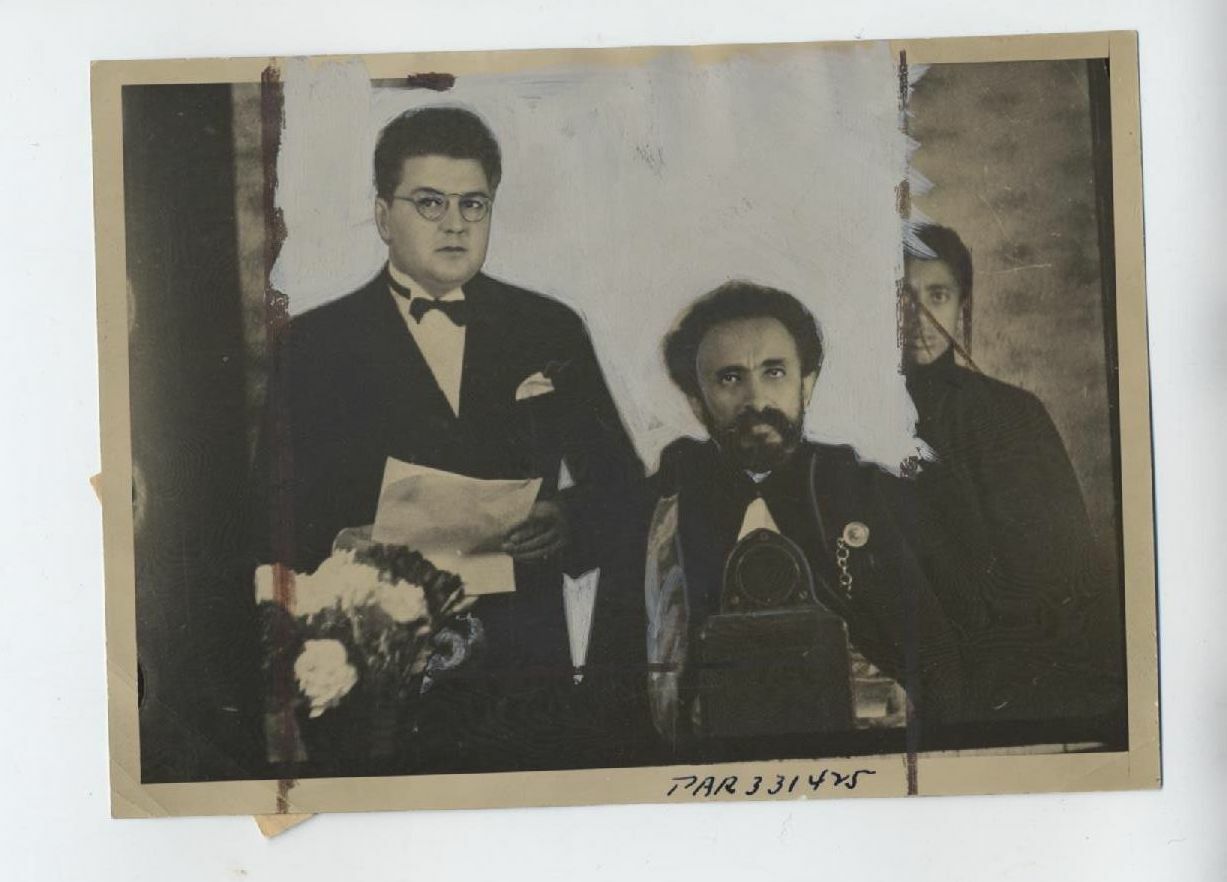
A VINTAGE 5 1/8 X 7 INCH PHOTO FROM 1936 DEPICTING HAILE SELASSIE AND HIS SON IN THE UNITED STATES
U.S. PUBLICIST AT NEGUS\' SIDE IN BROADCAST. JOSEF ISRAELS, AMERICAN PUBLICITY EXPERT, WHO WAS RECENTLY APPOINTED PUBLIC RELATIONS COUNSEL TO THE ETHIOPIAN GOVERNMENT, IS SHOWN BESIDE EMPEROR HAILE SELASSIE. DURING THE LATTER\'S RECENT BROADCAST THAT WAS HEARD IN AMERICA. ON THE RIGHT IS THE EMPEROR\'S SON ANS HEIR, DUKE MAKOHNEN. ISRAELS DIRECTED FORMER GOVERNOR ALFRED E. SMITH\'S PRESIDENTIAL CAMPAIGN.
aile Selassie is one of the most bizarre and misunderstood figures in 20th-century history, alternately worshipped and mocked, idolised and marginalised. This magnificent biography by the German-Ethiopian historian Asfa-Wossen Asserate (a distant relation of Selassie), and translated by Peter Lewis, is diligently researched and fair-minded; he is at last accorded a proper dignity. The book is manifestly a riposte to Ryszard Kapuscinski’s The Emperor: Downfall of an Autocrat, which portrayed the emperor, and indeed Addis Ababa’s entire Amharic elite, as a comic-opera laughing stock.
Selassie came to power as regent of Abyssinia, later Ethiopia, in 1916, but many of the myths around him originated with Mussolini’s invasion of the country in 1935. Selassie and his armies resisted, but he was eventually forced into exile. In 1941, after six years of brutal occupation, the Italians were defeated by British and South African forces and Selassie was allowed to return to his throne in Addis Ababa, where he remained in power until 1974.Sign up for Bookmarks: discover new books in our weekly emailRead moreOne unexpected side-effect of the plunder of Selassie’s sub-Saharan state by a fascist power was to give Jamaica’s fledgling Rastafari movement impetus and a cause. The invasion became a dominant event in the Rastafarian narrative of black martyrdom. Selassie was seen as a manifestation of the one true God and a bulwark against “Babylon” (oppressive colonial society). The movement took its name from Selassie’s pre-coronation title, Ras Tafari Makonnen.
The Rastafarian movement was not the only radical current in Jamaica to co-opt Selassie. Marcus Garvey, the Jamaican apostle of black liberation, had condemned the ruler as a “great coward” for fleeing Mussolini’s troops in 1935, yet went on to dub him the “black Christ” of his Back to Africa movement. Inspired by Garvey, and believing in Ethiopia as the one true “Zion”, during the 50s and 60s some 2,500 West Indians and African Americans went to live in the vicinity of Addis Ababa, in what is now Shashamane village. Only 300 of their number are believed to remain today.
There is a wonderful chapter on Jamaica here, in which Asserate recreates Selassie’s historic visit to Kingston in April 1966. A large crowd of Rastafarians swarmed the airport and banners showing the Ethiopian Lion of Judah rippled amid clouds of ganja smoke. Converging around the Ethiopian plane even as the propellers were turning, they sang praise to their god in human form, who they believed had come to redeem his Jamaican brethren. The impact of Selassie’s four-day state visit endured for many years, inspiring poems and songs – one of which, “Rasta Shook Them Up”, by Peter Tosh, contained introductory words in Amharic, the Ethiopian language. Bob Marley, like Tosh, his fellow Wailer, believed that Selassie was a reborn messiah. The irony was that the emphasis placed by Rastafari on dietary laws and ganja-inspired “reasoning” of Old Testament scriptures was quite alien to the conservative Selassie, who was at pains to deny his status as the Rastafari Pope Almighty.
Meanwhile, the Ethiopian royal family promoted myths of its own, particularly its vaunted descent from King Solomon, the legendary third king of Israel. Selassie proclaimed himself a collateral descendent of Solomon’s wife, the Queen of Sheba (who may or may not have come from present day Yemen). Yet for all the dizzying Semitic connections, Asserate reminds us, Ethiopia converted to Christianity in the fourth century AD, when the Ark of the Covenant was allegedly transferred there from southern Egypt. The Old Testament casket, lined with gold to accommodate the two tablets of the Ten Commandments, is said to reside today in the church of St Mary of Zion, near the Eritrean border. The evidence for Ethiopia’s Semitic past is far from watertight (Rider Haggard made much of it in his schoolboy hokum, King Solomon’s Mines). But some believed that Selassie was the saviour whose coming had been foretold in the Old Testament. The belief was aided, Asserate notes, by the emperor’s “pure Semitic” features and “sphinx-like dignity”.
Selassie projected an image of himself as a paternalistic ruler. His ambition was to found a dynasty and “modernise” his country’s feudal system through a forward-looking (if paradoxially absolute) monarchy. His coronation in 1930 – attended by Evelyn Waugh, who Asserate describes as a “notorious sneerer” – drew ridicule for its display of sumptuously plumed and gold-braided uniforms and other regalia. Yet in lampooning Selassie as a tinpot Caesar, Waugh and other critics rather missed the point. The Napoleonic hats and gowns were part of Selassie’s vision of a parallel world equal to that of the white man. Why should the European powers have all the pomp and ceremony?
More contentious was Selassie’s tolerance of slavery. Most people-traffickers under his regime were Muslims, who converted their captives to Islam. As a condition of Ethiopia’s entry into the League of Nations, Selassie was required to eradicate the trade. He did what he could, and Ethiopia was admitted in 1923. Yet chattel servitude was not entirely eradicated. Bondsmen employed at the Addis Ababa palace were often actually “proud” of their position, writes Asserate. Slavery had long been a part of such African nation states as Dahomey, Oyo, and the Niger city-states.
With his unbending antipathy to any kind of social reform, from the 1950s onwards Selassie became out of touch and indifferent to the suffering of his people. When his 60-year rule ended, the subsequent “Red Terror” under President Mengistu, combined with Ethiopia’s border dispute with Eritrea, has left the African nation state depleted and corrupt.
Haile Selassie I (Ge\'ez: ቀዳማዊ ኃይለ ሥላሴ, romanized: qädamawi haylä səllasé,[nb 2] Amharic pronunciation: [ˈhaɪlə sɨlˈlase] (About this soundlisten);[nb 3] born Lij Tafari Makonnen Woldemikael; 23 July 1892 – 27 August 1975)[4] was an Ethiopian regent from 1916 to 1930 and emperor from 1930 to 1974. He is a defining figure in modern Ethiopian history.[5][6] He was a member of the Solomonic dynasty who traced his lineage to Emperor Menelik I.
Selassie\'s internationalist views led to Ethiopia becoming a charter member of the United Nations.[7] At the League of Nations in 1936, he condemned Italy\'s use of chemical weapons against its people during the Second Italo-Ethiopian War.[8] He has been criticized by some historians for his suppression of rebellions among the landed aristocracy (the mesafint), which consistently opposed his reforms; some critics have also criticized Ethiopia\'s failure to modernize rapidly enough.[9][10] During his rule the Harari people were persecuted and many left the Harari Region.[11] His regime was also criticized by human rights groups as autocratic and illiberal, such as Human Rights Watch.[10][12]
Among the Rastafari movement, whose followers are estimated to number between 700,000 and one million, Haile Selassie is revered as the returned messiah of the Bible, God incarnate.[13][14] Beginning in Jamaica in the 1930s, the Rastafari movement perceives Haile Selassie as a messianic figure who will lead a future golden age of eternal peace, righteousness, and prosperity.[15] He was an Ethiopian Orthodox Christian throughout his life.
The 1973 famine in Ethiopia led to Selassie\'s removal from the throne.[16] He was strangled to death on 27 August 1975 at age 83 following a coup d\'état.[17]Contents1 Name2 Biography2.1 Early life2.2 Governorship2.3 Regency2.3.1 Travel abroad2.4 King and Emperor2.5 Conflict with Italy2.5.1 Mobilization2.5.2 Progress of the war2.5.3 Exile debate2.5.4 Collective security and the League of Nations, 19362.5.5 Exile2.6 1940s and 1950s2.7 1960s2.8 1970s2.8.1 Wollo famine2.8.2 Revolution2.8.3 Imprisonment2.8.4 Death and interment3 Descendants4 Rastafari messiah4.1 Selassie\'s position5 Titles and styles5.1 National orders6 Ancestry7 Military ranks8 1958 famine of Tigray9 In popular culture10 See also11 Notes12 References12.1 Citations12.2 Sources13 Further reading14 External linksNameStyles ofHaile Selassie I of EthiopiaImperial coat of arms of Ethiopia (Haile Selassie).svgReference style His Imperial MajestyAmharic: ግርማዊ; girmāwīSpoken style Your Imperial MajestyAmharic: ጃንሆይ; djānhoilit. \"O [esteemed] royal\"Alternative style Our Lord (familiar)Amharic: ጌቶቹ; getochulit. \"Our master\" (pl.) This article contains Ethiopic text. Without proper rendering support, you may see question marks, boxes, or other symbols instead of Ethiopic characters.Haile Selassie was known as a child as Lij Tafari Makonnen (Amharic: ልጅ ተፈሪ መኮንን; lij teferī mekōnnin). Lij is translated as \"child\", and serves to indicate that a youth is of noble blood. His given name, Tafari, means \"one who is respected or feared\". Like most Ethiopians, his personal name \"Tafari\" is followed by that of his father Makonnen and that of his grandfather Woldemikael. His Ge\'ez name Haile Selassie was given to him at his infant baptism and adopted again as part of his regnal name in 1930.
As Governor of Harar, he became known as Ras Tafari Makonnen About this soundlisten (help·info). Ras is translated as \"head\"[18] and is a rank of nobility equivalent to Duke;[19] though it is often rendered in translation as \"prince\". In 1916, Empress Zewditu I appointed him to the position of Balemulu Silt\'an Enderase (Regent Plenipotentiary). In 1928, she granted him the throne of Shewa, elevating his title to Negus or \"King\".[20]
On 2 November 1930, after the death of Empress Zewditu, Tafari was crowned Negusa Nagast, literally King of Kings, rendered in English as \"Emperor\".[21] Upon his ascension, he took as his regnal name Haile Selassie I. Haile means in Ge\'ez \"Power of\" and Selassie means trinity—therefore Haile Selassie roughly translates to \"Power of the Trinity\".[22] Haile Selassie\'s full title in office was \"By the Conquering Lion of the Tribe of Judah, His Imperial Majesty Haile Selassie I, King of Kings of Ethiopia, Elect of God\".[23][nb 4] This title reflects Ethiopian dynastic traditions, which hold that all monarchs must trace their lineage to Menelik I, who was the offspring of King Solomon and the Queen of Sheba.[24]
To Ethiopians, Haile Selassie has been known by many names, including Janhoy, Talaqu Meri, and Abba Tekel.[25] The Rastafari movement employs many of these appellations, also referring to him as Jah, Jah Jah, Jah Rastafari (the abbreviation of \"His Imperial Majesty\").[25]
BiographyEarly life
Ras Makonnen Woldemikael and his son Lij Tafari MakonnenHaile Selassie\'s royal line (through his father\'s mother) descended from Sahle Selassie,[26] He was born on 23 July 1892, in the village of Ejersa Goro, in the Harar province of Ethiopia. His mother was Woizero (\"Lady\") Yeshimebet Ali Abba Jifar, daughter of the renowned Oromo ruler of Wollo province Dejazmach Ali Abba Jifar.[27] His maternal grandmother was of Gurage heritage.[28] Tafari\'s father was Ras Makonnen Woldemikael Gudessa, the governor of Harar. Ras Makonnen served as a general in the First Italo–Ethiopian War, playing a key role at the Battle of Adwa;[27] he too was paternally Oromo but maternally Amhara.[28] Haile Selassie was thus able to ascend to the imperial throne through his paternal grandmother, Woizero Tenagnework Sahle Selassie, who was an aunt of Emperor Menelik II and daughter of Negus Sahle Selassie of Shewa. As such, Haile Selassie claimed direct descent from Makeda, the Queen of Sheba, and King Solomon of ancient Israel.[29]
Ras Makonnen arranged for Tafari as well as his first cousin, Imru Haile Selassie, to receive instruction in Harar from Abba Samuel Wolde Kahin, an Ethiopian capuchin monk, and from Dr. Vitalien, a surgeon from Guadeloupe. Tafari was named Dejazmach (literally \"commander of the gate\", roughly equivalent to \"count\")[30] at the age of 13, on 1 November 1905.[31] Shortly thereafter, his father Ras Makonnen died at Kulibi, in 1906.[32]
Governorship
Dejazmatch Tafari, as governor of HararTafari assumed the titular governorship of Selale in 1906, a realm of marginal importance,[33] but one that enabled him to continue his studies.[31] In 1907, he was appointed governor over part of the province of Sidamo. It is alleged that during his late teens, Haile Selassie was married to Woizero Altayech, and that from this union, his daughter Princess Romanework was born.[34]
Following the death of his brother Yelma in 1907, the governorate of Harar was left vacant,[33] and its administration was left to Menelik\'s loyal general, Dejazmach Balcha Safo. Balcha Safo\'s administration of Harar was ineffective, and so during the last illness of Menelik II, and the brief reign of Empress Taitu Bitul, Tafari was made governor of Harar in 1910[32] or 1911.[35]
On 3 August, he married Menen Asfaw of Ambassel, niece of the heir to the throne Lij Iyasu.
RegencyThe extent to which Tafari Makonnen contributed to the movement that would come to depose Lij Iyasu has been discussed extensively, particularly in Haile Selassie\'s own detailed account of the matter. Iyasu was the designated but uncrowned emperor of Ethiopia from 1913 to 1916. Iyasu\'s reputation for scandalous behavior and a disrespectful attitude towards the nobles at the court of his grandfather, Menelik II,[36] damaged his reputation. Iyasu\'s flirtation with Islam was considered treasonous among the Ethiopian Orthodox Christian leadership of the empire. On 27 September 1916, Iyasu was deposed.[37]
Contributing to the movement that deposed Iyasu were conservatives such as Fitawrari Habte Giyorgis, Menelik II\'s longtime Minister of War. The movement to depose Iyasu preferred Tafari, as he attracted support from both progressive and conservative factions. Ultimately, Iyasu was deposed on the grounds of conversion to Islam.[18][37] In his place, the daughter of Menelik II (the aunt of Iyasu) was named Empress Zewditu, while Tafari was elevated to the rank of Ras and was made heir apparent and Crown Prince. In the power arrangement that followed, Tafari accepted the role of Regent Plenipotentiary (Balemulu \'Inderase)[nb 5] and became the de facto ruler of the Ethiopian Empire (Mangista Ityop\'p\'ya). Zewditu would govern while Tafari would administer.[38]Empress Zewditu with one of her trusted priestsWhile Iyasu had been deposed on 27 September 1916, on 8 October he managed to escape into the Ogaden Desert and his father, Negus Mikael of Wollo, had time to come to his aid.[39] On 27 October, Negus Mikael and his army met an army under Fitawrari Habte Giyorgis loyal to Zewditu and Tafari. During the Battle of Segale, Negus Mikael was defeated and captured. Any chance that Iyasu would regain the throne was ended and he went into hiding. On 11 January 1921, after avoiding capture for about five years, Iyasu was taken into custody by Gugsa Araya Selassie.
On 11 February 1917, the coronation for Zewditu took place. She pledged to rule justly through her Regent, Tafari. While Tafari was the more visible of the two, Zewditu was far from an honorary ruler. Her position required that she arbitrate the claims of competing factions. In other words, she had the last word. Tafari carried the burden of daily administration but, because his position was relatively weak, this was often an exercise in futility for him. Initially his personal army was poorly equipped, his finances were limited, and he had little leverage to withstand the combined influence of the Empress, the Minister of War, or the provincial governors.[39]
During his Regency, the new Crown Prince developed the policy of cautious modernization initiated by Menelik II. Also, during this time, he survived the 1918 flu pandemic, having come down with the illness.[40] He secured Ethiopia\'s admission to the League of Nations in 1923 by promising to eradicate slavery; each emperor since Tewodros II had issued proclamations to halt slavery,[41] but without effect: the internationally scorned practice persisted well into Haile Selassie\'s reign with an estimated 2 million slaves in Ethiopia in the early 1930s.[42][43]
Travel abroadIn 1924, Ras Tafari toured Europe and the Middle East visiting Jerusalem, Alexandria, Paris, Brussels, Amsterdam, Stockholm, London, Geneva, and Athens. With him on his tour was a group that included Ras Seyum Mangasha of western Tigray Province; Ras Hailu Tekle Haymanot of Gojjam province; Ras Mulugeta Yeggazu of Illubabor Province; Ras Makonnen Endelkachew; and Blattengeta Heruy Welde Sellase. The primary goal of the trip to Europe was for Ethiopia to gain access to the sea. In Paris, Tafari was to find out from the French Foreign Ministry (Quai d\'Orsay) that this goal would not be realized.[44] However, failing this, he and his retinue inspected schools, hospitals, factories, and churches. Although patterning many reforms after European models, Tafari remained wary of European pressure. To guard against economic imperialism, Tafari required that all enterprises have at least partial local ownership.[45] Of his modernization campaign, he remarked, \"We need European progress only because we are surrounded by it. That is at once a benefit and a misfortune.\"[46]
Throughout Tafari\'s travels in Europe, the Levant, and Egypt, he and his entourage were greeted with enthusiasm and fascination. He was accompanied by Seyum Mangasha and Hailu Tekle Haymanot who, like Tafari, were sons of generals who contributed to the victorious war against Italy a quarter-century earlier at the Battle of Adwa.[47] Another member of his entourage, Mulugeta Yeggazu, actually fought at Adwa as a young man. The \"Oriental Dignity\" of the Ethiopians[48] and their \"rich, picturesque court dress\"[49] were sensationalized in the media; among his entourage he even included a pride of lions, which he distributed as gifts to President Alexandre Millerand and Prime Minister Raymond Poincaré of France, to King George V of the United Kingdom, and to the Zoological Garden (Jardin Zoologique) of Paris, France.[47] As one historian noted, \"Rarely can a tour have inspired so many anecdotes\".[47] In return for two lions, the United Kingdom presented Tafari with the imperial crown of Emperor Tewodros II for its safe return to Empress Zewditu. The crown had been taken by General Sir Robert Napier during the 1868 Expedition to Abyssinia.[50]
In this period, the Crown Prince visited the Armenian monastery of Jerusalem. There, he adopted 40 Armenian orphans (አርባ ልጆች Arba Lijoch, \"forty children\"), who had lost their parents in Ottoman massacres. Tafari arranged for the musical education of the youths, and they came to form the imperial brass band.[51]
King and EmperorSee also: Modernisation of Ethiopia under Haile Selassie I
Emperor Haile Selassie standing in front of throne c. 1965Tafari\'s authority was challenged in 1928 when Dejazmach Balcha Safo went to Addis Ababa with a sizeable armed force. When Tafari consolidated his hold over the provinces, many of Menelik\'s appointees refused to aoffere by the new regulations. Balcha Safo, the governor (Shum) of coffee-rich Sidamo Province, was particularly troublesome. The revenues he remitted to the central government did not reflect the accrued profits and Tafari recalled him to Addis Ababa. The old man came in high dudgeon and, insultingly, with a large army.[nb 6] The Dejazmatch paid homage to Empress Zewditu, but snubbed Tafari.[52][53] On 18 February, while Balcha Safo and his personal bodyguard[nb 7] were in Addis Ababa, Tafari had Ras Kassa Haile Darge buy off his army and arranged to have him displaced as the Shum of Sidamo Province[54] by Birru Wolde Gabriel who himself was replaced by Desta Damtew.[39]
Even so, the gesture of Balcha Safo empowered Empress Zewditu politically and she attempted to have Tafari tried for treason. He was tried for his benevolent dealings with Italy including a 20-year peace accord which was signed on 2 August.[31] In September, a group of palace reactionaries including some courtiers of the empress, made a final offer to get rid of Tafari. The attempted coup d\'état was tragic in its origins and comic in its end. When confronted by Tafari and a company of his troops, the ringleaders of the coup took refuge on the palace grounds in Menelik\'s mausoleum. Tafari and his men surrounded them only to be surrounded themselves by the personal guard of Zewditu. More of Tafari\'s khaki clad soldiers arrived and, with superiority of arms, decided the outcome in his favor.[55] Popular support, as well as the support of the police,[52] remained with Tafari. Ultimately, the Empress relented and, on 7 October 1928, she crowned Tafari as Negus (Amharic: \"King\").
The crowning of Tafari as King was controversial. He occupied the same territory as the empress rather than going off to a regional kingdom of the empire. Two monarchs, even with one being the vassal and the other the emperor (in this case empress), had never occupied the same location as their seat in Ethiopian history. Conservatives agitated to redress this perceived insult to the dignity of the crown, leading to the rebellion of Ras Gugsa Welle. Gugsa Welle was the husband of the empress and the Shum of Begemder Province. In early 1930, he raised an army and marched it from his governorate at Gondar towards Addis Ababa. On 31 March 1930, Gugsa Welle was met by forces loyal to Negus Tafari and was defeated at the Battle of Anchem. Gugsa Welle was killed in action.[56] News of Gugsa Welle\'s defeat and death had hardly spread through Addis Ababa when the empress died suddenly on 2 April 1930. Although it was long rumored that the empress was poisoned upon the defeat of her husband,[57] or alternately that she died from shock upon hearing of the death of her estranged yet beloved husband,[58] it has since been documented that the Empress succumbed to a flu-like fever and complications from diabetes.[59]Cover of Time magazine, 3 November 1930With the passing of Zewditu, Tafari himself rose to emperor and was proclaimed Neguse Negest ze-\'Ityopp\'ya, \"King of Kings of Ethiopia\". He was crowned on 2 November 1930, at Addis Ababa\'s Cathedral of St. George. The coronation was by all accounts \"a most splendid affair\",[60] and it was attended by royals and dignitaries from all over the world. Among those in attendance were The Duke of Gloucester (King George V\'s son), Marshal Franchet d\'Esperey of France, and the Prince of Udine representing King Victor Emmanuel III of Italy. Emissaries from the United States,[61] Egypt, Turkey, Sweden, Belgium, and Japan were also present.[60] British author Evelyn Waugh was also present, penning a contemporary report on the event, and American travel lecturer Burton Holmes shot the only known film footage of the event.[62] One newspaper report suggested that the celebration may have incurred a cost in excess of $3,000,000.[63] Many of those in attendance received lavish gifts;[64] in one instance, the Christian emperor even sent a gold-encased Bible to an American bishop who had not attended the coronation, but who had dedicated a prayer to the emperor on the day of the coronation.[65]
Haile Selassie introduced Ethiopia\'s first written constitution on 16 July 1931,[66] providing for a bicameral legislature.[67] The constitution kept power in the hands of the nobility, but it did establish democratic standards among the nobility, envisaging a transition to democratic rule: it would prevail \"until the people are in a position to elect themselves.\"[68] The constitution limited the succession to the throne to the descendants of Haile Selassie, a point that met with the disapprobation of other dynastic princes, including the princes of Tigrai and even the emperor\'s loyal cousin, Ras Kassa Haile Darge.
In 1932, the Sultanate of Jimma was formally absorbed into Ethiopia following the death of Sultan Abba Jifar II of Jimma.
Conflict with ItalySee also: Abyssinia Crisis and Second Italo-Abyssinian WarEthiopia became the target of renewed Italian imperialist designs in the 1930s. Benito Mussolini\'s Fascist regime was keen to avenge the military defeats Italy had suffered to Ethiopia in the First Italo-Abyssinian War, and to efface the failed attempt by \"liberal\" Italy to conquer the country, as epitomised by the defeat at Adwa.[69][70][71] A conquest of Ethiopia could also empower the cause of fascism and embolden its rhetoric of empire.[71] Ethiopia would also provide a bridge between Italy\'s Eritrean and Italian Somaliland possessions. Ethiopia\'s position in the League of Nations did not dissuade the Italians from invading in 1935; the \"collective security\" envisaged by the League proved useless, and a scandal erupted when the Hoare-Laval Pact revealed that Ethiopia\'s League allies were scheming to appease Italy.[72]
MobilizationFollowing 5 December 1934 Italian invasion of Ethiopia at Welwel, Ogaden Province, Haile Selassie joined his northern armies and set up headquarters at Desse in Wollo province. He issued his mobilization order on 3 October 1935:
If you withhold from your country Ethiopia the death from cough or head-cold of which you would otherwise die, refusing to resist (in your district, in your patrimony, and in your home) our enemy who is coming from a distant country to attack us, and if you persist in not shedding your blood, you will be rebuked for it by your Creator and will be cursed by your offspring. Hence, without cooling your heart of accustomed valour, there emerges your decision to fight fiercely, mindful of your history that will last far into the future… If on your march you touch any property inside houses or cattle and crops outside, not even grass, straw, and dung excluded, it is like killing your brother who is dying with you… You, countryman, living at the various access routes, set up a market for the army at the places where it is camping and on the day your district-governor will indicate to you, lest the soldiers campaigning for Ethiopia\'s liberty should experience difficulty. You will not be charged excise duty, until the end of the campaign, for anything you are marketing at the military camps: I have granted you remission… After you have been ordered to go to war, but are then idly missing from the campaign, and when you are seized by the local chief or by an accuser, you will have punishment inflicted upon your inherited land, your property, and your body; to the accuser I shall grant a third of your property…
On 19 October 1935, Haile Selassie gave more precise orders for his army to his Commander-in-Chief, Ras Kassa:
When you set up tents, it is to be in caves and by trees and in a wood, if the place happens to be adjoining to these―and separated in the various platoons. Tents are to be set up at a distance of 30 cubits from each other.When an aeroplane is sighted, one should leave large open roads and wide meadows and march in valleys and trenches and by zigzag routes, along places which have trees and woods.When an aeroplane comes to drop bombs, it will not suit it to do so unless it comes down to about 100 metres; hence when it flies low for such action, one should fire a volley with a good and very long gun and then quickly disperse. When three or four bullets have hit it, the aeroplane is bound to fall down. But let only those fire who have been ordered to shoot with a weapon that has been selected for such firing, for if everyone shoots who possesses a gun, there is no advantage in this except to waste bullets and to disclose the men\'s whereabouts.Lest the aeroplane, when rising again, should detect the whereabouts of those who are dispersed, it is well to remain cautiously scattered as long as it is still fairly close. In time of war it suits the enemy to aim his guns at adorned shields, ornaments, silver and gold cloaks, silk shirts and all similar things. Whether one possesses a jacket or not, it is best to wear a narrow-sleeved shirt with faded colours. When we return, with God\'s help, you can wear your gold and silver decorations then. Now it is time to go and fight. We offer you all these words of advice in the hope that no great harm should befall you through lack of caution. At the same time, We are glad to assure you that in time of war. We are ready to shed Our blood in your midst for the sake of Ethiopia\'s freedom…\"[73]
Haile Selassie in 1934Compared to the Ethiopians, the Italians had an advanced, modern military which included a large air force. The Italians would also come to employ chemical weapons extensively throughout the conflict, even targeting Red Cross field hospitals in violation of the Geneva Conventions.[74]
Progress of the warStarting in early October 1935, the Italians invaded Ethiopia. But, by November, the pace of invasion had slowed appreciably and Haile Selassie\'s northern armies were able to launch what was known as the \"Christmas Offensive\". During this offensive, the Italians were forced back in places and put on the defensive. In early 1936, the First Battle of Tembien stopped the progress of the Ethiopian offensive and the Italians were ready to continue their offensive. Following the defeat and destruction of the northern Ethiopian armies at the Battle of Amba Aradam, the Second Battle of Tembien, and the Battle of Shire, Haile Selassie took the field with the last Ethiopian army on the northern front. On 31 March 1936, he launched a counterattack against the Italians himself at the Battle of Maychew in southern Tigray. The emperor\'s army was defeated and retreated in disarray. As Haile Selassie\'s army withdrew, the Italians attacked from the air along with rebellious Raya and Azebo tribesmen on the ground, who were armed and paid by the Italians.[75]When the struggle to resist Italy appeared doomed, Haile Selassie traveled to the rock-hewn churches of Lalibela for fasting and prayer.[76]Haile Selassie made a solitary pilgrimage to the churches at Lalibela, at considerable risk of capture, before returning to his capital.[77] After a stormy session of the council of state, it was agreed that because Addis Ababa could not be defended, the government would relocate to the southern town of Gore, and that in the interest of preserving the Imperial house, the emperor\'s wife Menen Asfaw and the rest of the imperial family should immediately depart for French Somaliland, and from there continue on to Jerusalem.[citation needed]
Exile debate
The emperor arrives in Jerusalem. May 1936After further debate as to whether Haile Selassie should go to Gore or accompany his family into exile, it was agreed that he should leave Ethiopia with his family and present the case of Ethiopia to the League of Nations at Geneva. The decision was not unanimous and several participants, including the nobleman Blatta Tekle Wolde Hawariat, strenuously objected to the idea of an Ethiopian monarch fleeing before an invading force.[78] Haile Selassie appointed his cousin Ras Imru Haile Selassie as Prince Regent in his absence, departing with his family for French Somaliland on 2 May 1936.
On 5 May, Marshal Pietro Badoglio led Italian troops into Addis Ababa, and Mussolini declared Ethiopia an Italian province. Victor Emanuel III was proclaimed as the new Emperor of Ethiopia. On the previous day, the Ethiopian exiles had left French Somaliland aboard the British cruiser HMS Enterprise. They were bound for Jerusalem in the British Mandate of Palestine, where the Ethiopian royal family maintained a residence. The Imperial family disembarked at Haifa and then went on to Jerusalem. Once there, Haile Selassie and his retinue prepared to make their case at Geneva. The choice of Jerusalem was highly symbolic, since the Solomonic Dynasty claimed descent from the House of David. Leaving the Holy Land, Haile Selassie and his entourage sailed aboard the British cruiser HMS Capetown for Gibraltar, where he stayed at the Rock Hotel. From Gibraltar, the exiles were transferred to an ordinary liner. By doing this, the government of the United Kingdom was spared the expense of a state reception.[79]
Collective security and the League of Nations, 1936Mussolini, upon invading Ethiopia, had promptly declared his own \"Italian Empire.\" Because the League of Nations afforded Haile Selassie the opportunity to address the assembly, Italy even withdrew its League delegation, on 12 May 1936.[80] It was in this context that Haile Selassie walked into the hall of the League of Nations, introduced by the President of the Assembly as \"His Imperial Majesty, the Emperor of Ethiopia\" (Sa Majesté Imperiale, l\'Empereur d\'Ethiopie). The introduction caused a great many Italian journalists in the galleries to erupt into jeering, heckling, and whistling. As it turned out, they had earlier been issued whistles by Mussolini\'s son-in-law, Count Galeazzo Ciano.[81] The Romanian delegate, Nicolae Titulescu, famously jumped to his feet in response and cried \"To the door with the savages!\", and the offending journalists were removed from the hall. Haile Selassie waited calmly for the hall to be cleared, and responded \"majestically\"[82] with a speech sometimes considered[by whom?] among the most stirring of the 20th century.[8]
Although fluent in French, the working language of the League, Haile Selassie chose to deliver his historic speech in his native Amharic. He asserted that, because his \"confidence in the League was absolute\", his people were now being slaughtered. He pointed out that the same European states that found in Ethiopia\'s favor at the League of Nations were refusing Ethiopia credit and matériel while aiding Italy, which was employing chemical weapons on military and civilian targets alike.
It was at the time when the operations for the encircling of Makale were taking place that the Italian command, fearing a rout, followed the procedure which it is now my duty to denounce to the world. Special sprayers were installed on board aircraft so that they could vaporize, over vast areas of territory, a fine, death-dealing rain. Groups of nine, fifteen, eighteen aircraft followed one another so that the fog issuing from them formed a continuous sheet. It was thus that, as from the end of January 1936, soldiers, women, children, cattle, rivers, lakes, and pastures were drenched continually with this deadly rain. In order to kill off systematically all living creatures, in order to more surely poison waters and pastures, the Italian command made its aircraft pass over and over again. That was its chief method of warfare.[83]
Noting that his own \"small people of 12 million inhabitants, without arms, without resources\" could never withstand an attack by a large power such as Italy, with its 42 million people and \"unlimited quantities of the most death-dealing weapons\", he contended that all small states were threatened by the aggression, and that all small states were in effect reduced to vassal states in the absence of collective action. He admonished the League that \"God and history will remember your judgment.\"[84]
It is collective security: it is the very existence of the League of Nations. It is the confidence that each State is to place in international treaties… In a word, it is international morality that is at stake. Have the signatures appended to a Treaty value only in so far as the signatory Powers have a personal, direct and immediate interest involved?
The speech made the emperor an icon for anti-fascists around the world, and Time named him \"Man of the Year\".[85] He failed, however, to get what he most needed: the League agreed to only partial and ineffective sanctions on Italy. Only six nations in 1937 did not recognize Italy\'s occupation: China, New Zealand, the Soviet Union, the Republic of Spain, Mexico and the United States.[70] It is often said the League of Nations effectively collapsed due to its failure to condemn Italy\'s invasion of Abyssinia.
Exile
A plate from the dinner service sold by Haile Selassie in England in 1937
Haile Selassie in 1942Haile Selassie spent his exile years (1936–41) in Bath, England, in Fairfield House, which he bought. The emperor and Kassa Haile Darge took morning walks together behind the high walls of the 14-room Victorian house. Haile Selassie\'s favorite reading was \"diplomatic history.\" But most of his serious hours were occupied with the 90,000-word story of his life that he was laboriously writing in Amharic.[86]
Prior to Fairfield House, he briefly stayed at Warne\'s Hotel in Worthing[87] and in Parkside, Wimbledon.[88] A bust of Haile Selassie by Hilda Seligman is in nearby Cannizaro Park to commemorate this time and is a popular place of pilgrimage for London\'s Rastafari community. Haile Selassie stayed at the Abbey Hotel in Malvern in the 1930s and his granddaughters and daughters of court officials were educated at Clarendon School in North Malvern. During his time in Malvern he attended services at Holy Trinity Church, in Link Top. A blue plaque, commemorating his stay in Malvern, was unveiled on Saturday, 25 June 2011. As part of the ceremony, a delegation from the Rastafari movement gave a short address and a drum recital.[89][90][91][92][93]
Haile Selassie\'s activity in this period was focused on countering Italian propaganda as to the state of Ethiopian resistance and the legality of the occupation.[94] He spoke out against the desecration of houses of worship and historical artifacts (including the theft of a 1,600-year-old imperial obelisk), and condemned the atrocities suffered by the Ethiopian civilian population.[95] He continued to plead for League intervention and to voice his certainty that \"God\'s judgment will eventually visit the weak and the mighty alike\",[96] though his attempts to gain support for the struggle against Italy were largely unsuccessful until Italy entered World War II on the German side in June 1940.[97]
The emperor\'s pleas for international support did take root in the United States, particularly among African-American organizations sympathetic to the Ethiopian cause.[98] In 1937, Haile Selassie was to give a Christmas Day radio address to the American people to thank his supporters when his taxi was involved in a traffic accident, leaving him with a fractured knee.[99] Rather than canceling the radio broadcast, he proceeded in much pain to complete the address, in which he linked Christianity and goodwill with the Covenant of the League of Nations, and asserted that \"War is not the only means to stop war\":[99]
With the birth of the Son of God, an unprecedented, an unrepeatable, and a long-anticipated phenomenon occurred. He was born in a stable instead of a palace, in a manger instead of a crib. The hearts of the Wise men were struck by fear and wonder due to His Majestic Humbleness. The kings prostrated themselves before Him and worshipped Him. \'Peace be to those who have good will\'. This became the first message.
...Although the toils of wise people may earn them respect, it is a fact of life that the spirit of the wicked continues to cast its shadow on this world. The arrogant are seen visibly leading their people into crime and destruction. The laws of the League of Nations are constantly violated and wars and acts of aggression repeatedly take place… So that the spirit of the cursed will not gain predominance over the human race whom Christ redeemed with his blood, all peace-loving people should cooperate to stand firm in order to preserve and promote lawfulness and peace.[99]
During this period, Haile Selassie suffered several personal tragedies. His two sons-in-law, Ras Desta Damtew and Dejazmach Beyene Merid, were both executed by the Italians.[96] The emperor\'s daughter, Princess Romanework, wife of Dejazmach Beyene Merid, was herself taken into captivity with her children, and she died in Italy in 1941.[100] His daughter Tsehai died during childbirth shortly after the restoration in 1942.[101]
After his return to Ethiopia, he donated Fairfield House to the city of Bath as a residence for the aged, until modified in the 1990s to be used as a day care centre.[102] Advanced negotiations are now proceeding for a community group to run the House to preserve and develop it.[citation needed]
1940s and 1950s
Newspaper illustration drawn by Charles H. Alston for the U.S. Office of War Information Domestic Operations Branch News Bureau, 1943
Meeting with Crown Prince Akihito in 1955
Haile Selassie with Brigadier Daniel Sandford (left) and Colonel Wingate (right) in Dambacha Fort, after its capture, 15 April 1941
Plaque commemorating the visit of Haile Selassie I to Mexico, 1954 – Etiopía Station, line 3 of the Mexico City MetroBritish forces, which consisted primarily of Ethiopian-backed African and South African colonial troops under the \"Gideon Force\" of Colonel Orde Wingate, coordinated the military effort to liberate Ethiopia. The emperor himself issued several imperial proclamations in this period, demonstrating that, while authority was not divided up in any formal way, British military might and the emperor\'s populist appeal could be joined in the concerted effort to liberate Ethiopia.[97]
On 18 January 1941, during the East African Campaign, Haile Selassie crossed the border between Sudan and Ethiopia near the village of Um Iddla. The standard of the Lion of Judah was raised again. Two days later, he and a force of Ethiopian patriots joined Gideon Force which was already in Ethiopia and preparing the way.[103] Italy was defeated by a force of the United Kingdom, the Commonwealth of Nations, Free France, Free Belgium, and Ethiopian patriots. On 5 May 1941, Haile Selassie entered Addis Ababa and personally addressed the Ethiopian people, five years to the day since his 1936 exile:
Today is the day on which we defeated our enemy. Therefore, when we say let us rejoice with our hearts, let not our rejoicing be in any other way but in the spirit of Christ. Do not return evil for evil. Do not indulge in the atrocities which the enemy has been practicing in his usual way, even to the last.
Take care not to spoil the good name of Ethiopia by acts which are worthy of the enemy. We shall see that our enemies are disarmed and sent out the same way they came. As Saint George who killed the dragon is the Patron Saint of our army as well as of our allies, let us unite with our allies in everlasting friendship and amity in order to be able to stand against the godless and cruel dragon which has newly risen and which is oppressing mankind.[104]
On 27 August 1942, Haile Selassie confirmed the legal basis for the abolition of slavery that had been enacted by Italy throughout the empire and imposed severe penalties, including death, for slave trading.[105] After World War II, Ethiopia became a charter member of the United Nations. In 1948, the Ogaden, a region disputed with both Italian Somaliland and British Somaliland, was granted to Ethiopia.[106] On 2 December 1950, the UN General Assembly adopted Resolution 390 (V), establishing the federation of Eritrea (the former Italian colony) into Ethiopia.[107] Eritrea was to have its own constitution, which would provide for ethnic, linguistic, and cultural balance, while Ethiopia was to manage its finances, defense, and foreign policy.[107]
Despite his centralization policies that had been made before World War II, Haile Selassie still found himself unable to push for all the programmes he wanted. In 1942, he attempted to institute a progressive tax scheme, but this failed due to opposition from the nobility, and only a flat tax was passed; in 1951, he agreed to reduce this as well.[108] Ethiopia was still \"semi-feudal\",[109] and the emperor\'s attempts to alter its social and economic form by reforming its modes of taxation met with resistance from the nobility and clergy, which were eager to resume their privileges in the post-war era.[108] Where Haile Selassie actually did succeed in effecting new land taxes, the burdens were often still passed by the landowners to the peasants.[108]
Between 1941 and 1959, Haile Selassie worked to establish the autocephaly of the Ethiopian Orthodox Tewahedo Church.[110] The Ethiopian Orthodox Church had been headed by the Abuna, a bishop who answered to the Pope of the Coptic Orthodox Church of Alexandria. In 1942 and 1945, Haile Selassie applied to the Holy Synod of the Coptic Orthodox Church to establish the independence of Ethiopian bishops, and when his appeals were denied he threatened to sever relations with the Coptic Church of Alexandria.[110] Finally, in 1959, Pope Kyrillos VI elevated the Abuna to Patriarch-Catholicos.[110] The Ethiopian Church remained affiliated with the Alexandrian Church.[108] In addition to these efforts, Haile Selassie changed the Ethiopian church-state relationship by introducing taxation of church lands, and by restricting the legal privileges of the clergy, who had formerly been tried in their own courts for civil offenses.[108]
In 1948, the Harari Muslims of Harar peacefully protested against religious oppression, however the state responded violently. Hundreds were arrested and the entire town of Harar was put under house arrest. The government also took control of many assets and estates belonging to the people.[111][112] This led to a massive exodus of Hararis from the Harari Region, which had not occurred in their history prior.[11][113] The dissatisfaction of the Harari stemmed from the fact that they had never received limited autonomy of Harar, which was promised by Menelik II after his conquest of the kingdom. The promise was eroded by successive Amhara governors. According to historian Tim Carmicheal, Haile Selassie was directly involved in the suppression of the Harari movement through his policies.[114]
In keeping with the principle of collective security, for which he was an outspoken proponent, Haile Selassie sent a contingent, under General Mulugueta Bulli, known as the Kagnew Battalion, to take part in the Korean War by supporting the United Nations Command. It was attached to the American 7th Infantry Division, and fought in a number of engagements including the Battle of Pork Chop Hill.[115] In a 1954 speech, the Selassie spoke of Ethiopian participation in the Korean War as a redemption of the principles of collective security:
Nearly two decades ago, I personally assumed before history the responsibility of placing the fate of my beloved people on the issue of collective security, for surely, at that time and for the first time in world history, that issue was posed in all its clarity. My searching of conscience convinced me of the rightness of my course and if, after untold sufferings and, indeed, unaided resistance at the time of aggression, we now see the final vindication of that principle in our joint action in Korea, I can only be thankful that God gave me strength to persist in our faith until the moment of its recent glorious vindication.[116]Haile Selassie, Emperor of Ethiopia, photographed during a radio broadcastDuring the celebrations of his Silver Jubilee in November 1955, Haile Selassie introduced a revised constitution,[117] whereby he retained effective power, while extending political participation to the people by allowing the lower house of parliament to become an elected body. Party politics were not provided for. Modern educational methods were more widely spread throughout the Empire, and the country embarked on a development scheme and plans for modernization, tempered by Ethiopian traditions, and within the framework of the ancient monarchical structure of the state.
Haile Selassie compromised, when practical, with the traditionalists in the nobility and church. He also tried to improve relations between the state and ethnic groups, and granted autonomy to Afar lands that were difficult to control. Still, his reforms to end feudalism were slow and weakened by the compromises he made with the entrenched aristocracy. The Revised Constitution of 1955 has been criticized for reasserting \"the indisputable power of the monarch\" and maintaining the relative powerlessness of the peasants.[118]
Haile Selassie also maintained cordial relations with the government of the United Kingdom through charitable gestures. He sent aid to the British government in 1947 when Britain was affected by heavy flooding. His letter to Lord Meork, National Distress Fund, London said, \"even though We are busy of helping our people who didn\'t recover from the crises of the war, We heard that your fertile and beautiful country is devastated by the unusually heavy rain, and your request for aid. Therefore, We are sending small amount of money, about one thousand pounds through our embassy to show our sympathy and cooperation.\"[119] He also left his home in exile, Fairfield House, Bath, to the City of Bath for the use of the aged in 1959.
1960s
This section needs additional citations for verification. Please help improve this article by adding citations to reliable sources. Unsourced material may be challenged and removed.Find sources: \"Haile Selassie\" – news · newspapers · books · scholar · JSTOR (September 2017) (Learn how and when to remove this template message)Haile & 5th Chairman of the Organization of African UnityIn office25 May 1963 – 17 July 1964Succeeded by Gamal Abdel NasserIn office5 November 1966 – 11 September 1967Preceded by Joseph Arthur AnkrahSucceeded by Joseph-Désiré MobutuHaile Selassie contributed Ethiopian troops to the United Nations Operation in the Congo peacekeeping force during the 1960 Congo Crisis, to preserve Congolese integrity, per United Nations Security Council Resolution 143. On 13 December 1960, while Haile Selassie was on a state visit to Brazil, his Kebur Zabagna (Imperial Guard) forces staged an unsuccessful coup, briefly proclaiming Haile Selassie\'s eldest son Asfa Wossen as emperor. The coup d\'état was crushed by the regular army and police forces. The coup attempt lacked broad popular support, was denounced by the Ethiopian Orthodox Church, and was unpopular with the army, air force and police. Nonetheless, the effort to depose the emperor had support among students and the educated classes.[120] The coup attempt has been characterized as a pivotal moment in Ethiopian history, the point at which Ethiopians \"for the first time questioned the power of the king to rule without the people\'s consent\".[121] Student populations began to empathize with the peasantry and poor, and to advocate on their behalf.[121] The coup spurred Haile Selassie to accelerate reform, which was manifested in the form of land grants to military and police officials.Haile Selassie with U.S. President John F. Kennedy, October 1963The emperor continued to be a staunch ally of the West, while pursuing a firm policy of decolonization in Africa, which was still largely under European colonial rule. The United Nations conducted a lengthy inquiry regarding the status of Eritrea, with the superpowers each vying for a stake in the state\'s future. Britain, the administrator at the time, suggested the partition of Eritrea between Sudan and Ethiopia, separating Christians and Muslims. The idea was instantly rejected by Eritrean political parties, as well as the UN.
A UN plebiscite voted 46 to 10 to have Eritrea be federated with Ethiopia, which was later stipulated on 2 December 1950 in resolution 390 (V). Eritrea would have its own parliament and administration and would be represented in what had been the Ethiopian parliament and would become the federal parliament.[122] Haile Selassie would have none of European attempts to draft a separate Constitution under which Eritrea would be governed, and wanted his own 1955 Constitution protecting families to apply in both Ethiopia and Eritrea. In 1961 the 30-year Eritrean Struggle for Independence began, followed by Haile Selassie\'s dissolution of the federation and shutting down of Eritrea\'s parliament.Emperor Haile Selassie with President Gamal Abdel Nasser of Egypt in Addis Ababa for the Organisation of African Unity summit, 1963.In September 1961, Haile Selassie attended the Conference of Heads of State of Government of Non-Aligned Countries in Belgrade, FPR Yugoslavia. This is considered to be the founding conference of the Non-Aligned Movement.
In 1961, tensions between independence-minded Eritreans and Ethiopian forces culminated in the Eritrean War of Independence. The emperor declared Eritrea the fourteenth province of Ethiopia in 1962.[123] The war would continue for 30 years, as first Haile Selassie, then the Soviet-backed junta that succeeded him, attempted to retain Eritrea by force.
In 1963, Haile Selassie presided over the formation of the Organisation of African Unity (OAU), the precursor of the continent-wide African Union (AU). The new organization would establish its headquarters in Addis Ababa. In May of that year, Haile Selassie was elected as the OAU\'s first official chairperson, a rotating seat. Along with Modibo Keïta of Mali, the Ethiopian leader would later help successfully negotiate the Bamako Accords, which brought an end to the border conflict between Morocco and Algeria. In 1964, Haile Selassie would initiate the concept of the United States of Africa, a proposition later taken up by Muammar Gaddafi.[124]
On 4 October 1963, Haile Selassie addressed the General Assembly of the United Nations[125][126] referring in his address to his earlier speech to the League of Nations:
Twenty-seven years ago, as Emperor of Ethiopia, I mounted the rostrum in Geneva, Switzerland, to address the League of Nations and to appeal for relief from the destruction which had been unleashed against my defenceless nation, by the fascist invader. I spoke then both to and for the conscience of the world. My words went unheeded, but history testifies to the accuracy of the warning that I gave in 1936. Today, I stand before the world organization which has succeeded to the mantle discarded by its discredited predecessor. In this body is enshrined the principle of collective security which I unsuccessfully invoked at Geneva. Here, in this Assembly, reposes the best – perhaps the last – hope for the peaceful survival of mankind.[127]
On 25 November 1963, the emperor was among other heads of state, including France\'s President Charles de Gaulle, who traveled to Washington, D.C., and attended the funeral of assassinated President John F. Kennedy.
In 1966, Haile Selassie attempted to replace the historical tax system with a single progressive income tax, which would significantly weaken the nobility who had previously avoided paying most of their taxes.[128] Even with alterations, this law led to a revolt in Gojjam, which was repressed although enforcement of the tax was abandoned. The revolt, having achieved its design in undermining the tax, encouraged other landowners to defy Haile Selassie.Haile Selassie on a state visit to Washington, 1963While he had fully approved and assured Ethiopia\'s participation in UN-approved collective security operations, including Korea and Congo, Haile Selassie drew a distinction between it and the non-UN-approved foreign intervention in Indochina, consistently deploring it as needless suffering and calling for the Vietnam War to end on several occasions. At the same time he remained open toward the United States and commended it for making progress with African Americans\' Civil Rights legislation in the 1950s and 1960s, while visiting the US several times during these years.
In 1967, he visited Montréal, Canada, to open the Ethiopian Pavilion at the Expo \'67 World\'s Fair where he received great acclaim amongst other World leaders there for the occasion.
Student unrest became a regular feature of Ethiopian life in the 1960s and 1970s. Marxism took root in large segments of the Ethiopian intelligentsia, particularly among those who had studied abroad and had thus been exposed to radical and left-wing sentiments that were becoming popular in other parts of the globe.[120] Resistance by conservative elements at the Imperial Court and Parliament, and by the Ethiopian Orthodox Church, made Haile Selassie\'s land reform proposals difficult to implement, and also damaged the standing of the government, costing Haile Selassie much of the goodwill he had once enjoyed. This bred resentment among the peasant population. Efforts to weaken unions also hurt his image. As these issues began to pile up, Haile Selassie left much of domestic governance to his Prime Minister, Aklilu Habte Wold, and concentrated more on foreign affairs.
1970s
Haile Selassie I in Toledo (Spain) in April 1971. Picture by Eduardo Butragueño.Outside of Ethiopia, Haile Selassie continued to enjoy enormous prestige and respect. As the longest-serving head of state in power, he was often given precedence over other leaders at state events, such as the state funerals of John F. Kennedy and Charles de Gaulle, the summits of the Non-Aligned Movement, and the 1971 celebration of the 2,500 years of the Persian Empire. In 1970 he visited Italy as a guest of President Giuseppe Saragat, and in Milan he met Giordano Dell\'Amore, President of Italian Savings Banks Association. He visited China in October 1971, and was the first foreign head of state to meet Mao Zedong following the death of Mao\'s designated successor Lin Biao in a plane crash in Mongolia.
Human rights in Ethiopia under Selassie\'s regime were poor. Civil liberties and political rights were low with Freedom House giving Ethiopia a \"Not Free\" score for both civil liberties and political rights in the last years of Selassie\'s rule.[129] Common human right abuses included imprisonment and torture of political prisoners and very poor prison conditions.[12] The Imperial Ethiopian Army also carried out a number of these atrocities while fighting the Eritrean separatists. This was due to a policy of destroying Eritrean villages that supported the rebels. There were a number of mass killings of hundreds of civilians during the war in the late 1960s and early \'70s.[130][131][132][133]
Wollo famineFamine—mostly in Wollo, north-eastern Ethiopia, as well as in some parts of Tigray—is estimated to have killed 40,000 to 80,000 Ethiopians[10][134] between 1972 and 1974. A BBC News report[135] has cited a 1973 estimate that 200,000 deaths occurred, based on a contemporaneous estimate from the Ethiopian Nutrition Institute. While this figure is still repeated in some texts and media sources, it was an estimate that was later found to be \"over-pessimistic\".[137] Although the region is infamous for recurrent crop failures and continuous food shortage and starvation risk, this episode was remarkably severe. A 1973 production of the ITV programme The Unknown Famine by Jonathan Dimbleby[138][139] relied on the unverified estimate of 200,000 dead,[135][140] stimulating a massive influx of aid while at the same time destabilizing Haile Selassie\'s regime.[134]
Against that background, a group of dissident army officers instigated a creeping coup against the emperor\'s faltering regime. To guard against a public backlash in favour of Haile Selassie (who was still widely revered), they contrived to obtain a copy of The Unknown Famine which they intercut with images of Africa\'s grand old man presiding at a wedding feast in the grounds of his palace. Retitled The Hidden Hunger, this film noir was shown round the clock on Ethiopian television to coincide with the day that they finally summoned the nerve to seize the emperor himself.
— Jonathan Dimbleby, \"Feeding on Ethiopia\'s famine\"[141]
The 1973 oil crisis, the severity of which is demonstrated by this graph, hit Ethiopia amidst a devastating famine, compounding its effect and undermining support for the emperor.[118]Some reports suggest that the emperor was unaware of the extent of the famine,[135] while others assert that he was well aware of it.[142][143] In addition to the exposure of attempts by corrupt local officials to cover up the famine from the imperial government, the Kremlin\'s depiction of Haile Selassie\'s Ethiopia as backwards and inept (relative to the purported utopia of Marxism-Leninism) contributed to the popular uprising that led to its downfall and the rise of Mengistu Haile Mariam.[144] The famine and its image in the media undermined popular support of the government, and Haile Selassie\'s once unassailable personal popularity fell.[145]
The crisis was exacerbated by military mutinies and high oil prices, the latter a result of the 1973 oil crisis. The international economic crisis triggered by the oil crisis caused the costs of imported goods, gasoline, and food to skyrocket, while unemployment spiked.[118]
RevolutionIn February 1974, four days of serious riots in Addis Ababa against a sudden economic inflation left five dead. The emperor responded by announcing on national television a reduction in petrol prices and a freeze on the cost of basic commodities. This calmed the public, but the promised 33% military wage hike was not substantial enough to pacify the army, which then mutinied, beginning in Asmara and spreading throughout the empire. This mutiny led to the resignation of Prime Minister Aklilu Habte-Wold on 27 February 1974.[146] Haile Selassie again went on television to agree to the army\'s demands for still greater pay, and named Endelkachew Makonnen as his new Prime Minister. Despite Endalkatchew\'s many concessions, discontent continued in March with a four-day general strike that paralyzed the nation.
Imprisonment
The deposition of Emperor Haile Selassie I (above rear window) from the Jubilee Palace on 12 September 1974, marking the coup d\'état\'s action on that day and the assumption of power by the Derg.The Derg, a committee of low-ranking military officers and enlisted men, set up in June to investigate the military\'s demands, took advantage of the government\'s disarray to depose the 82-year-old Selassie on 12 September.[147] General Aman Mikael Andom, a Protestant of Eritrean origin,[146] served briefly as provisional head of state pending the return of Crown Prince Asfa Wossen, who was then receiving medical treatment abroad. Selassie was placed under house arrest briefly at the 4th Army Division in Addis Ababa,[146] while most of his family was detained at the late Duke of Harar\'s residence in the north of the capital. The last months of the emperor\'s life were spent in imprisonment, in the Grand Palace.[148] Reportedly, his mental condition was such that he believed he was still Emperor of Ethiopia.[149]
Later, most of the imperial family was imprisoned in the Addis Ababa prison Kerchele, also known as \"Alem Bekagne\", or \"I\'ve had Enough of This World\". On 23 November, 60 former high officials of the imperial government were executed by firing squad without trial,[150] which included Selassie\'s grandson Iskinder Desta, a rear admiral, as well as General Andom and two former prime ministers.[148][151] These killings, known to Ethiopians as \"Bloody Saturday\", were condemned by Crown Prince Asfa Wossen; the Derg responded to his rebuke by revoking its acknowledgment of his imperial legitimacy, and announcing the end of the Solomonic dynasty.[150]
Death and intermentOn 28 August 1975, the state media reported that Selassie had died on 27 August of \"respiratory failure\" following complications from a prostate examination followed up by a prostate operation.[152] Dr. Asrat Woldeyes denied that complications had occurred and rejected the government version of his death. The prostate operation in question apparently had taken place months before the state media claimed, and Selassie had apparently enjoyed strong health in his last days.[153] An Ethiopian court found several former military officers guilty of strangling the emperor in his bed in 1994, three years after the military socialist Derg regime was overthrown.[154] The court charged them with genocide and murder, claiming that it had obtained documents attesting to a high-level order from the military regime to assassinate Selassie for leading a \"feudal regime\".[155] Documents have been widely circulated online showing the Derg\'s final assassination order and bearing the military regime\'s seal and signature.[156][157] The veracity of these documents has been corroborated by multiple former members of the military Derg regime.[158][159]
The Soviet-backed PDRE fell in 1991. In 1992, Selassie\'s bones were found under a concrete slab on the palace grounds,[160] though some reports suggest that his remains were discovered beneath a latrine.[161] Selassie\'s coffin rested in Bhata Church for nearly a decade, near his great-uncle Menelik II\'s resting place.[162] On 5 November 2000, the Ethiopian Orthodox church gave him a funeral, but the government refused calls to declare the ceremony an official imperial funeral.[162]
Prominent Rastafari figures such as Rita Marley participated in the funeral, but most Rastafari rejected the event and refused to accept that the bones were the remains of Selassie. There is some debate within the Rastafari movement whether he actually died in 1975.[163]
Descendants
Prince Makonnen, son of Haile Selassie IBy Menen Asfaw, Haile Selassie had six children: Princess Tenagnework, Crown Prince Asfaw Wossen, Princess Zenebework, Princess Tsehai, Prince Makonnen, and Prince Sahle Selassie.
There is some controversy as to the motherhood of Haile Selassie\'s eldest daughter, Princess Romanework. While the living members of the royal family state that Romanework is the eldest daughter of Empress Menen,[164] it has been asserted that Princess Romanework is actually the daughter of a previous union of the emperor with a Woizero Altayech.[165] This may be a nickname she used, as nobleman Blata Merse Hazen Wolde Kirkos, a contemporary source prominent in both the Imperial Court and the Ethiopian Orthodox Tewahedo Church names her as Woizero Woinetu Amede. The emperor\'s own autobiography makes no mention of this previous marriage or having fathered children with anyone other than Empress Menen, although he mentions the death of this daughter in captivity at Turin. Other sources such as Blata Merse Hazen Wolde Kirkos mentions Princess Romanework\'s mother Woizero Woinetu Amede as attending the wedding of her daughter to Dejazmatch Beyene Merid in a firsthand account in his book about the years before the Italian occupation.
Prince Asfaw Wossen was first married to Princess Wolete Israel Seyoum and then following their divorce to Princess Medferiashwork Abebe. Prince Makonnen was married to Princess Sara Gizaw. Prince Sahle Selassie was married to Princess Mahisente Habte Mariam. Princess Romanework married Dejazmatch Beyene Merid. Princess Tenagnework first married Ras Desta Damtew, and after she was widowed later married Ras Andargachew Messai. Princess Zenebework married Dejazmatch Haile Selassie Gugsa. Princess Tsehai married Lt. General Abiye Abebe.
A public rift between some of the descendants ensued when the late Emperor\'s Patek Philippe watch came up for sale in 2017. In the end it was sold for $2.9 million by leading international sale house Christie\'s.[166]
Rastafari messiah“ …Ethiopia shall soon stretch out her hands unto God. ”— Psalms 68:31Rastafari1897 flag of EthiopiaMain doctrinesCannabis useDreadlocksItalIyaricJahLion of JudahLivityZionCentral figuresHaile Selassie IJesusMenen AsfawMarcus GarveyKey scripturesBibleKebra NagastMy Life and Ethiopia\'s ProgressThe Promise KeyHoly PibyRoyal Parchment Scrollof Black SupremacyMansionsBobo AshantiNyabinghiTwelve Tribes of IsraelFestivalsShashamaneGrounation DayReasoningNotable individualsLeonard HowellJoseph HibbertArchibald DunkleyMortimer PlannoVernon CarringtonCharles EdwardsBob MarleyPeter ToshSocietyRelation to JudaismPersecutionIn the United StatesSee alsoChaliceEthiopian ChristianityRastacapRoots reggaevteToday, Haile Selassie is worshipped as God incarnate[167] among some followers of the Rastafari movement (taken from Haile Selassie\'s pre-imperial name Ras—meaning Head, a title looking equivalent to Duke—Tafari Makonnen), which emerged in Jamaica during the 1930s under the influence of Leonard Howell, a follower of Marcus Garvey\'s \"African Redemption\" movement. He is viewed as the messiah who will lead the peoples of Africa and the African diaspora to freedom.[168] His official titles are Conquering Lion of the Tribe of Judah and King of Kings of Ethiopia and Elect of God, and his traditional lineage is thought to be from Solomon and Sheba.[169] These notions are perceived by Rastafari as confirmation of the return of the messiah in the prophetic Book of Revelation in the New Testament: King of Kings, Lord of Lords, Conquering Lion of the Tribe of Judah, and Root of David. Rastafari faith in the incarnate divinity of Haile Selassie[170] began after news reports of his coronation reached Jamaica,[171] particularly via the two Time magazine articles on the coronation the week before and the week after the event. Haile Selassie\'s own perspectives permeate the philosophy of the movement.[171][172]
In 1961, the Jamaican government sent a delegation composed of both Rastafari and non-Rastafari leaders to Ethiopia to discuss the matter of repatriation, among other issues, with the emperor. He reportedly told the Rastafari delegation (which included Mortimer Planno), \"Tell the Brethren to be not dismayed, I personally will give my assistance in the matter of repatriation.\"[173]
Haile Selassie visited Jamaica on 21 April 1966, and approximately one hundred thousand Rastafari from all over Jamaica descended on Palisadoes Airport in Kingston,[171] having heard that the man whom they considered to be their messiah was coming to visit them. Spliffs[174] and chalices[175] were openly[176] smoked, causing \"a haze of ganja smoke\" to drift through the air.[177][178][179] Haile Selassie arrived at the airport but was unable to come down the mobile steps of the airplane, as the crowd rushed the tarmac. He then returned into the plane, disappearing for several more minutes. Finally, Jamaican authorities were obliged to request Ras Mortimer Planno, a well-known Rasta leader, to climb the steps, enter the plane, and negotiate the emperor\'s descent.[180] Planno re-emerged and announced to the crowd: \"The Emperor has instructed me to tell you to be calm. Step back and let the Emperor land\".[181] This day is widely held by scholars to be a major turning point for the movement,[182][183][184] and it is still commemorated by Rastafari as Grounation Day, the anniversary of which is celebrated as the second holiest holiday after 2 November, the emperor\'s Coronation Day.
From then on, as a result of Planno\'s actions, the Jamaican authorities were asked to ensure that Rastafari representatives were present at all state functions attended by the emperor,[183][184] and Rastafari elders also ensured that they obtained a private audience with the emperor,[183] where he reportedly told them that they should not emigrate to Ethiopia until they had first liberated the people of Jamaica. This dictum came to be known as \"liberation before repatriation\".
Haile Selassie defied expectations of the Jamaican authorities[185] and never rebuked the Rastafari for their belief in him as the returned Jesus. Instead, he presented the movement\'s faithful elders with gold medallions—the only recipients of such an honor on this visit.[186][187] During PNP leader (later Jamaican Prime Minister) Michael Manley\'s visit to Ethiopia in October 1969, the emperor allegedly still recalled his 1966 reception with amazement, and stated that he felt that he had to be respectful of their beliefs.[188] This was the visit when Manley received the Rod of Correction or Rod of Joshua as a present from the emperor, which is thought to have helped him to win the 1972 election in Jamaica.
Rita Marley, Bob Marley\'s wife, converted to the Rastafari faith after seeing Haile Selassie on his Jamaican trip. She claimed in interviews (and in her book No Woman, No Cry) that she saw a stigmata print on the palm of Haile Selassie\'s hand as he waved to the crowd which resembled the markings on Christ\'s hands from being nailed to the cross—a claim that was not supported by other sources, but was used as evidence for her and other Rastafari to suggest that Haile Selassie I was indeed their messiah.[189] She was also influential in the conversion of Bob Marley, who then became internationally recognized. As a result, Rastafari became much better known throughout much of the world.[190] Bob Marley\'s posthumously released song \"Iron Lion Zion\" refers to Haile Selassie.
Selassie\'s positionIn a 1967 recorded interview with the CBC, Haile Selassie appeared to deny his alleged divinity. In the interview Bill McNeil says: \"there are millions of Christians throughout the world, your Imperial Majesty, who regard you as the reincarnation of Jesus Christ.\" Selassie replied in his native language:
I have heard of that idea. I also met certain Rastafarians. I told them clearly that I am a man, that I am mortal, and that I will be replaced by the oncoming generation, and that they should never make a mistake in assuming or pretending that a human being is emanated from a deity.[191]
For many Rastafari the CBC interview is not interpreted as a denial of his divinity, and according to Robert Earl Hood, Haile Selassie neither denied nor affirmed his divinity either way.[192] In Reggae Routes: The Story of Jamaican Music, Kevin Chang and Wayne Chen note:
It\'s often said, though no definite date is ever cited, that Haile Selassie himself denied his divinity. Former senator and Gleaner editor, Hector Wynter, tells of asking him, during his visit to Jamaica in 1966, when he was going to tell Rastafari he was not God. \"Who am I to disturb their belief?\" replied the emperor.[185]
After his return to Ethiopia, he dispatched Archbishop Abuna Yesehaq Mandefro to the Caribbean to help draw Rastafari and other West Indians to the Ethiopian church and, according to some sources, denied his divinity.[193][194][195][196]
In 1948, Haile Selassie donated a piece of land at Shashamane, 250 kilometres (160 mi) south of Addis Ababa, for the use of people of African descent from the West Indies. Numerous Rastafari families settled there and still live as a community to this day.[197]
Titles and stylesMain article: List of titles and honours of Haile Selassie23 July 1892 – 1 November 1905: Lij Tafari Makonnen1 November 1905 – 8 September 1911: Dejazmach Tafari Makonnen8 September 1911 – 7 October 1928: Ras Tafari Makonnen7 October 1928 – 2 November 1930: Negus Tafari Makonnen2 November 1930 – 12 September 1974: His Imperial Majesty the King of Kings of Ethiopia, Conquering Lion of the Tribe of Judah, Elect of God.National ordersETH Order of the Star of Ethiopia - Grand Cross BAR.png Chief Commander of the Order of the Star of Ethiopia (1909)[198]ETH Order of Solomon BAR.png Grand Cordon of the Order of Solomon (1930)[199]ETH Order of Solomon BAR.png Grand Collar of the Order of the Seal of Solomon[198]Order of The Queen of Sheba (Ethiopia) ribbon.gif Grand Cordon of the Order of the Queen of Sheba[198]Order of the Holy Trinity (Ethiopia) - ribbon bar.gif Grand Cordon of the Order of the Holy Trinity (Ethiopia)[198]ETH Order of Menelik II - Grand Cross BAR.png Grand Cordon of the Order of Menelik II[198]AncestryAncestors of Haile SelassieMilitary ranksHaile Selassie held the following ranks:[200]
Field Marshal, Imperial Ethiopian ArmyAdmiral of the Fleet, Imperial Ethiopian NavyMarshal of the Imperial Ethiopian Air ForceField Marshal, British Army, 20 January 1965[201]1958 famine of TigrayIn 1958, there was a widespread famine in the Tigray province of northern Ethiopia. Despite this, Emperor Haile Selassie refused to send significant emergency food aid, resulting in the deaths of approximately 100,000 people.[202][203][204]
In popular cultureWilliam Saroyan wrote a short story about him entitled \"The Lion of Judah\" in his 1971 book, Letters from 74 rue Taitbout or Don\'t Go But If You Must Say Hello To Everybody.Prince Makonnen Haile Selassie, Duke of Harar (baptismal name: Araya Yohannes; 16 October 1924 – 13 May 1957) was the second son, and second-youngest child, of Emperor Haile Selassie of Ethiopia and Empress Menen Asfaw. He was made Mesfin (or Duke) of Harar upon the coronation of his parents in 1930.Contents1 Prince Makonnen\'s family2 Death3 Honours and decorations4 Ancestry5 References6 External linksPrince Makonnen\'s familyPrince Makonnen was married to Sara Gizaw, who also became a Princess and the Duchess of Harar. Together they had five sons, all of whom are entitled to the style of Imperial Highness:
Prince (Leul) Paul Wossen Seged, Duke of Harar.Prince (Leul) Mikael.Prince (Leul) Dawit (known as Makonnen Makonnen).Prince (Leul) Taffari.Prince (Leul) Beede Mariam.In 1974, with the overthrow of the Ethiopian monarchy, the widowed Duchess of Harar and her sons were all placed under detention, with the exception of Prince Makonnen Makonnen (Dawit) and Prince Taffari who were abroad at school. After a long and harsh imprisonment, Princess Sara was released by the Derg regime along with the other female members of the Imperial family in 1989. A year later, her sons were also released from their imprisonment. Days before their release, Prince Dawit Makonnen was found dead at his home in Switzerland.
After the fall of the Derg regime, Princess Sara and her sons were allowed to travel abroad. And after a number of years living in London, the Duchess has now returned to live in Addis Ababa. The Duchess of Harar was prominent at the Imperial funerals held for her brother-in-law, the Crown Prince Asfaw Wossen (also known as Emperor-in-Exile Amha Selassie I), the Emperor Haile Selassie I, and the funeral for Princess Tenagnework.
DeathIt was widely believed that Emperor Haile Selassie favoured the Duke of Harar over all his other children, and it was even rumoured that the Emperor even considered naming Mekonnen as his heir, instead of his liberal elder son, Crown Prince Asfaw Wossen. However, Prince Makonnen died in a car crash in 1957 on his way to the resort town of Nazret from Debre Zeit, east of Addis Ababa. He was buried in the crypt of Holy Trinity Cathedral in Addis Ababa.
Honours and decorationsPrince Makonnen received numerous honors and decorations:[1]
Grand Collar and Chain of the Order of SolomonGrand Cordon of the Order of the Seal of SolomonGrand Cordon of the Order of the Holy TrinityGrand Cordon of the Order of Menelik IIGrand Cordon of the Order of the Star of EthiopiaImperial Coronation Medal in Gold (1930)Grand Cross of the Order of Vasa of Sweden (1935)St George Medal of WarHaile Selassie I Medal of WarHaile Selassie Gold MedalStar of Victory (1944)Exile Medal with five torches (1945)Knight of the Royal Order of the Seraphim of Sweden (1954)Knight of the Order of the Elephant of Denmark (1954)Grand Cross of the Order of Isabella the Catholic of Spain (1954)Grand Cross of the Order of Merit of the Federal Republic of Germany (1954)Grand Cross of the Order of St Olav of Norway (1954)Grand Cross of the Order of Leopold II of Belgium (1954)Grand Cross of the Order of the House of Orange of the Netherlands (1954)Grand Cross of the Order of the Phoenix of Greece (1954)Grand Decoration of Honour in Gold with Sash for Services to the Republic of Austria (1954)Order of the Yugoslav Star, 1st class (1954)Imperial Silver Jubilee Medal, 1st Class (1955)Grand Cordon of the Order of the Chrysanthemum of Japan (1956)Grand Cordon of the Order of the Star of Burma (1958, post.)[2]Grand Cross of the Order of George I of Greece (1959, post.)[3]Ancestryhistory of Ethiopia, a survey of notable events and people in the history of Ethiopia, from the prehistoric era to the present day. Ethiopia is the largest and most populated country in the Horn of Africa. It is also one of the world’s oldest countries (sometimes referred to as Abyssinia in previous historical periods), its territorial extent having varied over the millennia of its existence. In ancient times it remained centerd on Aksum, an imperial capital whose remains are located in the northern part of the modern state, about 100 miles (160 km) from the Red Sea coast. The present territory was consolidated during the 19th and 20th centuries.
EthiopiaEthiopiaEthiopia lies completely within the tropical latitudes. It is also landlocked, having become so following the 1993 secession of Eritrea, its former province along the Red Sea. Ethiopia’s capital city, Addis Ababa, lies near the center of the country.
From Ethiopia’s prehistory to the Aksumite kingdom“Lucy”“Lucy” “Lucy,” a 3.2-million-year-old Australopithecus afarensis skeleton found by anthropologist Donald Johanson in 1974 at Hadar, Ethiopia.That the human lineage is of great antiquity in Ethiopia is indicated by the Hadar remains, a group of skeletal fragments found in the lower Awash River valley. The bone fragments, thought to be 3.4 to 2.9 million years old, belong to Australopithecus afarensis, an apelike creature that may have been an ancestor of modern humans.How Everything Works LogoDiscover how ordinary objects work, and expand your understanding of the familiar.Email AddressSIGN UPHow Everything Works ImageBy clicking \"Sign Up\", you consent to the Britannica Privacy Policy and Terms of Use.Sometime between the 8th and 6th millennia bce, pastoralism and then agriculture developed in northern Africa and southwestern Asia, and, as the population grew, an ancient tongue spoken in this region fissured into the modern languages of the Afro-Asiatic (formerly Hamito-Semitic) family. This family includes the Cushitic, Semitic, and Omotic languages now spoken in Ethiopia. During the 2nd millennium bce, cereal grains and the use of the plow were introduced into Ethiopia, possibly from the region of the Sudan, and peoples speaking Geʿez (a Semitic language) came to dominate the rich northern highlands of Tigray. There, in the 7th century bce, they established the kingdom of Dʾmt (Daʾamat). This kingdom dominated lands to the west, obtaining ivory, tortoiseshell, rhinoceros horn, gold, silver, and slaves and trading them to South Arabian merchants.
Obelisk at AksumObelisk at AksumAn obelisk from the ancient Ethiopian kingdom of Aksum, in the modern town of the same name.After 300 bce, Dʾmt deteriorated as trade routes were diverted eastward for easier access to coastal ports, and a number of smaller city-states arose in its place. Subsequent wars of aggrandizement led to unification under the inland state of Aksum, which, from its base on the Tigray Plateau, controlled the ivory trade into the Sudan, other trade routes leading farther inland to the south, and the port of Adulis on the Gulf of Zula. Aksum’s culture comprised Geʿez, written in a modified South Arabian alphabet, sculpture and architecture based on South Arabian prototypes, and an amalgam of local and Middle Eastern deities. Thus, evidence exists of a close cultural exchange between Aksum and the Arabian Peninsula, but the traditional scholarly view, that South Arabian immigrants actually peopled and created pre-Aksumite northern Ethiopia, is increasingly under siege. Nevertheless, the ancient cultural exchange across the Red Sea became enshrined in Ethiopian legend in the persons of Makeda—the Queen of Sheba—and the Israelite king Solomon. Their mythical union was said to have produced Menilek I, the progenitor of Ethiopia’s royal dynasty.
By the 5th century ce, Aksum was the dominant trading power in the Red Sea region. Commerce rested on sound financial methods, attested to by the minting of coins bearing the effigies of Aksumite emperors. In the anonymous Greek travel book Periplus Maris Erythraei, written in the 1st century ce, Adulis is described as an “open harbour” containing a settlement of Greco-Roman merchants. It was through such communities, established for the purposes of trade, that the Christianity of the eastern Mediterranean reached Ethiopia during the reign of the emperor Ezanas (c. 303–c. 350). By the mid-5th century, monks were evangelizing among the Cushitic-speaking Agau (Agaw, or Agew) people to the east and south. The Ethiopian church opted to follow the leadership of the Coptic church (in Alexandria, Egypt) in rejecting the Christology proposed at the Council of Chalcedon in 451 and breaking with the bishops of Rome and Constantinople (relations would not resume until the second half of the 20th century).
At its height, Aksum extended its influence westward to the kingdom of Meroe, southward toward the Omo River, and eastward to the spice coasts on the Gulf of Aden. Even the South Arabian kingdom of the Himyarites, across the Red Sea in what is now Yemen, came under the suzerainty of Aksum. In the early 6th century, the emperor Caleb (Ella-Asbeha; reigned c. 500–534) was strong enough to reach across the Red Sea in order to protect his coreligionists in Yemen against persecution by a Jewish prince. However, Christian power in South Arabia ended after 572, when the Persians invaded and disrupted trade. They were followed 30 years later by the Arabs, whose rise in the 7th and 8th centuries cut off Aksum’s trade with the Mediterranean world.
Explore Britannica Premium!The trusted destination for professionals, college students, and lifelong learners.
Penguin, ship, mountain, atlasshohei ohtani, plants, andy wharhol artThe Zagwe and Solomonic dynastiesBete Giyorgis (House of St. George)Bete Giyorgis (House of St. George)Bete Giyorgis (House of St. George), one of the rock-hewn churches in Lalībela, Ethiopia, designated a World Heritage site in 1978.As Christian shipping disappeared from the Red Sea, Aksum’s towns lost their vitality. The Aksumite state turned southward, conquering adjacent grain-rich highlands. Monastic establishments moved even farther to the south; for example, a major church was founded near Lake Hayk in the 9th century. Over time, one of the subject peoples, the Agau, learned Geʿez, became Christian, and assimilated their Aksumite oppressors to the point that Agau princes were able to transfer the seat of the empire southward to their own region of Lasta. Thus the Zagwe dynasty appeared in Ethiopia. Later ecclesiastical texts accused this dynasty of not having been of pure “Solomonic” stock (i.e., not being descended from the union of Solomon and the Queen of Sheba), but it was in the religious plane that the Zagwe nonetheless distinguished themselves. At the Zagwe capital of Roha (modern-day Lalībela), the emperor Lalībela (reigned c. 1185–1225) directed the hewing of 11 churches out of living rock—a stupendous monument to Christianity, which he and the other Zagwes fostered along with the Ethiopianization of the countryside.
However, Zagwe hegemony was never complete, and opposition continued among the Semitic-speaking elite of Tigray, to the north, and the newly emergent Amhara people, to the south. The opposition increasingly focused on questions of “Solomonic” legitimacy. In 1270 a leading nobleman of the province of Shewa, Yekuno Amlak, rebelled. He was supported by an influential faction of monastic churchmen, who condoned his regicide of the emperor Yitbarek and legitimated his descent from Solomon. The genealogy of the new Solomonic dynasty was published in the early 14th century in the Kebra nagast (“Glory of the Kings”), a collection of legends that related the birth of Menilek I, associated Ethiopia with the Judeo-Christian tradition, and provided a basis for Ethiopian national unity through the Solomonic dynasty, Semitic culture, and the Amharic language. Well-armed ideologically, the Ethiopian state was prepared for a struggle impending in its eastern and southern provinces, where Christianity was meeting increasing resistance from the forces of Islam.
Islamic preaching had converted many of the people living on the peripheries of Ethiopian rule. In the late 13th century, various Muslim sultanates on Ethiopia’s southern border fell under the hegemony of Ifat, located on the eastern Shewan Plateau and in the Awash valley. The Ethiopian emperor Amda Tseyon proved a vigorous campaigner, waging wars in all directions—to the Red Sea in the north, unincorporated areas in the south, and eastward against the Muslim state of Ifat. He established strategic garrisons to consolidate the newly conquered regions, creating a system of gults, or fiefs, in which the holders of a gult were paid tribute by the gult’s inhabitants. His heavy taxation of exports, especially of gold, ivory, and enslaved people that were transshipped from Ifat to Arabia, met with resistance. Amda Tseyon and his successors replied with brutal pacification campaigns that carried Solomonic power into the Awash valley and even as far as Seylac (Zeila) on the Gulf of Aden.
Aggrandizement into non-Christian areas was accompanied by internal reform and consolidation of the Christian state. As heads of the church, the Solomonic monarchs actively participated in the development of religious culture and discipline by building and beautifying churches, repressing “pagan” practices, and promoting the composition of theological and doctrinal works. Nevertheless, the relations between church and state were marked by conflict as well as cooperation. The rise of the Shewan Solomonics had been preceded by a revival of monasticism in the Amhara areas, and the monks had an uneasy relationship with the new dynasty. The bolder ones among them condemned the dynasty’s practice of polygyny, and not until the late 14th century was the conflict resolved, the royal court having won over the monks with rich grants of land. Other conflicts also arose. The monk Ewostatewos (c. 1273–1352) preached isolation from corrupting state influences and a return to biblical teachings—including observance of the Judaic Sabbath on Saturday in addition to the Sunday observance, an idea apparently already widely diffused in Ethiopia. The great emperor Zara Yaqob (Zara Yakob; reigned 1434–68) conceded the latter point in 1450 at the Council of Debre Mitmaq, but he also initiated severe reforms in the church, eliminating abuses by strong measures and executing the leaders of heretical sects. In addition, Zara Yaqob conducted an unsuccessful military campaign against the Beta Israel, a group of Agau-speaking Jews who practiced a non-Talmudic form of Judaism.
Aḥmad ibn Ibrāhīm al-GhāzīAḥmad ibn Ibrāhīm al-GhāzīStatue of the 16th-century Muslim leader Aḥmad ibn Ibrāhīm al-Ghāzī (also known as Sahib al-Fath and Aḥmad Grāñ), Mogadishu, Somalia.Zara Yaqob valued national unity above all and feared Muslim encirclement. In 1445 he dealt Ifat such a crushing military defeat that hegemony over the Muslim states passed to the sultans of Adal, in the vicinity of Harer. About 1520 the leadership of Adal was assumed by Aḥmad ibn Ibrāhīm al-Ghāzī, a Muslim reformer who became known as Sahib al-Fath (“the Conqueror”) to the Muslims and Aḥmad Grāñ (“Ahmad the Left-Handed”) to the Christians. Aḥmad drilled his men in modern Ottoman tactics and led them on a jihad, or holy war, against Ethiopia, quickly taking areas on the periphery of Solomonic rule. In 1528 the emperor Lebna Denegel was defeated at the battle of Shimbra Kure, and the Muslims pushed northward into the central highlands, destroying settlements, churches, and monasteries. In 1541 the Portuguese, whose interests in the Red Sea were imperiled by Muslim power, sent 400 musketeers to train the Ethiopian army in European tactics. The emperor Galawdewos (reigned 1540–59) opted for a hit-and-run strategy and on February 21, 1543, caught Aḥmad in the open near Lake Tana and killed him in action. The Muslim army broke, leaving the field and north-central Ethiopia to the Christians.
Challenge, revival, and decline (16th–19th century)Meanwhile, population pressures had mounted among the Oromo, a pastoral people who inhabited the upper basin of the Genalē (Jubba) River in what is now southern Ethiopia and northern Kenya. Oromo society was based upon an “age-set” system known as gada, in which all males born into an eight-year generation moved together through all the stages of life. The warrior classes (luba) raided and rustled in order to prove themselves, and in the 16th century they began to undertake long-distance expeditions, availing themselves of the collapse of the frontier defenses of both the Christian and the Muslim states. By 1600 the Oromo had spread so widely in Ethiopia that the emperor Sarsa Dengel (reigned 1563–97) limited his government to what are now Eritrea, the northern regions of Tigray and Gonder, and parts of Gojam, Shewa, and Welo—areas that included the bulk of the Christian Semitic-speaking agriculturalists. Meanwhile, the church had barely revived following the destruction and mass apostasy of the jihad era, when it found itself facing a different kind of threat, from Roman Catholicism.
Following close upon the Portuguese musketeers were missionaries who, sent by the Jesuit founder St. Ignatius of Loyola, sought to convert Ethiopia to the Western church. The most successful of these was the Jesuit Pedro Páez. His personal authority and eminent qualities were such that the emperor Susenyos (reigned 1607–32) was persuaded to accept the doctrine of the dual nature of Christ and to notify the pope of his submission. This apostasy was joined by many in the royal court but met with violent resistance from the provincial nobles, the church, and the people at large. Susenyos was forced to abdicate in favour of his son Fasilides (reigned 1632–67).
Fasilides\' castle in GonderFasilides\' castle in GonderFasilides\' castle in Gonder, Ethiopia.Fasilides established a new capital at Gonder, a trading center north of Lake Tana that connected the interior to the coast. At its height, about 1700, the city supported the arts and educational, religious, and social institutions as well as Beta Israel craftspeople, Muslim traders, and a large population of farmers, day laborers, students, and soldiers. Fasilides was succeeded by his son, Yohannes, and then by a grandson, Iyasu the Great. The court sponsored secular and religious construction, manuscript writing and copying, the verbal arts, and painting. A second wave of cultural productivity followed, in the middle decades of the 18th century, under the sponsorship of the empress Mentewwab (reigned 1730–69), a remarkable woman who ruled jointly with her son and grandson. However, ethnic, regional, and religious factionalism undermined the kingdom and led in 1769 to its collapse. The Zamana Masafent (“Age of the Princes”; 1769–1855), an era of feudal anarchy, had commenced.
For most Ethiopians, life during the Age of the Princes was difficult. Power had shifted from the central court to the courts of regional princes, and they vied with one another in battle. There were no significant changes in the social order, but the oppression of the farming population increased as armies traversed the highlands, ruining the countryside and plundering the harvests of farmers. Nevertheless, significant developments were taking place in the south.
Agricultural development in the Gībē River basin led to the formation of Oromo states to the southwest of Shewa; the Gonga people developed their own states in the Kefa highlands on the west bank of the Omo River; and a line that claimed Solomonic descent established a formidable regional kingdom in northern Shewa. Shewa prospered in the growing trade of the Gībē states, and Shewa’s self-proclaimed king, Sahle Selassie (reigned 1813–47), and his successors expanded southward; by 1840 they controlled most of Shewa to the Awash River and enjoyed suzerainty as far south as Guragē.
To the north, Kassa Hailu was in the process of ending the Age of the Princes. After serving as a mercenary in Gojam, Kassa returned to his native Qwara on the extreme edge of the western highlands, where he prospered as a highwayman and built a good small army. By 1847 he had monopolized the lowlands’ revenues from trade and smuggling, forcing Gonder’s leading magnates to integrate him into the establishment. Finally, in April 1853 at Takusa, Kassa defeated Ras (Prince) Ali, the last of a succession of the Oromo lords who had played a central role in the Age of the Princes. After defeating the ruler of northern Ethiopia, Kassa was crowned Emperor Tewodros II on February 11, 1855. Later that year he marched south and forced the submission of Shewa. His consolidation of power over the formerly separate states established the modern Ethiopian country.
Emergence of modern Ethiopia (1855–1916)Tewodros II (1855–68)Although Tewodros’s first years were marked by attempts at social reform, his effort to establish garrisons nationwide lost the allegiance of the already heavily taxed peasantry, and he alienated parish clergy by converting “excess” church land to military and secular tenure. Such measures gave heart to the regional aristocrats, who returned to rebellion. The emperor held Ethiopia together only through coercion. In 1861 he conceived a bold foreign policy to bolster his kingdom and promote his reforms. In 1862 Tewodros offered Britain’s Queen Victoria an alliance to destroy Islam. The British ignored the scheme, and, when no response came, Tewodros imprisoned the British envoy and other Europeans. This diplomatic incident led to an Anglo-Indian military expedition in 1868. Sir Robert Napier, the commander, paid money and weapons to Kassa, a dejazmatch (earl) of Tigray, in order to secure passage inland, and on April 10, on the plains below Āmba Maryam (or Mekʾdela), British troops defeated a small imperial force. In order to avoid capture, Tewodros committed suicide two days later.
Yohannes IV (1872–89)After a period of conflict that saw the brief and self-proclaimed rule of Tekle Giorgis (1868–72), the Tigrayan Kassa took the imperial crown as Yohannes IV on January 21, 1872. After ejecting two Egyptian armies from the highlands of Eritrea in 1875–76, Yohannes moved south, forcing Shewa’s king Sahle Mariam to submit and to renounce imperial ambitions. Yohannes thus became the first Ethiopian emperor in 300 years to wield authority from Tigray south to Guragē. He then sought to oust the Egyptians from coastal Eritrea, where they remained after the Mahdists had largely taken over the Sudan, but he was unable to prevent Italy from disembarking troops at Mitsiwa (now Massawa) in February 1885. In order to weaken the emperor, Rome tried to buy Sahle Mariam’s cooperation with thousands of rifles. The Shewan king remained faithful to Yohannes but took the opportunity in January 1887 to incorporate Harer into his kingdom. Meanwhile, Yohannes repulsed Italian forays inland, and in 1889 he marched into the Sudan to avenge Mahdist attacks on Gonder. On March 9, 1889, with victory in his grasp, he was shot and killed at Metema.
Menilek II (1889–1913)Sahle Mariam declared himself emperor of Ethiopia on March 25, taking the name Menilek II, and at Wichale (or Ucciali, as the Italians called it) in Wallo on May 2 he signed a treaty of amity and commerce granting Italy rule over Eritrea. The Italian version of Article XVII of the Treaty of Wichale made Rome the medium for Ethiopia’s foreign relations, whereas the Amharic text was noncommittal. Both texts agreed that, in the case of differences, the Amharic text was to prevail. Learning that Rome had used the mistranslation to claim a protectorate over all of Ethiopia, Menilek first sought a diplomatic solution. Meanwhile, during 1891–93 he sent expeditions south and east to obtain gold, ivory, musk, coffee, hides, and enslaved people to trade for modern weapons and munitions. In December 1895, after two years of good harvests had filled Ethiopia’s granaries, Menilek moved his army into Tigray.
Rome believed that as few as 35,000 soldiers could control Ethiopia, but it was proved wrong on March 1, 1896, at the Battle of Adwa, where Gen. Oreste Baratieri led 14,500 Italian troops on a poorly organized attack against Menilek’s well-armed host of some 100,000 fighters. The Italian lines crumbled, and at noon retreat was sounded. The emperor retired into Ethiopia to await negotiations, and on October 26, 1896, he signed the Treaty of Addis Ababa, which abrogated the Treaty of Wichale.
Ethiopia, c. 1902Ethiopia, c. 1902Map of northeastern Africa, with Ethiopia (as Abyssinia) shown in the lower right corner, as depicted in the 10th edition of the Encyclopædia Britannica, published in 1902.Menilek subsequently directed the Solomonic state into areas never before under its rule. Between 1896 and 1906 Ethiopia expanded to its present size, taking in the highlands, the key river systems, and a buffer of low-lying zones around the state’s central core. Revenues from the periphery were used to modernize the new capital of Addis Ababa, to open schools and hospitals, and to build communication networks. Menilek contracted with a French company to construct a railway between Addis Ababa and Djibouti, which thus spurred the exploitation of the country’s produce by foreign merchants in cooperation with the ruling elites.
Iyasu (1913–16)Imperial partitions of eastern Africa, 1881–1925Imperial partitions of eastern Africa, 1881–1925As Menilek aged, he appointed a cabinet to act for his grandson and heir designate, Iyasu (Lij Yasu), a son of the Muslim Oromo ruler of Wallo. Upon the emperor’s death in 1913, Iyasu took power in his own right. Seeking a society free of religious and ethnic divisions, he removed many of Menilek’s governors and integrated Muslims into the administration, outraging Ethiopia’s Christian ruling class. During World War I, Iyasu dallied with Islam and with the Central Powers in the hope of regaining Eritrea and freeing himself still further from the dominance of the Shewan aristocrats. After the Allied powers formally protested, the Shewan aristocrats met, accused Iyasu of apostasy and subversion, and deposed him on September 27, 1916.
The rise and reign of Haile Selassie I (1916–74)Regent and heir apparentIyasu was replaced by Menilek’s daughter, Zauditu. Since it was considered unseemly for a woman to serve in her own right, Ras Tafari, the son of Ras Makonnen and a cousin of Menilek, served as Zauditu’s regent and heir apparent. The prince developed the rudiments of a modern bureaucracy by recruiting the newly educated for government service. He also engineered Ethiopia’s entry into the League of Nations in 1923, reasoning that collective security would protect his country from aggression. To brighten Ethiopia’s external image, he hired foreign advisers for key departments and set about abolishing slavery—a process possibly helped by the stirrings in Ethiopia of a market economy.
By 1928, when Zauditu named Tafari king, the economy was booming, thanks mainly to the export of coffee. In the countryside, local officials built roads and improved communications, facilitating the penetration of traders and entrepreneurs. Ethiopians remained in charge of the economy, since Tafari forced foreigners to take local partners and maintained tight control over concessions.
EmperorEmperor Haile Selassie I of Ethiopia stands in an ornate ceremonial uniform beside a table with a crownHaile Selassie IEthiopian Emperor Haile Selassie I posing in ceremonial uniform, c. 1930.On April 1, 1930, Zauditu died, and Tafari declared himself emperor. He was crowned Haile Selassie I (“Power of the Trinity”; his baptismal name) on November 2. In July 1931 the emperor promulgated a constitution that enshrined as law his prerogative to delegate authority to an appointed and indirectly elected bicameral parliament, among other modern institutions. During 1931–34 Haile Selassie instituted projects for roads, schools, hospitals, communications, administration, and public services. The combined effect of these projects was to increase the country’s exposure to the world economy. By 1932, revenues were pouring into Addis Ababa from taxes applied to 25,000 tons of coffee exported each year.
Conflict with ItalyItalian soldiers in the Italo-Ethiopian WarItalian soldiers in the Italo-Ethiopian WarItalian soldiers being transported by truck during the Italo-Ethiopian War in Ethiopia.Haile Selassie’s success persuaded Italy’s ruler Benito Mussolini to undertake a preemptive strike before Ethiopia grew too strong to oppose Italian ambitions in the Horn of Africa. After an Ethiopian patrol clashed with an Italian garrison at the Welwel oasis in the Ogaden in November–December 1934, Rome began seriously preparing for war. Haile Selassie continued to trust in the collective security promised by the League of Nations. Only on October 2, 1935, upon learning that Italian forces had crossed the frontier, did he order mobilization. During the subsequent seven-month Italo-Ethiopian War, the Italian command used air power and poison gas to separate, flank, and destroy Haile Selassie’s poorly equipped armies. The emperor went into exile on May 2, 1936.
For five years (1936–41) Ethiopia was joined to Eritrea and Italian Somaliland to form Italian East Africa. During this period Italy carried out a program of public works, concentrating especially on highways and on agricultural and industrial development. Resistance to the occupation continued, however. The Italians dominated the cities, towns, and major caravan routes, while Ethiopian patriots harried the occupiers and sometimes tested the larger garrison towns. When Italy entered World War II in June 1940, the United Kingdom recognized Haile Selassie as a full ally, and the emperor was soon in Khartoum, Sudan, to help train a British-led Ethiopian army. This joint force entered Gojam on January 20, 1941, and encountered an enemy quick to surrender. On May 5 the emperor triumphantly returned to Addis Ababa. Defying the British occupation authorities, he quickly organized his own government.
Return to powerIn February 1945 at a meeting with U.S. Pres. Franklin D. Roosevelt, Haile Selassie submitted memoranda stressing the imperative for recovering Eritrea and thereby gaining free access to the sea. In 1948 and again in 1949 two commissions established by the wartime Allied powers and by the United Nations (UN) reported that Eritrea lacked national consciousness and an economy that could sustain independence. Washington, wishing to secure a communications base in Asmara (Asmera) and naval facilities in Massawa—and also to counter possible subversion in the region—supported Eritrea’s federation with Ethiopia. The union took place in September 1952.
During the 1950s Ethiopia’s coffee sold well in world markets. Revenues were used to centralize the government, to improve communications, to develop a national system of education based on the western model, and to modernize urban centers. In November 1955 the emperor promulgated a revised constitution, which permitted the parliament to authorize finances and taxes, to question ministers, and to disapprove imperial decrees. The constitution also introduced an elected lower house of parliament, a theoretically independent judiciary, separation of powers, a catalog of human rights, and a mandate for bureaucratic responsibility to the people. At the same time, the emperor retained his power of decree and his authority to appoint the government. Among his ministers, he subtly established competing power factions—a stratagem that had the ultimate effect of retarding governmental functioning and bureaucratic modernization.
Internal conflicts and the fall of the monarchySome officials concluded that the country would move ahead only when the imperial regime was destroyed. In December 1960, while the emperor was abroad, members of the security and military forces attempted a coup d’état. The coup rapidly unraveled, but not before the country’s social and economic problems had been described in radical terms. Even then, the emperor ignored the coup’s significance; in February 1961 he began to name a new government, which reflected the status quo ante by depending on the landowning military, aristocracy, and oligarchy for authority. Haile Selassie showed himself unable to implement significant land reform, and, as a result, progressives and students opposed the regime. The monarchy gradually lost its credibility, especially as it became embroiled in intractable conflicts in Eritrea and with Somalia.
Somalia’s independence in 1960 stimulated Somali nationalists in Ethiopia’s Ogaden to rebel in February 1963. When Somalia joined the fighting, the Ethiopian army and air force smashed its enemy. Somalia’s consequent military alliance with the Soviet Union upset the regional balance of power, driving up Ethiopia’s arms expenditures and necessitating more U.S. assistance. Meanwhile, an insurrection in Eritrea, which had begun in 1960 mainly among Muslim pastoralists in the western lowlands, came to attract highland Christians disaffected by the government’s dissolution of the federation in 1962 and the imposition of Amharic in the schools. At the same time, an increasingly radical student movement in Addis Ababa identified Haile Selassie as an agent of U.S. imperialism and his landowning oligarchs as the enemy of the people. Under the motto “Land to the tiller,” the students sought to limit property size and rights, and, by fostering debate on the issue of ethnicity, they confronted a problem marginalized by Haile Selassie. Some students espoused the Leninist notion that nationalities had the right to secede and, in so doing, gave strength and ideological justification to the Eritrean rebellion.
By the early 1970s one-third of Ethiopia’s 45,000 soldiers were in Eritrea, and others were putting down rebellions in Balē, Sīdamo, and Gojam. In January 1974 there began a series of mutinies led by junior officers and senior noncommissioned officers, who blamed the imperial elites for their impoverishment and for the country’s economic and social ills. For the government the situation was greatly worsened by drought and famine in the north, the denial of which became an international scandal. In June, representatives of the mutineers constituted themselves as the Coordinating Committee (Derg; also spelled Dergue) of the Armed Forces, Police, and Territorial Army. Maj. Mengistu Haile Mariam, of Harer’s 3rd Division, was elected chairman. The Derg proceeded to dismantle the monarchy’s institutions and to arrest Haile Selassie’s cronies, confidantes, and advisers. It then campaigned against the old and senile emperor, who was deposed on September 12, 1974. The Provisional Military Administrative Council (PMAC) was established. The PMAC was administered by the Derg and assumed the functions of government, with Lieut. Gen. Aman Andom as chairman and head of state and Mengistu as the first vice chairman. Tensions within the Derg soon fueled a power struggle and led to Bloody Saturday (November 23, 1974), when as many as 60 leaders, including Andom, were executed. Andom was replaced by Brig. Gen. Teferi Banti. The new government issued a Declaration of Socialism on December 20, 1974.
Socialist Ethiopia (1974–91)The Derg borrowed its ideology from competing Marxist parties, all of which arose from the student movement. One of them, the Ethiopian People’s Revolutionary Party (EPRP), believed so strongly in civilian rule that it undertook urban guerrilla war against the military rulers, and anarchy ensued in the following years.
In February 1977 Mengistu (now a lieutenant colonel) survived a battle between his supporters and those of rivals on the PMAC. Banti and several other members were killed, and Mengistu seized complete power as chairman and head of state. A series of EPRP attacks against Derg members and their supporters, known as the White Terror, was countered by Mengistu’s Red Terror, a bloody campaign that crushed armed opponents among the EPRP and other groups, as well as members of the civilian populace. As a result of the campaign, which continued into 1978, thousands of Ethiopia’s best-educated and idealistic young people were killed or exiled; in all, as many as 100,000 people were killed, and thousands more were tortured or imprisoned.
Mengistu Haile MariamMengistu Haile MariamEthiopian army officer and head of state Mengistu Haile Mariam delivering a speech in Addis Ababa, Ethiopia, May 1977.Meanwhile, in May and June 1977, Somalia’s army advanced into the Ogaden. The U.S.S.R. labeled Somalia the aggressor and diverted arms shipments to Ethiopia, where Soviet and allied troops trained and armed a People’s Militia, provided fighting men, and reequipped the army. Unable to entice the United States into resupplying its troops and faced with renewed Ethiopian military vigor, Somalia withdrew in early 1978. Mengistu quickly shifted troops to Eritrea, where by year’s end the Eritrean nationalists had been pushed back into mountainous terrain around Nakʾfa.
Land reform and famineMengistu sought to transform Ethiopia into a command state led by a disciplined and loyal party that would control all organs of authority. To this end, a land-reform proclamation of 1975 transferred ownership of all land to the state and provided allotments of no more than 25 acres (10 hectares) to individual peasants who farmed the land themselves. Extensive nationalization of industry, banking, insurance, large-scale trade, and urban land and extra dwellings completed the reforms and wiped out the economic base of the old ruling class. To implement the reforms, adjudicate disputes, and administer local affairs, peasants’ associations were organized in the countryside and precinct organizations (kebele) in the towns. In 1984 the Workers’ Party of Ethiopia was formed, with Mengistu as secretary-general, and in 1987 a new parliament inaugurated the People’s Democratic Republic of Ethiopia, with Mengistu as president.
Despite initial expectations, farmers failed to generate the high yields expected from the land reform, for there was little incentive for them to do so. Moreover, their plots were tiny, rendering the legal limit of 25 acres irrelevant. Holdings varied according to the country’s different regions, but overall probably averaged not much more than 3.7 acres (1.5 hectares). In order to feed Ethiopia’s cities and the army, the government tried to force the peasants’ associations to deliver grain at below-market prices, a measure that alienated the peasants and did nothing to stimulate production. Meanwhile, drought intensified yearly from 1980, building to a climax in 1984, when the small rains were scanty and the main rains failed altogether. Famine ensued, government controls having limited the mobility with which peasants had responded to previous shortfalls. Ideological suspicions precluded the West from responding to alarms that the Ethiopian government put forward in the spring of 1984 following the small rains, and its own preoccupation with celebrating its 10th anniversary and founding the Workers’ Party led the government to cover up the developing famine in the fall of that same year. With one-sixth of Ethiopia’s people at risk of starvation, Western countries made available enough surplus grain to end the crisis by mid-1985. Donors were not so forthcoming for a mammoth population-resettlement program that proposed to move people from the drought-prone and crowded north to the west and south, where supposedly surplus lands were available. The Mengistu regime handled the shift callously and did not have the necessary resources to provide proper housing, tools, medical treatment, or food for the 600,000 farming families it moved. Resources were also lacking for a related villagization program, which had the putative aim of concentrating scattered populations into villages where they might receive modern services. As late as 1990 most villages lacked the promised amenities, in part because of resource-draining civil strife in the north.
Challenges to the regimeBy 1985–86 the government was embattled in most of Eritrea and Tigray, but Mengistu simply stepped up recruitment and asked the U.S.S.R. for more arms. In December 1987 the Eritrean People’s Liberation Front (EPLF) broke through the Ethiopian lines before Nakʾfa and waged increasingly successful war with weapons captured from demoralized government troops. In early 1988 the EPLF began to coordinate its attacks with the Tigray People’s Liberation Front (TPLF), which had long been fighting for the autonomy of Tigray and for the reconstitution of Ethiopia on the basis of ethnically autonomous regions. The Soviets refused to ship more arms, and in February 1989 a series of defeats and a worsening lack of weaponry forced the Ethiopian government to evacuate Tigray. The TPLF then organized the largely Amhara Ethiopian People’s Democratic Movement. Together, these two groups formed the Ethiopian People’s Revolutionary Democratic Front (EPRDF), and their forces easily advanced into Gonder and Welo provinces. The following year the EPLF occupied Massawa, which broke the Ethiopian stranglehold on supplies entering the country and demonstrated that the government no longer ruled in Tigray and Eritrea. Shortly thereafter, when the TPLF cut the Addis Ababa–Gonder road and put Gojam at risk, Mengistu announced the end of many of the regime’s most unpopular socialist measures.
The peasants immediately abandoned their new villages for their old homesteads, dismantled cooperatives, and redistributed land and capital goods. They ejected or ignored party and government functionaries, in several cases killing recalcitrant administrators. The regime was thus weakened in the countryside—not least in southern Ethiopia, where the long-dormant Oromo Liberation Front (OLF) became active. By May 1991, with EPRDF forces controlling Tigray, Welo, Gonder, Gojam, and about half of Shewa, it was obvious that the Ethiopian army did not have sufficient morale, manpower, weapons, munitions, and leadership to stop the rebels’ advance on Addis Ababa. Mengistu fled to Zimbabwe, and on May 28 the EPRDF took power.
Ethiopian transition (1991–95)The new government, led by a Tigrayan, the EPRDF chairman Meles Zenawi, claimed that it would democratize Ethiopia through recognition of the country’s ethnic heterogeneity. No longer would Ethiopia be maintained by force; rather, it would be a voluntary federation of its many peoples. To this end, the EPRDF and other political groups, including the OLF, agreed to the creation of a transitional government that would engineer a new constitution and elections, to a national charter that recognized an ethnic division of political power, and to the right of nationalities to secede from Ethiopia—thus paving the way for Eritrea’s legal independence, which became official on May 24, 1993.
The new regime began to lay the foundations for Ethiopia’s first federal administrative structure, the component units consisting of ostensibly ethnically homogeneous regions. There was little lessening of control from the center, however, as the ruling parties of the regional governments intimately affiliated politically and ideologically with the EPRDF. Many of the country’s elite feared that the regime was weakening the country’s unity. The Amhara, identified by the EPRDF as colonizers and unaccustomed to thinking of themselves as but one of the country’s many different ethnic groups, were particularly affronted by the apparent fragmentation of the country. The government fought back by denouncing Amhara leaders as antidemocratic chauvinists and by muzzling the press through the application of a new law, which, ironically, primarily served to end decades of systematic censorship under previous regimes but also established media regulations and penalties. In the provinces, the government did not bother to maintain even the guise of freedom: there the suppression of anti-EPRDF forces, especially the OLF, was so blatant as to be noticed by the members of an international team sent to observe hastily called regional elections in June 1992. The OLF left the government over the conduct of these elections and has been in increasingly armed opposition ever since.
Throughout 1992–93 the transitional government worked with donor governments and the World Bank to forge a structural-adjustment program. This program devalued the Ethiopian currency, sharply reduced government intervention in the economy, dictated redundancies in the civil service, and made it easier for foreign companies to invest in Ethiopia and repatriate their profits. However, the government refused to denationalize land, and foreign investment was slow to return. The economy grew modestly but experienced no structural transformations. Yet another famine, stemming from a lack of national integration and the stifling overregulation of business, and again accompanied by drought, was signaled in 1994. Millions of Ethiopians were put at risk, largely in the north and east. The government called upon the international donor community for help, but, by failing to find measures to stimulate agricultural production, Ethiopia remained unable to finance its own development and to create the surplus needed to relieve its own population. Meanwhile, population growth had reduced the size of the average Ethiopian farm to under 2.5 acres (1 hectare).
Harold G. Marcus Donald Edward CrummeyFederal Democratic Republic of EthiopiaPolitical and economic reformsIn 1994 the EPRDF adopted Ethiopia’s third constitution in 40 years; it was promulgated in 1995, creating the Federal Democratic Republic of Ethiopia. This constitution enshrined the principles of regionalism and ethnic autonomy, devolving power to regional states, several of them coalitions of smaller ethnic groups. It also enshrined, for the first time as a constitutional principle, national ownership of land. The country’s first multiparty elections were also held in 1995, but they were boycotted by most opposition groups in protest against harassment, arrests, and other actions instigated by the EPRDF-led government. As a result, the multiethnic EPRDF easily retained control of the federal government and most of the regional states. Negasso Gidada, a Christian Oromo who had served as minister of information in the transitional government, became president, and Meles became prime minister. The ethnic balance of the country was reflected in the careful selection of members for the Council of Ministers.
The economic-reform efforts that had begun in 1991 were somewhat successful, as the economy showed improvement in the mid-1990s. However, some aspects of reform, such as privatization of state-owned enterprises, progressed slowly, and the government’s cautious approach to economic liberalization remained an obstacle for foreign investment, as did the issue of nationalized property, which continued to be a source of consternation.
War with EritreaIn 1998 simmering border tensions between Eritrea and Ethiopia erupted into war. At the heart of the dispute was some 250 square miles (640 square km) of land near Badme, but the conflict quickly spread to two other areas, Zela Ambesa and the important Eritrean port city of Assab. A cease-fire signed in June 2000 provided for a UN mission (United Nations Mission in Eritrea and Ethiopia; UNMEE) to monitor the cease-fire and deploy troops in a buffer zone between the two countries while the border was being demarcated. A peace agreement signed in Algeria in December ended the conflict, although relations between Ethiopia and Eritrea remained tense, and UNMEE troops stayed to monitor the truce and supervise the withdrawal of Ethiopian troops from Eritrean territory. The Ethiopian government was not pleased with the border demarcation proposed in 2002, as the town of Badme was awarded to Eritrea, and Meles protested this decision. Discussions continued during the next few years. UNMEE troops remained until July 2008 but ultimately left with the issue of demarcation still unsettled.
Dissent, protests, and increasing oppressionMeanwhile, the EPRDF remained in power into the 2000s, although it was weakened by internal dissent in 2001 when the EPRDF’s TPLF faction split over the government’s anticorruption policies and Meles’s embrace of more-liberal economic policies. The TPLF members who opposed Meles were purged from the party and held under house arrest. President Negasso sided with the TPLF splinter group, and, as a result, he was ousted from the leadership of his own party, the Oromo People’s Democratic Organization (OPDO). He did, however, keep his position as federal president until his term was up in September 2001. He was succeeded by Girma Wolde-Giorgis, who, like Negasso, was an Oromo, although he was not affiliated with the OPDO. Against the backdrop of political infighting, drought and famine continued to periodically plague the country, particularly in 2003, when the crisis was exacerbated by widespread incidence of waterborne illnesses and a malaria epidemic.
A strong performance by opposition parties in the May 2005 elections greatly increased the number of seats they held in the legislature. The EPRDF remained in power but with less of a majority and amid questionable circumstances. Although the elections were initially found to have been generally credible, there were reports of voter intimidation and other problems, and allegations of irregularities from more than half the country’s electoral constituencies delayed the announcement of the results for eight weeks. Accusations of fraud, as well as the final outcome of the elections, led to considerable protests and demonstrations in Addis Ababa; ensuing clashes between protesters and security forces left more than three dozen people dead, hundreds injured, and 3,000 arrested. This was followed in November by additional rioting, which left dozens more dead. Some of the victorious opposition candidates refused to take their legislative seats, in protest against the questionable circumstances surrounding the elections and aftermath; some were arrested for “violent activities aimed at subverting the constitutional order.” Tensions continued into the next year, as thousands of Ethiopians—including activists, journalists, and other legislators—were detained across the country. However, many detainees were released periodically throughout 2006, often without having had any charges filed against them. In May 2006 the EPRDF reached an agreement with the two primary opposition political parties, which then took their seats in the legislature.
More than a decade after his ouster, former Derg ruler Mengistu and his legacy still weighed heavily in the Ethiopian consciousness. To the dismay of many, Mengistu continued to live in exile in Zimbabwe, despite the Ethiopian government’s repeated attempts since the 1990s to lobby for his extradition. Nevertheless, he was tried, in absentia, on charges of genocide for his role in the Red Terror campaign. In December 2006 he was found guilty, and the next year he was given a life sentence. Following a successful appeal from the prosecution, he was sentenced to death in May 2008.
Also in 2006, Ethiopia sent troops to neighboring Somalia to defend that country’s beleaguered transitional government against rebel forces, and in December Ethiopia began a coordinated air and ground war there. Ethiopian troops had withdrawn from the country by January 2009, although they remained close to the Ethiopian-Somali border in case future intervention was deemed necessary. The intervention in the Somali crisis heightened the existing tensions with Eritrea, which supported Somalia’s rebels.
General elections were held in Ethiopia in May 2010. With the memories of the protests, violence, and deaths that followed the 2005 general elections still fresh in the minds of many Ethiopians, the political climate prior to the 2010 elections was somewhat subdued, although not free of controversy. Opposition groups complained that they were not given as much media coverage as the ruling EPRDF and that the government was harassing some opposition leaders. Those claims were supported by some international observers, who noted that not all political groups participating in the elections were afforded the same campaigning opportunities. Some international observers also noted evidence of voter intimidation and violence, although it was not considered to be enough of a factor to affect the final outcome of the elections, which were held on May 23. The EPRDF was overwhelmingly victorious in securing the majority of legislative seats, allowing Meles to remain prime minister. International observers deemed the electoral process to have been organized and largely peaceful overall, yet some also noted that it had not quite met international standards.
Meles’s health became the target of speculation in mid-2012, after he was conspicuously absent from the public eye. After weeks of such speculation, the government issued a comment in July, noting that Meles was doing well as he recuperated from an illness, which was not disclosed. Meles died on August 20, 2012, while he was abroad for medical treatment. He was succeeded by the deputy prime minister and minister of foreign affairs, Hailemariam Desalegn.
The next year saw the regularly scheduled end of Girma’s second presidential term. On October 7, 2013, the parliament elected veteran diplomat Mulatu Teshome Wirtu to succeed him. Prior to his election as president, Mulatu had served as ambassador to Turkey since 2006. He had held other ambassadorships and ministerial posts as well.
Although Ethiopia had seen considerable economic growth under EPRDF rule—the country’s economy was among the fastest growing in the world—that was contrasted by a worsening human rights record. In 2009 a harsh antiterrorism law had been passed, and in the following years it was one of the tools the EPRDF-led government used to suppress dissent. Numerous journalists and opposition activists were arrested, many of whom were charged with having violated that law; many others fled the country. In 2011 the government declared that two armed opposition groups as well as an opposition movement, Ginbot 7, were terrorist organizations and banned them, which led to a slew of arrests and antiterrorism charges against those accused of having interviewed or otherwise interacted with members of the proscribed groups. Prominent among those charged under the antiterrorism law was journalist Eskinder Nega, who was arrested in 2011 and later sentenced to 18 years in prison.
As the May 2015 general election approached, opposition groups complained of harassment by the government. The government was also criticized for stifling the independent media and preventing any meaningful political discourse prior to the election. The ruling EPRDF and its affiliates won every legislative seat in the May 24 vote, and on October 5 Hailemariam was unanimously reelected prime minister by the lower legislative house.
Meanwhile, a highly controversial plan by the government to expand Addis Ababa by linking it with areas in the neighboring Oromia region generated months of protest by the Oromo people in 2015; the plan was abandoned in January 2016. More protests occurred in 2016—primarily in the Oromia and Amhara regional states and, to a lesser extent, in the Southern Nations, Nationalities, and Peoples’ region—fueled by issues such as the government’s questionable detentions of activists and journalists, feelings of political marginalization, and general discontent with the government. Security forces often responded harshly to protests and demonstrations, killing or wounding some of the protesters and arbitrarily arresting thousands more, which elicited condemnation from human rights groups. In October 2016 the government declared a state of emergency, which it did not rescind until August 2017.
Winds of changeIn early 2018 the government surprised many by releasing thousands of prisoners, including Eskinder as well as other well-known individuals who had been detained for speaking out against the current administration. The government also announced that it was closing a notorious detention center. The moves were intended to ease tensions and allow for political dialogue between the government and the opposition. Those events were followed by the equally surprising resignation of Hailemariam, which he announced on February 15, 2018; he agreed to stay on until a new prime minister could be appointed. Hailemariam stated that he hoped his resignation would help usher in political reform. The next day the government declared another state of emergency; it was expected to last six months and was intended to limit the ongoing unrest. On March 25 Eskinder and several other journalists and activists who had been recently released from prison were rearrested, allegedly for holding a gathering in violation of the declared state of emergency and having an older, prohibited version of the country’s flag.
Abiy AhmedAbiy AhmedAbiy Ahmed, 2018.The ruling EPRDF selected a successor to Hailemariam in late March. Abiy Ahmed, of the Oromo ethnic group, was first elected as chair of the ruling coalition on March 27, and he was then elected as prime minister by the lower legislative house on April 2 and was sworn in on the same day. Abiy was the first Oromo to hold the position of prime minister, and it was hoped that his ascent to the post would help calm the ongoing tensions between that group and the government. In his inaugural address, Abiy promised to improve conditions in the country, including strengthening the democratic process, fighting corruption, and growing the economy. He also vowed to work toward resolving the long-standing conflict with Eritrea.
In the months after his inauguration, Abiy quickly made efforts to fulfill his vows. Domestically, thousands more political prisoners were pardoned and released, including Eskinder and prominent opposition leader Andargachew Tsige. The government lifted its latest state of emergency ahead of schedule, on June 5. It also removed Ginbot 7, the Ogaden National Liberation Front (ONLF), and the OLF from its list of organizations deemed to be terrorist groups. In August the ONLF declared a cease-fire, and in October the government and the group signed a peace agreement that was intended to end the hostilities that had plagued the Ogaden region for more than 30 years. On the economic front, Abiy announced that the government would allow for some degree of privatization of some state-owned industries, such as the national airlines and the country’s telecommunications provider, in an effort to encourage domestic and foreign investment and to spur economic growth. The new developments as well as the pace at which they were being unveiled surprised Ethiopians and the international community alike.
Perhaps nothing was as astonishing as the efforts of Abiy and the EPRDF-led government to achieve peace with Eritrea and the swiftness with which they moved. On June 5 Abiy announced that Ethiopia would finally honor the terms of the 2000 peace agreement that was meant to end its war with Eritrea. The agreement’s terms included accepting and implementing the controversial 2002 ruling that demarcated the border between the two countries. That announcement led to a flurry of diplomatic overtures, and in early July Abiy and Eritrean Pres. Isaias Afwerki met in Eritrea. The two agreed to reopen their borders and reestablish ties between the two countries in the areas of diplomacy, trade, communications, and transportation. Most stunning was the joint statement from Abiy and Isaias on July 9 announcing that the state of war that had existed between their two countries for 20 years had come to an end.
Abiy formed a new cabinet in October 2018. It was notable not only for its smaller size—Abiy cut the number of posts in the cabinet from 28 to 20—but, more strikingly, for Abiy’s appointment of women to half of the positions, providing the country with its first gender-balanced cabinet. Later that month President Mulatu resigned before the end of his six-year term, paving the way for a new president to be selected by lawmakers. On October 25 the parliament elected Sahle-Work Zewde to succeed him; she was sworn in the same day, becoming the first woman to serve as president of Ethiopia. Sahle-Work was an accomplished diplomat who had served as an ambassador for Ethiopia and had held several positions with the United Nations.
In October 2019 Abiy was awarded the Nobel Prize for Peace. The Nobel Committee highlighted his actions in resolving Ethiopia’s long-running border dispute with Eritrea as an example of his efforts to attain peace.
In November 2019 the Sidamo people held a referendum to determine if there was enough support to create a new ethnic-based regional state for themselves, an option provided to all ethnic groups under the country’s constitution. The referendum passed, with more than 98 percent of Sidamo voters supporting the measure.
Challenges, ethnic tensions, and the Tigrayan conflictAbiy’s reforms and changes, while welcomed and lauded by many in Ethiopia and abroad, were criticized by others for their scope and the speed at which they occurred. One of the consequences of the loosening of restrictions was that existing ethnic tensions that had been held to a simmer under the previous administration could now rise to the surface, the repercussions of which were sometimes violent, as were the actions of some who felt threatened by the rapid reforms. In June 2018, shortly after Abiy took office, a grenade was detonated near him at a rally; while he was not hurt, two others were killed and many more injured. A year later several high-ranking officials were killed in what the government alleged was a failed coup attempt in the Amhara regional state. The murder in June 2020 of Oromo activist and songwriter Hachalu Hundessa, presumed by many to have been politically motivated. sparked weeks of protests and ethnic violence that led to more than 280 deaths.
Abiy’s reforms also had the effect of sidelining the TPLF—despite Tigrayans’ constituting less than 10 percent of the country’s population, the TPLF had previously been the dominant member of the ruling EPRDF coalition—and led to growing resentment from that party. Furthermore, many Tigrayan officials and military officers were caught in a crackdown on corruption during Abiy’s administration.