When you click on links to various merchants on this site and make a purchase, this can result in this site earning a commission. Affiliate programs and affiliations include, but are not limited to, the eBay Partner Network.
A Night at the Paradise — 1930s New York Cabaret Clacker
Picture Broadway after dark. Theater crowds spill onto the sidewalk at 49th Street. Electric signs glow above the traffic, and upstairs at the Paradise Cabaret Restaurant, the orchestra is playing loudly enough to reach the back of a packed room. You’ve come for dinner, dancing, and a floor show—and someone puts this little wooden clacker in your hand.
Give it a shake. The colored wooden balls strike the paddle with a sharp clack-clack-clack. Around you, other guests join in as the performers take their bows. It is part souvenir, part advertisement, and part invitation to make a little more noise.
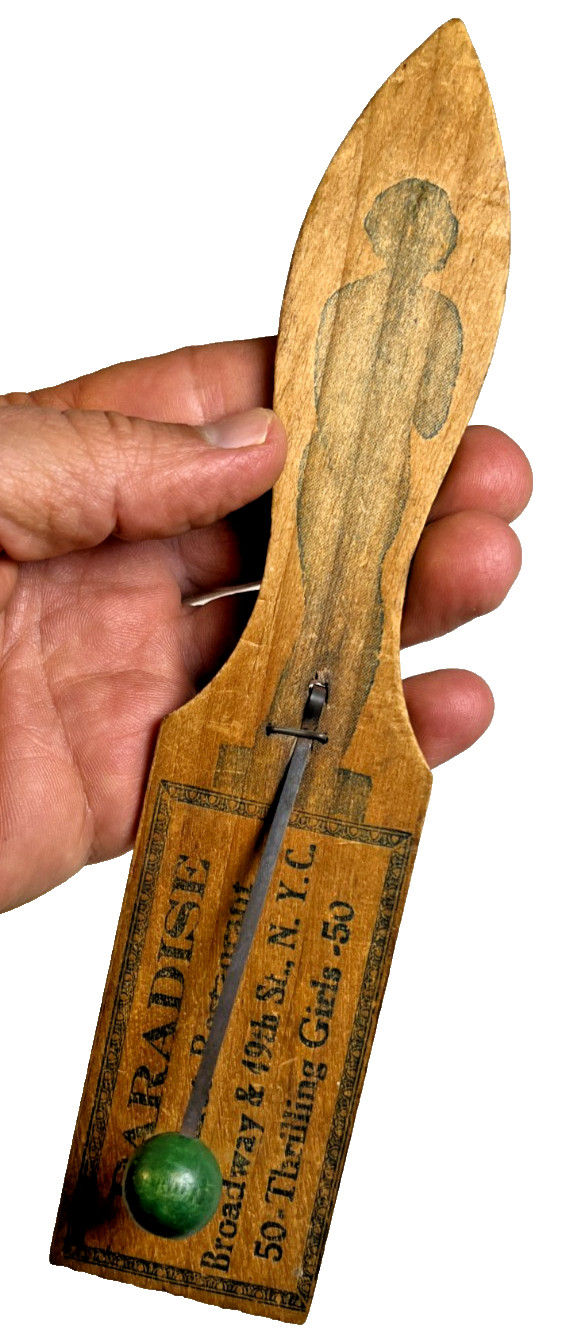
This original Paradise Cabaret noisemaker measures approximately 8½\" long × 1⅞\" wide. One side advertises the club at Broadway and 49th Street, New York City, promising “50 Thrilling Girls.” The reverse calls it the “Heart and Center of New York Night Life” and boasts “Never a Cover Charge.” The handle carries the claim “The Greatest Cabaret Revue.” Even the shape of the handle contributes to the period’s playful showgirl imagery.
The Club Behind the Clacker
The Paradise occupied the enormous second floor of the Art Deco Brill Building, reached by stairs from Broadway. It was a dining room, dance floor, and live entertainment venue on a grand scale, with room for as many as a thousand people. Its floor shows mixed chorus numbers with singers, dancers, acrobats, and comedy. Between shows, guests could get up and dance to the orchestra.
This was no quiet supper club. A visitor writing in 1933 described a lively, roaring room, with elaborate shows at dinner and supper and a crowd drawn from many corners of New York life. A 1936 account described a stage that rolled out over the dance floor and an emcee urging the audience to applaud even louder. Imagine how readily a room like that could put a clacker to work.
“Never a Cover Charge” was more than a line on this paddle. It was a centerpiece of the Paradise’s advertising. Its Broadway sign carried the same promise so prominently that a contemporary report said the club wanted those words repaired immediately if their lights went out. The souvenir let patrons take that sales pitch home in their pockets.
Broadway Outside the Door
The Paradise belonged to Depression era New York: a city where money was tight for many people, yet a night of music and spectacle still held a powerful draw. Outside were theatergoers, taxis, bright signs, and crowds moving between restaurants and shows. Inside, the band and the floor show offered a few hours away from ordinary worries.
Was the neighborhood safe? This was a busy entertainment district, with people and businesses active after dark—not a deserted side street. It was also a crowded city nightlife district where a sensible visitor would keep track of a coat, purse, and wallet. The scene was glamorous and hectic in equal measure. That contrast is part of what makes a small, cheerful survival from the Paradise so evocative.
National Souvenir Co.
Fine printing on this clacker identifies National Souvenir Co. as its maker. The firm produced this kind of wooden advertising noisemaker for entertainment venues and other customers. Its simple design was clever: a lightweight printed paddle, a flexible metal strip, and wooden striker balls made a souvenir that could advertise a show and become part of the audience’s response to it. Comparable National Souvenir Co. clackers survive from other cabarets, but this one names the Paradise itself.
Condition and Details
Original vintage condition with age appropriate surface wear, small marks, and wear to portions of the printing. The Paradise name, location, and principal advertising remain readable. The showgirl image is present but worn and faded. Both colored wooden striker balls—the green ball on one side and the red ball on the other—are present, along with the metal strip and its attachment. There is visible wear around the attachment points. Sound and spring action have not been tested, so it is offered as a collectible historical object rather than guaranteed for repeated use. Please study the photographs for the best account of its condition.
A wonderfully specific piece of New York nightlife history: small enough to slip into a coat pocket after the show, and still carrying the name, address, salesmanship, and spirit of one of Broadway’s great 1930s cabarets.