When you click on links to various merchants on this site and make a purchase, this can result in this site earning a commission. Affiliate programs and affiliations include, but are not limited to, the eBay Partner Network.
🌅 What Flew From the Masts of Spain's Golden Age?⚓
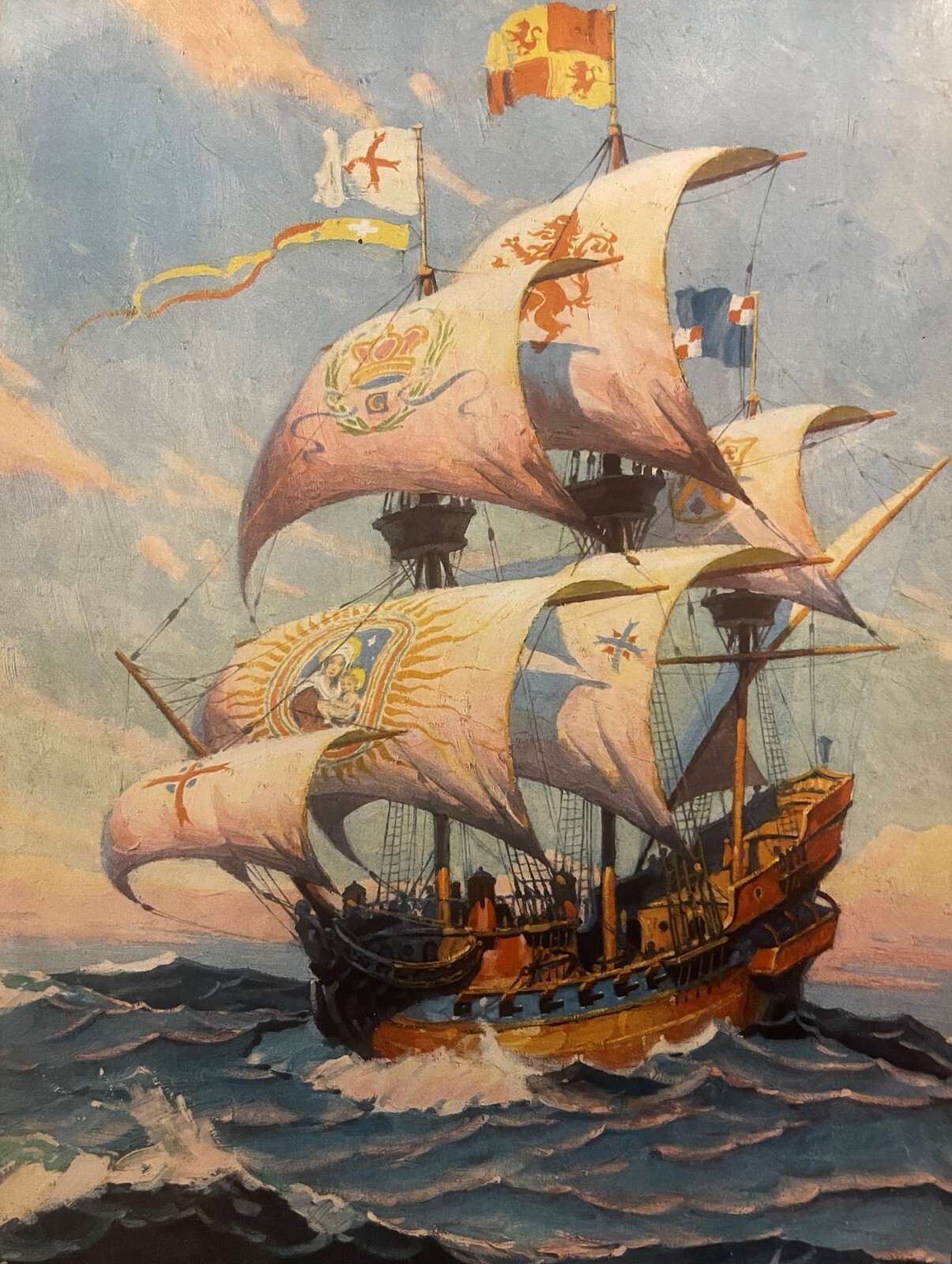
There's a particular kind of daydream that a galleon under full sail invites — heraldic crests billowing overhead, spray breaking white against a hull the color of old amber, a horizon gone pink and gold with the last light of a Spanish sunset. It's the stuff of matinee swashbucklers and boyhood atlases, of harbor taverns with ships' wheels nailed to the wall, of a grandfather's study lined in brass and old books.Long before anyone hung this print on a wall, someone sat down and imagined a ship that never quite existed in any single historical record — and painted her exactly as the Age of Sail deserved to be remembered.
This is a vintage full-color print of a Spanish galleon, produced by halftone offset lithography and rendered with the kind of soft, romanticized brushwork that makes it read, at a glance, like an oil painting rather than a printed reproduction.The vessel drives hard through a rolling teal-green sea beneath a spectacular sky streaked in cream, orange, and dusty pink. Every sail becomes its own small tapestry — a rampant lion worked in burnt orange and gold, a crowned laurel wreath enclosing an initial, and, most strikingly, a glowing medallion of the Madonna and Child ringed in golden sunburst rays, exactly the kind of protective icon that real ships of Spain's maritime empire carried into unmapped waters.Overhead fly heraldic banners quartered in red, gold, and cream, several bearing the plain cross long associated with the great royal maritime orders of the Iberian kingdoms. The palette runs warm throughout — cream, orange, yellow, blue, brown, and teal green — with the hull rendered in a deep, weathered brown-orange that anchors all that color against the waves.It measures a true 16" x 12" (40.6 x 30.5 cm), a forgiving, ready-to-frame size, and it comes to you as new old stock — genuine unused printed stock from its era, held back in supply rather than ever framed or displayed. Stylistically, the soft palette, painterly wave and cloud work, and full-sail romantic composition place it in the family of decorative marine illustration prints popular from the 1930s into the 1940s, the golden decades of this kind of dramatic nautical wall art.
🎨 The Painter Behind the Sails
Collectors who have spent real time with this particular style of galleon print trace it, as lore passed down in the trade holds, to the hand of a working California marine painter named Joe Duncan Gleason (1881–1959).The story goes that Gleason was no dabbler who wandered into ships by accident — born in Watsonville and raised in Los Angeles, he was already working professionally as an engraver for the Union Engraving Company by the age of fourteen. He trained formally at the University of Southern California under Lees Judson, then made his way north to study at the Mark Hopkins Institute of Art in San Francisco while earning his keep at the Sunset Engraving Company.Later still, so the story is told, he studied at the Art Institute of Chicago and under the celebrated Frank DuMond at the Art Students League in New York — a genuinely coast-to-coast education in an era when very few working illustrators had that kind of formal grounding.
What makes the legend worth retelling is the claim that Gleason's ships didn't stay confined to canvas — that his marine paintings and technical eye for rigging made their way into early Hollywood, informing the tall ships built and filmed for the swashbuckler pictures of the era, before those same dramatic compositions were reproduced as prints for dens, offices, and seaside parlors across the country.Whether or not any single print can be traced back to his easel with total certainty, the attribution has followed this exact style of galleon-under-flags composition among print collectors for years, and it's a good story worth keeping alive rather than letting it quietly disappear the way so much of this kind of unwritten collector lore tends to.
⚜️ Heraldry on the Wind — Reading the Sails
Part of what makes this composition so satisfying to a collector's eye is that none of the heraldry is decoration for decoration's sake — it echoes a real tradition.Ships of Spain's maritime empire genuinely sailed under quartered banners bearing lions, crowns, and crosses tied to the royal and religious orders that financed and blessed their voyages, and it was common practice to paint a protective Marian icon somewhere prominent on the ship — often on a sail or sterncastle — as a plea for safe passage across genuinely dangerous water.The crowned laurel wreath enclosing an initial nods at the kind of royal cipher a flagship might carry to mark whose fleet she sailed under. None of this identifies a specific historic vessel — this is an artist's romantic composite of Spain's Age of Exploration rather than a portrait of one named ship — but the heraldic vocabulary is drawn straight from the real thing, which is exactly why this style of print has held up so well as decorative art for the better part of a century.
🖨️ The Golden Age of the Wall Print
The 1930s and 1940s were, by any measure, a boom time for this particular genre of decorative marine illustration.Full-color halftone offset lithography had matured enough by then to put rich, painterly-looking reproductions within easy reach of ordinary households, at a moment when the public's imagination for the Age of Sail was running hot — pulp adventure serials, historical novels, and the era's swashbuckler pictures were putting galleons and pirate fleets in front of American audiences in a way they hadn't seen since the tall ships themselves had vanished from working harbors.A print like this one answered that appetite directly: affordable, vivid, ready to frame, and dramatic enough to anchor a den, a study, an office, or a seaside cottage without needing an actual antique on the wall. It's worth remembering that this was genuinely mass-market art in its moment — produced to be reproduced, sold in volume, and enjoyed rather than treated as precious — which is exactly why surviving examples in strong, unused condition like this one are worth holding onto today.
🌊 The Ship Herself
Look closely at the vessel and you can see the artist knew his rigging — three towering masts carrying a full press of canvas, fighting tops mounted high for lookouts and marksmen, an ornately built-up sterncastle trimmed in gold, and a run of gunports along the hull that speaks to a ship built as much for defense as for cargo.This is the visual shorthand of the great Spanish treasure fleets — the galleons that carried silver from the Americas and silk and spice across the Pacific from Manila, ships that were as much floating fortresses as merchant vessels, built heavy and high precisely because the waters they sailed were never safe. The foreground waves, rendered with real painterly texture breaking white against the hull, put the viewer right at sea level with her, which is part of what gives this composition its sense of motion and drama rather than a static, flat ship's portrait.
🏛️ Why This Kind of Print Still Holds Its Own Today
There's a reason vintage galleon prints like this one keep resurfacing in collections rather than fading into the background of decorative art history — that warm, storybook whimsy in the coloring and the sheer theatrical energy of the composition simply doesn't date the way flatter, more literal marine art can.It reads as vivid today as it would have hanging in a 1930s study, and that's a rarer quality in decorative prints than people tend to assume. Between the swashbuckler-era nostalgia it taps into and the genuine heraldic detail worked into every sail, it occupies a sweet spot between fine decorative art and real historical storytelling — which is exactly what keeps this kind of piece moving from one collector's wall to the next instead of into a drawer.
🖼️ Display Ideas
- ⚓ Frame it simply in dark wood or gilt and let it anchor a study, library, or home office wall on its own
- 🧭 Pair it alongside a ship's wheel, compass, or sextant for a genuine nautical vignette
- 🏠 Hang it in an entryway or stairwell landing where its color and drama catch the eye from a distance
- 🎁 Give it as a milestone gift for a retired sailor, Navy veteran, or lifelong sailing enthusiast
- 🛋️ Use it as the color anchor in a coastal or seaside-cottage room, pulling from its blues and warm ambers
- 📚 Set it above a bookshelf of maritime history or Age-of-Sail fiction for a room that tells its own story
🎁 Who Collects These
This kind of print draws a wide and genuinely enthusiastic crowd.Maritime history buffs and tall-ship model builders love it for the rigging detail and heraldic accuracy. Vintage print and decorative art collectors seek it out as a strong example of the golden age of full-color offset lithography. Heraldry enthusiasts appreciate the crests and quartered banners for their own sake. Age-of-Sail readers and swashbuckler-film fans respond to the sheer theatrical romance of the composition.And a good number of buyers simply want a piece of unused period wall art with real color and presence — something that looks like an old master's canvas at a glance, with the accessible size and price of a print.
❓ FAQIs this an original painting or a print?
It's a full-color print, produced by halftone offset lithography — the reproduction of a painterly marine composition rather than a hand-painted original.The brushwork in the waves and sky is rendered convincingly enough that it reads like an oil at a glance, which is part of its charm.
What condition is it in?
This is new old stock — genuine unused period printed stock that was never framed or hung, held back in supply rather than shop-worn.
What size is the print?
It measures 16" x 12" (40.6 x 30.5 cm), a forgiving, ready-to-frame size for most standard frames.
Does it come framed?
No — it's supplied as an unframed print, ready for you to choose a frame that suits your own room.
Who painted the original artwork?
Collector lore surrounding this style of galleon-and-heraldry composition attributes it to California marine painter Joe Duncan Gleason, though as with many unsigned decorative prints of this era, the attribution is passed down among collectors rather than confirmed by a printed credit line.
Is this a specific historic ship?
No — it's a romantic composite portrait of a Spanish galleon in the spirit of the great treasure fleets, drawing on real heraldic and rigging detail rather than depicting one named historic vessel.
What era does the print date to?
Its style, palette, and printing method place it in the 1930s–1940s window, the peak era for this kind of dramatic, full-color marine illustration print.