When you click on links to various merchants on this site and make a purchase, this can result in this site earning a commission. Affiliate programs and affiliations include, but are not limited to, the eBay Partner Network.
Title: Evidences of the Authenticity, Inspiration, and Canonical Authority of the Holy Scriptures
Author: Rev. Archibald Alexander, D.D.
(Founding professor at Princeton Theological Seminary)
Publisher: Presbyterian Board of Publication, Philadelphia
Copyright page: 1836
Precise Date
Even though the copyright says 1836, this specific copy is:
circa 1840–1855
Here’s why:
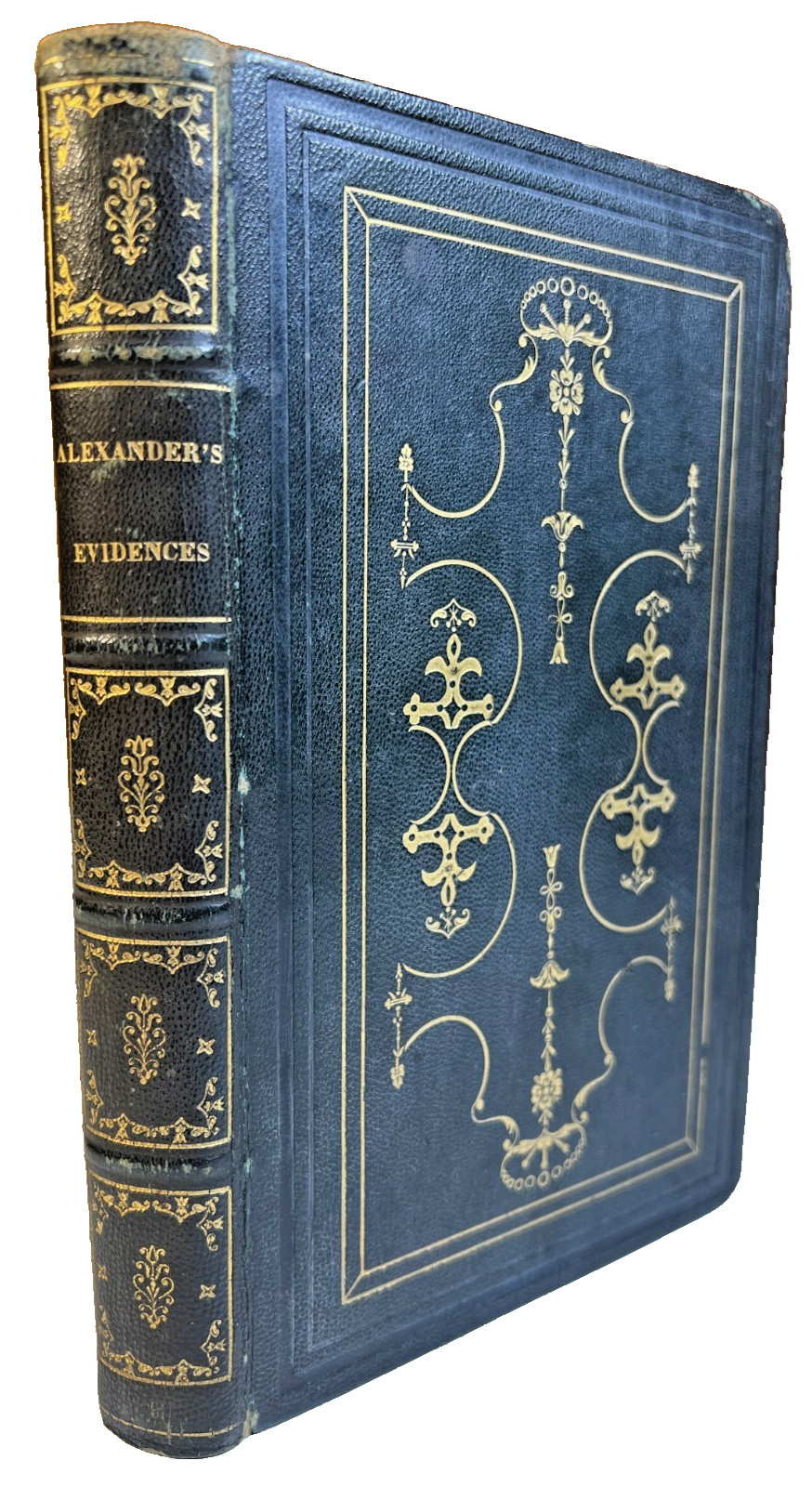
The ornate blind-stamped + gilt publisher’s cloth binding is classic 1840s–50s
The all-gilt edges and decorative spine panels point to a slightly later, nicer issue—not the earliest 1836 printings
The steel-engraved portrait frontispiece also fits that window
So you’ve got an early mid-century “gift binding” edition, not the first issue—but still quite desirable.
Binding & Aesthetic (this is the star)
This is what makes your copy pop:
Deep black pebbled cloth (or possibly publisher’s leather cloth hybrid)
Heavy gilt panel stamping front & back
All edges gilt
Decorative spine compartments with floral tooling
This was meant to look impressive on a parlor table—religious books were status objects in this period.
About the Book
Archibald Alexander was a major early American Presbyterian theologian. This book:
Defends the Bible’s authenticity and divine inspiration
Uses logic, history, and early apologetics
Pushes back against rising skepticism and Enlightenment thinking
Basically:
“Let me prove the Bible is legit—with receipts.”
Life Around 1840–1855
This book sits right in a fascinating moment:
Technology
Railroads exploding across the U.S.
Telegraph just coming online (1840s)
Books becoming more widely produced and affordable
Religion
Height of the Second Great Awakening
Massive revival movements
Heavy emphasis on personal salvation + Biblical authority
Politics
Pre–Civil War tension building
Slavery debates intensifying
Religious arguments often tied into moral and political discourse
Books like this weren’t just theology—they were part of the national conversation.
Condition Notes
Positives:
Condition issues:
Overall:
Very respectable collector condition for the age
TOC
Here’s the Table of Contents (TOC) from your copy, cleaned up and organized:
ContentsPart I — General Evidences
Chapter I
The right use of reason in religion — p. 9
Chapter II
It is impossible to banish all religion from the world, and if it were possible, it would be the greatest calamity which could befall the human race — p. 17
Chapter III
If Christianity be rejected, there is no other religion which can be substituted in its place, at least none which will at all answer the purpose for which religion is desirable — p. 24
Chapter IV
Revelation necessary to teach us how to worship God acceptably—the nature and certainty of a future state—and especially, the method by which sinners may obtain salvation — p. 34
Chapter V
There is nothing improbable or unreasonable in the idea of a revelation from God, and consequently nothing improbable or unreasonable in such a manifest divine interposition as may be necessary to establish a revelation — p. 61
Part II — Miracles & Prophecy
Chapter VI
Miracles are capable of proof from testimony — p. 88
Chapter VII
The miracles of the Gospel are credible — p. 98
Chapter VIII
The rapid and extensive progress of the Gospel, by instruments so few and feeble, is a proof of divine interposition — p. 118
Chapter IX
Prophecies respecting the Jewish nation which have been remarkably fulfilled — p. 130
Chapter X
Prophecies relating to Nineveh, Babylon, Tyre, &c. — p. 138
Chapter XI
Prophecies respecting Messiah—predictions of Christ respecting the destruction of Jerusalem — p. 159
Part III — Internal & Comparative Evidence
Chapter XII
No other religion possesses the same kind and degree of evidence as Christianity; and no other miracles are as well attested as those recorded in the Bible — p. 169
Chapter XIII
The Bible contains internal evidence that its origin is divine — p. 186
Part IV — Inspiration & Canon
Chapter XIV
The Scriptures of the Old and New Testament were written by the inspiration of God — p. 222
Chapter XV
The inspiration of the books of the New Testament — p. 235
Part V — Canonical Authority
Chapter XVI
The importance of ascertaining the true canon of Holy Scripture — p. 245
Chapter XVII
The care with which the books of the Old Testament were preserved—their canonical authority—the sanction given to these books by the Saviour and his apostles—and the method of ascertaining what books were in the canon at the time of Christ’s advent — p. 249
Chapter XVIII
The books denominated apocryphal have no just claim to a place among the canonical Scriptures of the Old Testament — p. 258
Chapter XIX
Canon of the New Testament—method of settling it—testimony of the Church—constitution of the canon—whence these books derive their authority—solicitude of early Christians — p. 266
Chapter XX
Testimonies in favour of the canonical authority of the books of the New Testament — p. 278
Chapter XXI
Canonical authority of Paul’s Epistles — p. 287
Chapter XXII
The canonical authority of the seven Catholic epistles, and of the book of Revelation — p. 295
Chapter XXIII
Recapitulation of evidence on the canon of the New Testament — p. 303