When you click on links to various merchants on this site and make a purchase, this can result in this site earning a commission. Affiliate programs and affiliations include, but are not limited to, the eBay Partner Network.
The second and final Elzevir edition of Aulus Gellius’s Noctes Atticae, preserving the anonymously edited Gronovian recension of 1651
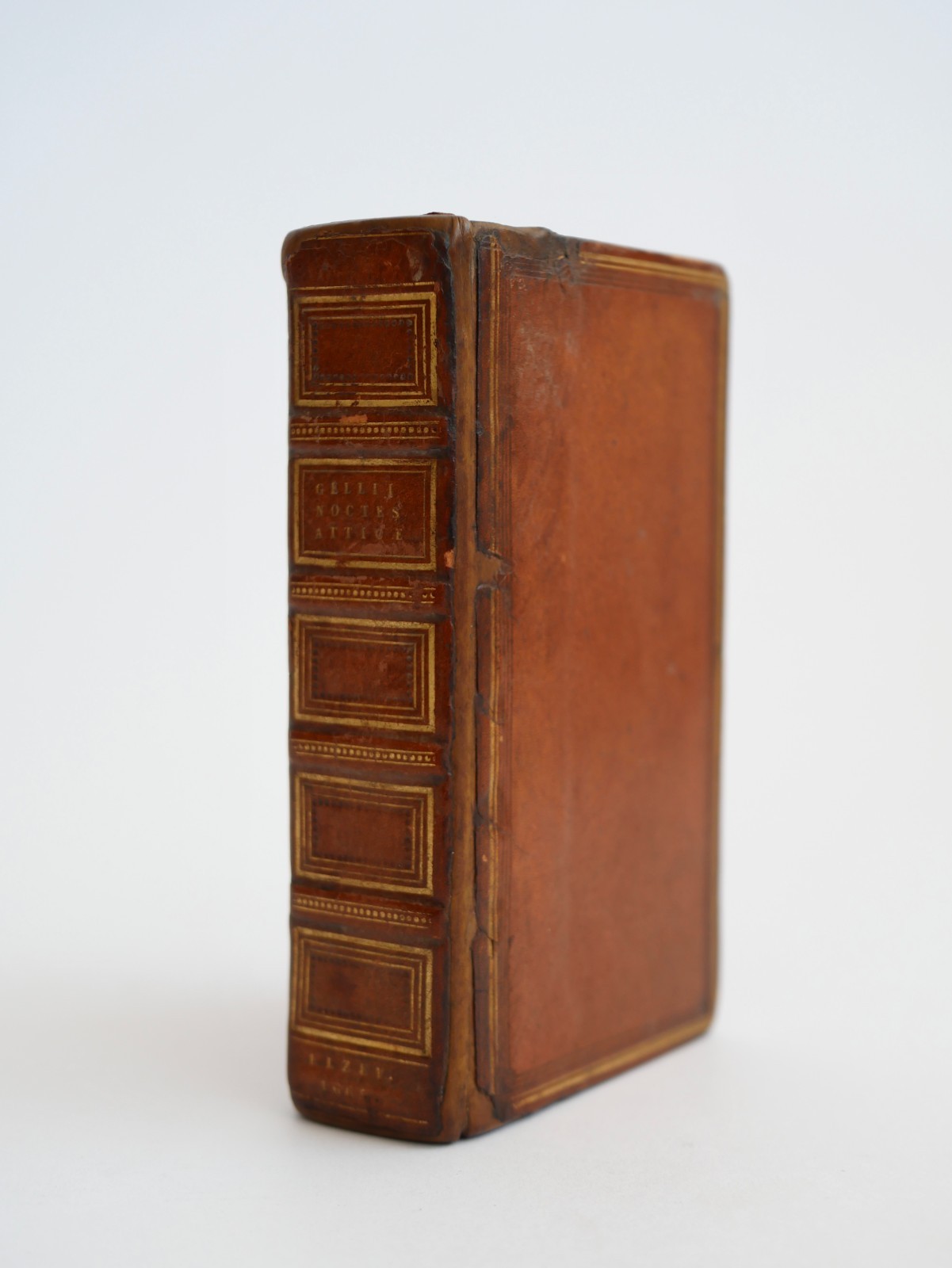
GELLIUS, Aulus. Noctes Atticae [Attic Nights]. Editio nova et prioribus omnibus docti hominis cura multo castigatior. Amsterdam: apud Danielem Elzevirium, 1665.
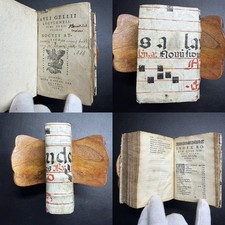
Small 12mo. [48], 482, [118] pp. Engraved title and extensive indices. Nineteenth-century calf, rebacked, spine lettered and decorated in gilt, covers ruled in gilt, all edges gilt.
Second and final Elzevir edition · Daniel Elzevir, Amsterdam, 1665 · Willems 1357 · Rahir 1409 · Berghman 2066
THE SECOND AND FINAL ELZEVIR EDITION
The present 1665 printing is the second Amsterdam Elzevir edition of Noctes Atticae and the final Elzevir edition of the work.
It reproduces the text of the highly regarded 1651 Amsterdam Elzevir edition prepared anonymously by the classical scholar Johann Friedrich Gronovius (1611–1671).
Willems states that the 1665 Daniel Elzevir edition reproduces the earlier edition textually. Berghman describes it explicitly as:
“Seconde et dernière édition elzevirienne.”
THE GRONOVIUS RECENSION
Gronovius’s role in the 1651 edition was deliberately anonymous. In correspondence with Nicolaas Heinsius he explained that he had supplied Louis Elzevir with a copy of Gellius corrected throughout, but that neither his notes nor his name would appear in the book.
The title phrase docti hominis cura multo castigatior — “much more carefully corrected through the care of a learned man” — thus refers to the recension associated with Gronovius.
The preliminaries of the present 1665 printing retain material from that recension, including a prefatory text dated 2 December 1650.
THE WORK — ATTIC NIGHTS
Noctes Atticae is the only surviving work of Aulus Gellius, the second-century Roman author and antiquarian.
Gellius assembled the work from notes gathered through reading, study and learned conversation. Its twenty books range across grammar, philology, literature, philosophy, history, law, mathematics and antiquarian learning.
The work is especially important for preserving quotations and information from numerous Greek and Latin authors whose writings have otherwise been lost.
Noctes Atticae first appeared in print at Rome in 1469 and remained an important repository of classical learning for Renaissance and early-modern scholars.
THE ENGRAVED TITLE
The engraved title depicts a scholar working at night at his desk, surrounded by books and writing implements, with a globe nearby and an owl prominently positioned above — an elegant visual interpretation of the title Attic Nights.
COLLATION
Willems records: 24 preliminary leaves, including the engraved title; 482 pages; and 59 unnumbered leaves of indices.
This corresponds to [48], 482, [118] pp.
The old Frognal Rare Books description preserved with this copy independently records the same count: 24 leaves, 482 pages, 59 leaves.
PROVENANCE
Eduardo Berwick — manuscript ownership plate preserved at the front of the volume.
The plate bears an adapted quotation from Martial, Epigrams V.42:
Extra Fortunam est — Quidquid donatur amico.
Approximately: “Whatever is given to a friend lies beyond the reach of Fortune.”
Frognal Rare Books / Frognal Bookshop Ltd — old descriptive bookseller’s slip preserved with the volume, stock reference shp 12087/E.
The Collection of Tim Lutz — stated provenance in the later sale catalogue.
CONDITION
Attractive and structurally sound. Rebacked calf, spine lettered and decorated in gilt, covers ruled in gilt, all edges gilt. Internally very well preserved, clean and bright. Manuscript ownership plate of Eduardo Berwick at front.
References: Alphonse Willems, Les Elzevier: histoire et annales typographiques, no. 1357; Édouard Rahir, Catalogue d’une collection unique de volumes imprimés par les Elzevier, no. 1409; Gustaf Berghman, Catalogue raisonné des impressions Elzeviriennes de la Bibliothèque royale de Stockholm, no. 2066.