When you click on links to various merchants on this site and make a purchase, this can result in this site earning a commission. Affiliate programs and affiliations include, but are not limited to, the eBay Partner Network.
Origin: Kayseri, Turkey
Type: Kilim, flat weave
Dimensions: 143 cm x 275 cm
Age: Vintage, 50+ years old
Condition: Excellent
Material: 100% Anatolian wool
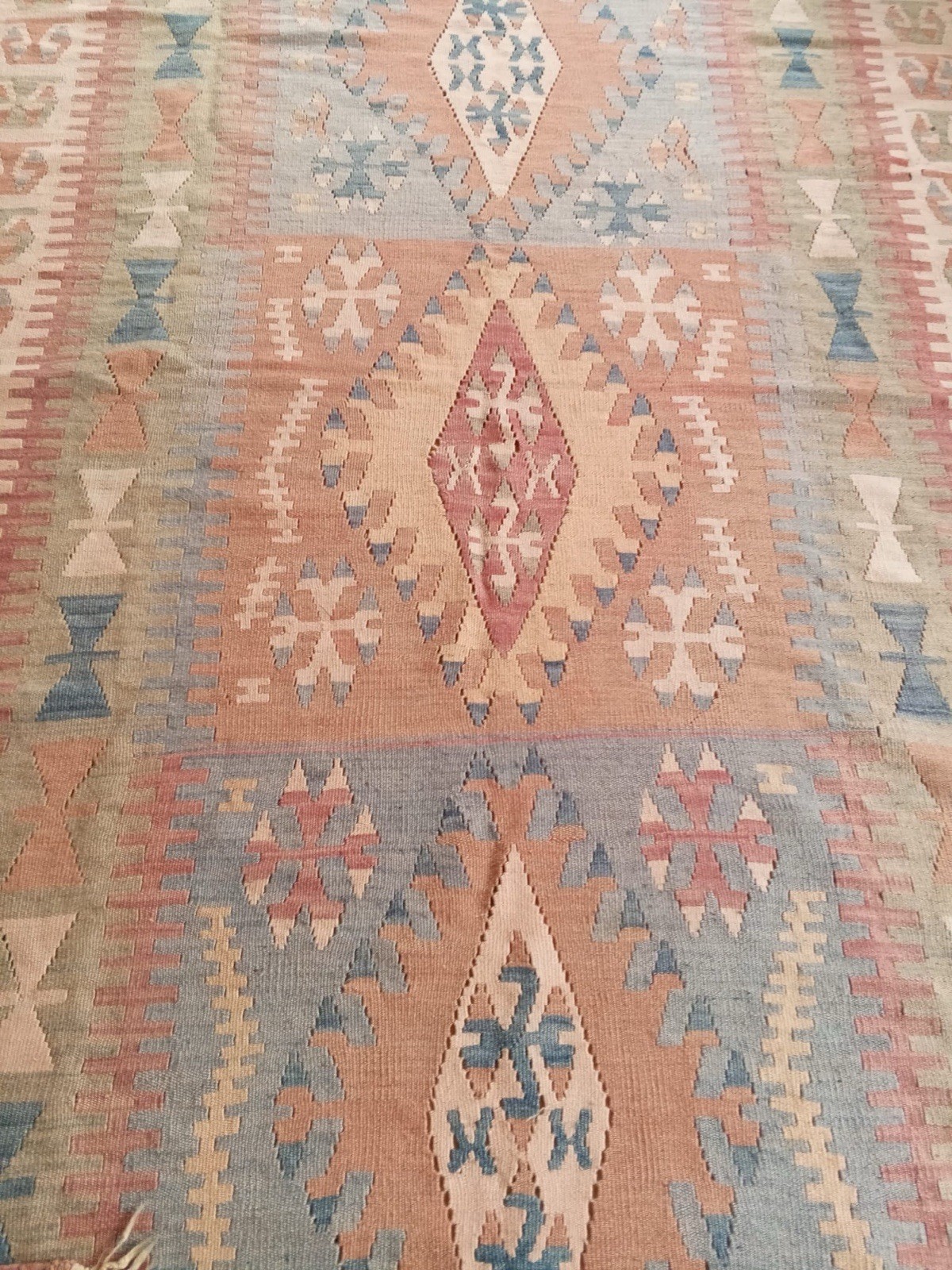
History and Design: Kayseri kilims (central Anatolia) are simple handmade pieces. They represent a type of rustic folk art that was most often practiced by women in a village setting, quickly producing woollen art for the home.
Texture: The hand-spun wool is rich and soft, the piece is flat-woven with no pile or relief.
Colour Palette: This piece features a vivid colour palette with blues, pinks, greys, and white highlights.
How to use: This is a durable piece that can be used as a floor rug or a furniture cover. It can also be used as a wall hanging.
On kilims:
Kilims are flatwoven textiles with a woollen weft on a woollen, goat hair or cotton warp. The art of Kilim-weaving is a very ancient handicraft with traces of Kilims found across Eurasia from the fifth century, but repressing a very ancient art.
There are many different techniques and designs depending on region and period of production. The designs reflect a deep history of Kilim-making within the Turkic world with designs reflecting the natural environment, protection (apotropaic symbols), and fertility and family relationships. However, weavers can and do add their own creativity elements. Kilims are often woven as part of a marriage dowry and can be used to create many different objects like storage bags, baby carriers, blankets, and wall and floor decorations.
This kilim was hand-woven on a simple loom by women in a village setting or nomadic weavers for their own personal use. Kilims are finite and there is currently little local production due to new technologies and changes to lifestyle. In the past, weavers used wool from their own sheep, which they would clean, hand-card, spin, and dye by hand. Some kilims feature natural dyes using roots, nuts, berries, fruits, flowers and plants. This process, as well as weaving, would have taken many months to complete. Kilims from the end of the twentieth century mostly use synthetic dyes.
**Please note that the colour of the product may vary from what is displayed online due to differences in monitor settings, lighting conditions, and individual perception. While we make every effort to capture photos that closely represent the real-life product, some variation is unavoidable. We are always more than happy to supply videos and further photos under various lighting conditions.