When you click on links to various merchants on this site and make a purchase, this can result in this site earning a commission. Affiliate programs and affiliations include, but are not limited to, the eBay Partner Network.
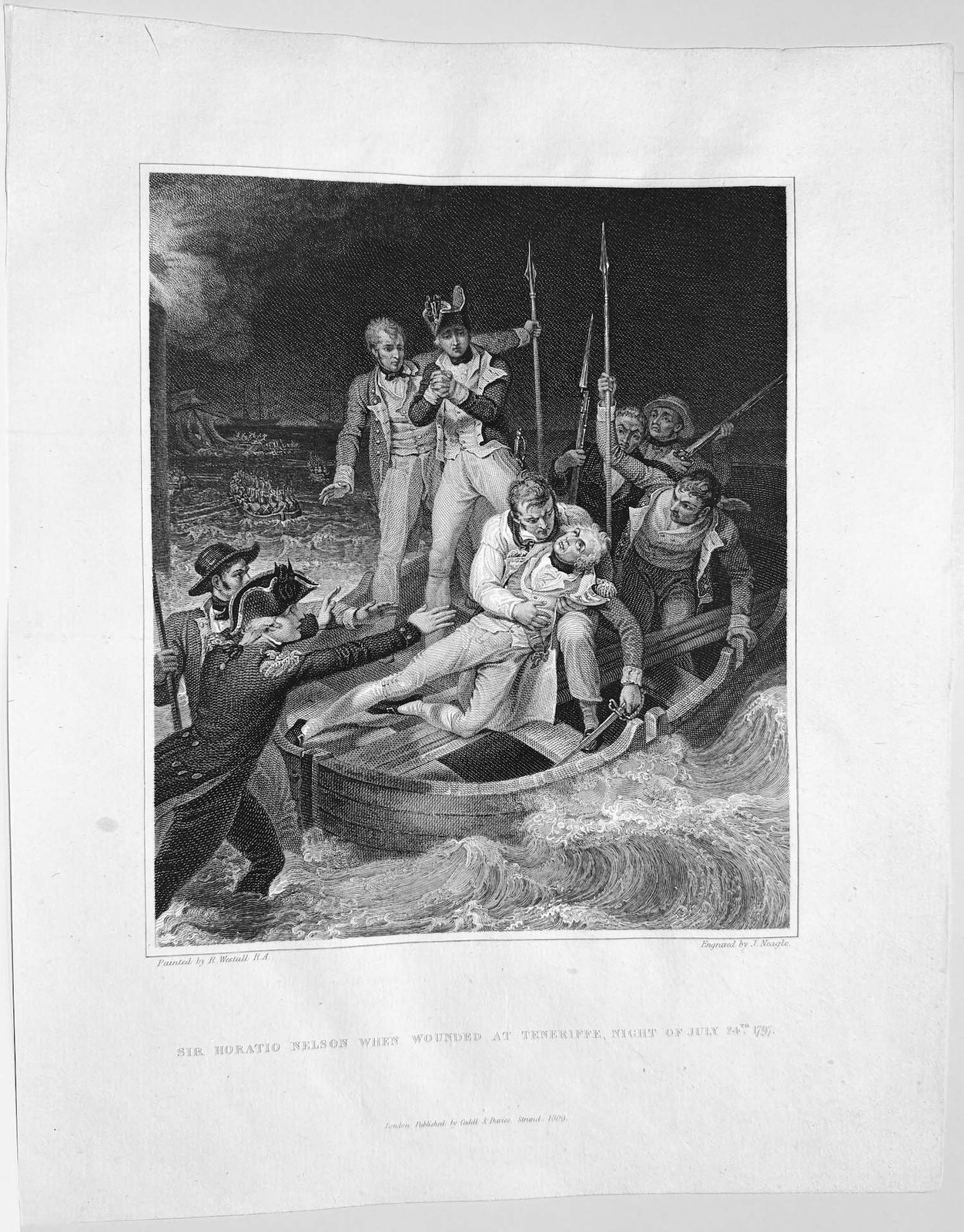
SIR HORATIO NELSON WHEN WOUNDED AT TENERIFFE, NIGHT OF JULY 24th, 1797
Painted by Richard Westall R. A.____________ Engraved by J. Neagle
PRINT DATE: This engraving is dated 1809 and was extracted from the 1809 well known two volume book set \"THE LIFE OF ADMIRAL LORD NELSON\"; it is not a modern reproduction in any way.
PRINT SIZE: Overall print size is 10 1/2 x 13 inches, actual scene is 7 1/4 x 8 3/8 inches.
PRINT CONDITION: Condition is excellent as shown in the detailed picture. Blank on reverse. Paper is quality woven rag stock paper.
We pack properly to protect your item!
PRINT DESCRIPTION:
A print after Richard Westall’s 1806 painting, ‘NelsonWounded at Tenerife, 24 July 1797’. It was exhibited at the Royal Academy in1807 with the title, ‘Admiral Sir Horatio Nelson in the act of Landing on theMole of Teneriffe, in July 1797, dangerously wounded by a cannon-shot in hisright arm, which was afterwards amputated. Upon this occasion, his life wassaved by the attention and presence of mind of his son-in-law, now CaptainNesbit. Owing to the absence of this gentleman his portrait is leftunfinished.’ The painting wascommissioned by John McArthur, as a plate for the first biography, ‘The Life ofAdmiral Lord Nelson, KB’, which he wrote with James Stainer Clarke in 1809.Engraved by John Neagle in 1809, it formed part of a series painted by Westallfor the book intended to illustrate Nelson’s life as a series of heroic acts.After the battle of Cape St Vincent, 14 February 1797, Nelson was blockadingCadiz but was ordered to make an assault on the town of Santa Cruz in Tenerife.He immediately set sail with three ships of the line, three frigates, and acutter and was joined by a fourth frigate and a bomb vessel en route. Afterseveral failed attempts Nelson decided upon a direct assault on Santa Cruz bynight, aiming for the central castle of San Cristobal where the Spanish generalstaff were based. Nelson commanded the attack, leading one of six divisions ofboats. At 10.30 pm on 24 July, the British sailors and marines met around the‘Zealous’ where they formed into six divisions and were roped together. Withmuffled oars they began the two-mile row to the mole but the initial landing inboats went wrong when many of them were swept off course and the element ofsurprise was lost. Although the attack failed, a truce was negotiated and theSpanish co-operated in allowing the British return to their ships. Early in theattack, Nelson was hit just above the right elbow by a musket ball as heattempted to disembark at the mole. Since the bone and joint were shattered,his arm was amputated aboard the ‘Theseus’ that night. Nelson’s barge is shown beached in the surf,in port-bow view. At the point of landing Nelson reeled and staggered back intothe boat, where he lies with his sword transferred to his left hand in the armsof a seaman, possibly intended as John Lovell who helped bind the wound. In theleft foreground, standing in the shallow water, is Captain Thomas BouldenThompson, arms outstretched towards Nelson, together with another lieutenant.Lieutenant Josiah Nisbet, Nelson’s stepson, stands behind him with hands clasped.In the right foreground the stylized depiction of waves enhances the dramaticimpact. Westall has conveyed the staged effect by employing a dramatic languageof gesture and expression.
The victory and death of Admiral Horatio Nelson(1758-1805)at thebattle of Trafalgar on 21 October 1805, and his solemn statefuneral on 9 January 1806 sealed his fame as a national hero. Eager tocapitalise on the considerable public interest, Earl Nelson commissioned anofficial biography of his late brother. It was entrusted to the foundingco-editors of theNaval Chronicle, the most prestigious maritimeperiodical of the time.James Stanier Clarke was chaplain and librarian tothe Prince of Wales, later George IV (r.1820-1830).John McArthur was theformer secretary of Admiral Samuel Hood under whom he and Nelson had served inthe Mediterranean.The biographywas conceived on an ambitious scaleandrequired a subscription. Clarke obtained the blessing of the Prince ofWales who headed the 15-page-long list of distinguished subscribers togetherwith his brother, the Duke of Clarence, who would suceed him as William IV(r.1830-1837). While Prince George admired Nelson, the future ‘sailor king’ hadbefriended the admiral during their service with the Royal Navy in the WestIndies.
Clarke and McArthur’s aim was to examine ‘the privatefeelings and motives of this extraordinary man as well as the great principlesof his public and professional character’ (p. vi). For this purpose, theyconsulted a large amount of original material, including Nelson’s manuscriptsby then in his brother’s possession, his letters to the Duke of Clarence andEarl St Vincent, and the naval papers of Admiral Hood. They also had access tothe correspondence kept by Nelson’s rejected wife Frances (Fanny), ‘kindlythough reluctantly granted’ (p. v). It is not surprising that Nelson’smistress, Lady Emma Hamilton, was written out of the narrative; theextra-marital relationship had scandalised Nelson’s patrons, Lord Hood and EarlSt Vincent, as well as George III.
The Life of Nelson is an 1809 two-volume biography thatcharts the life of the British Admiral Horatio Nelson from birth to his deathduring his greatest victory at the Battle of Trafalgar in 1805. Nelson hadbecome a national hero Trafalgar, ending the threat of an invasion by France,been given a state burial at St. Paul\'s Cathedral. At a time when Britain was still fighting theNapoleonic Wars, the authors looked to promote Nelson\'s role as a patriotichero to inspire the British public. It glossed over Nelson\'s private life,which included a long-standing affair with Lady Hamilton. Despite the ample original material at theirdisposal, the official status of the biography and the attendant claims toauthenticiy – or beacuse of these – Clarke and McArthur created an enduringlegend, often at odds with other first-hand accounts about Admiral Nelson.Their biased use of the original sources was criticised by contemporaries,including Robert Southey (1774-1843), the Poet Laureate, whose literary feudwith James Stanier Clarke led to the publication of his ownLife ofNelsonin 1813. Today, Clarke and McArthur are credited with thefashioning of more myths about the admiral than any of his other biographers.This was due to the patronage and readership of theirwork as well as itselegantproductionby Thomas Bensley, one of the foremost printers ofthe time, for the eminent London publishers Thomas Cadell andWilliamDavies. Printed on high quality paper, theimposing volumescontaindetailed plans of battles, facsimiles of Nelson’s letters and speciallycommissioned engravings after painting by Benjamin West, Richard Westall andNicholas Pocock.
AN EXTREMELY RARE PRINT! VERY HARD TO FIND IN SUCH NICE CONDITION!