When you click on links to various merchants on this site and make a purchase, this can result in this site earning a commission. Affiliate programs and affiliations include, but are not limited to, the eBay Partner Network.
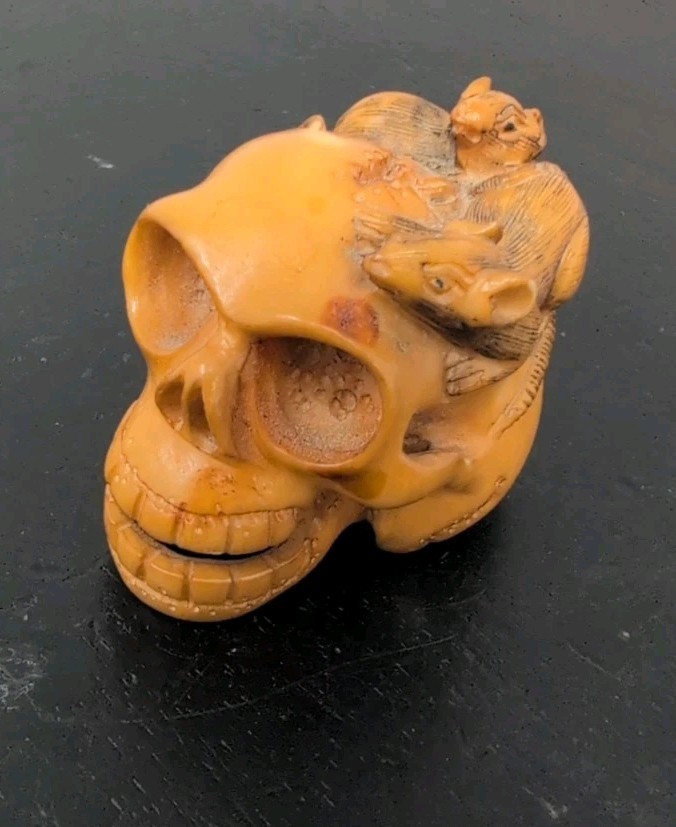
This intricate, miniature netsuke depicts a stylized human skull (sharekōbe), meticulously rendered with deep orbital sockets, a hollow nasal cavity, and an exposed row of finely defined teeth. Atop the cranium, two highly detailed rats (nezumi) are nestled together, showcasing fine, textured hair-work across their bodies.
The reverse features two functional himotoshi (cord holes) bored asymmetrically into the back of the skull to guide the cord of an inro pouch or tobacco container. Directly below the cord holes sits an incised, ink-enhanced rectangular cartouche containing the two-character cursive signature of Tomokazu (友一). The piece exhibits a warm, smooth, honey-toned caramel patina from decades of handling, characteristic of aged organic carving materials such as boxwood, tagua nut, or horn.
The Skull (Sharekōbe): Grounded in Buddhist philosophy (mujōkan), the skull is a classic Japanese memento mori representing the impermanence of life and transience of all things.The Two Rats (Nezumi): In Japanese culture, rats are symbols of wealth, prosperity, and fertility due to their association with Daikoku, the god of wealth. They also represent the first animal of the Zodiac cycle, symbolizing new beginnings.The Contrast: Combining rats (symbols of thriving, abundant life) with a skull (a symbol of death) creates a profound visual metaphor for the natural cycle of life, regeneration, and the contrast between vitality and decay.
This is very important. The pictures are the description , look at them closely you can blow them up.