When you click on links to various merchants on this site and make a purchase, this can result in this site earning a commission. Affiliate programs and affiliations include, but are not limited to, the eBay Partner Network.
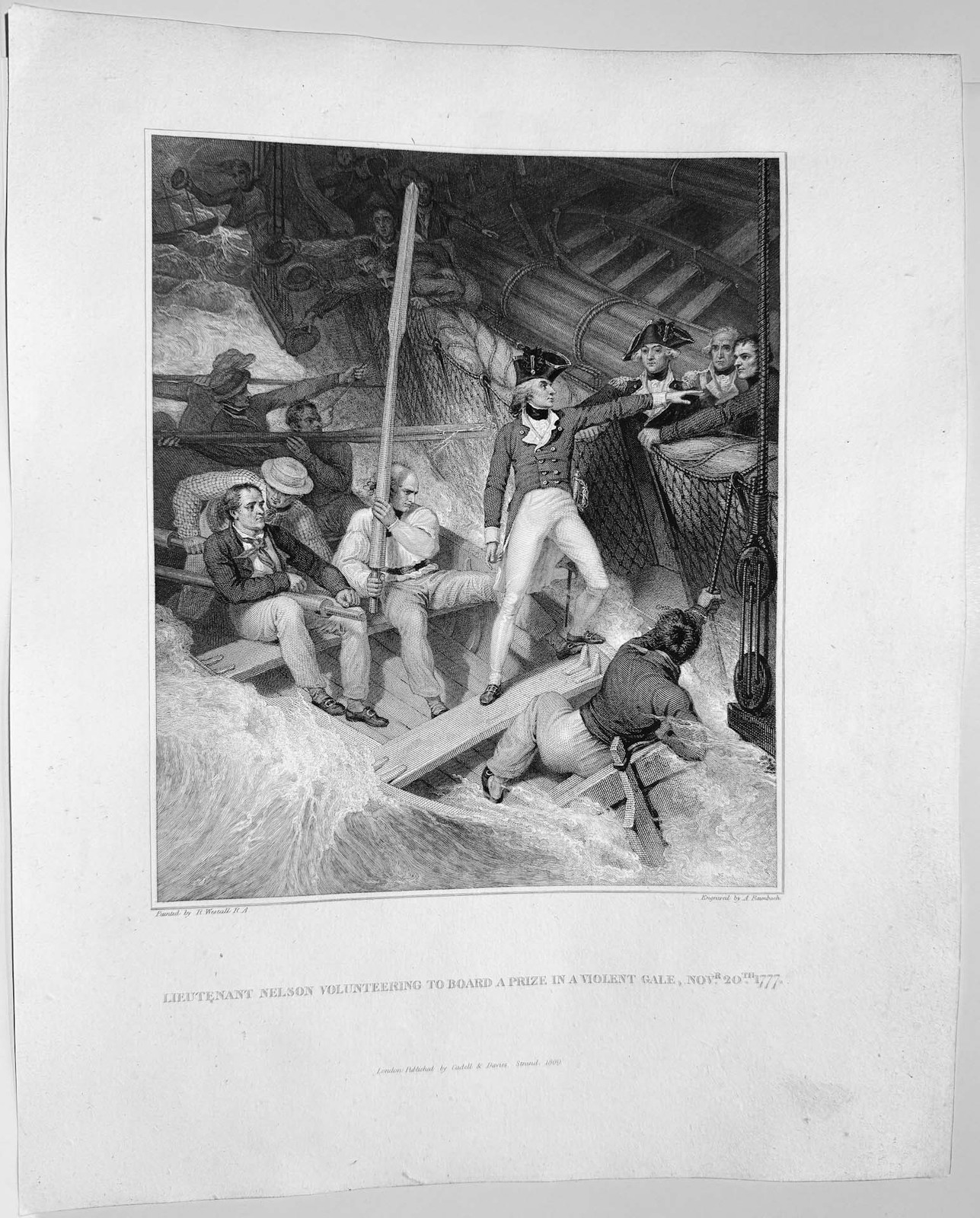
LIEUTENANT NELSON VOLUNTEERING TO BOARD A PRIZE IN A VIOLENT GALE, NOV. 20th 1777
Painted by Richard Westall, R. A.____________ Engraved by A. Bambach
PRINT DATE: This engraving is dated 1809 and was extracted from the 1809 well known two volume book set \"THE LIFE OF ADMIRAL LORD NELSON\"; it is not a modern reproduction in any way.
PRINT SIZE: Overall print size is 10 1/2 x 13 inches, actual scene is 7 x 8 3/8 inches.
PRINT CONDITION: Condition is excellent as shown in the detailed picture. Blank on reverse. Paper is quality woven rag stock paper.
We pack properly to protect your item!
PRINT DESCRIPTION:
A print after the painting by Richard Westall. It wasexhibited at the Royal Academy in 1807 with the title, ‘Lord Nelson, whensecond lieutenant of the Lowestoffe frigate, 32 guns, Captain Locker, going totake possession of an American marque, during a strong gale of wind, and aheavy sea; the first lieutenant having returned, and declared itimpracticable.’ It shows an incidentduring the American Revolutionary War, 1775–83, and was commissioned by JohnMcArthur, as a plate for the first biography, ‘The Life of Admiral Lord Nelson,KB’, which he published with James Stainer Clarke in 1809. The image was one ofa series painted by Westall for the book and intended to illustrate Nelson’slife as a series of heroic acts. In 1777 Captain William Locker sailed to theWest Indies station in the ‘Lowestoffe’, 32 guns. He arrived at Port Royal,Jamaica, in July with a convoy of 18 sail of merchantmen and with the youngHoratio Nelson as his second lieutenant. When the ‘Lowestoffe’ captured anAmerican privateer on 20 November, a rough sea made the first lieutenantreluctant to try to board it to take formal possession. It was important tocapture these American privateers because they were harassing British trade inthe West Indies. However Nelson volunteered for the task and he succeeded inboarding and taking possession of the ship despite the heavy sea. The painting denotes the moment that Nelsonleaves the ‘Lowestoffe’ into the ship’s boat that will take him to the capturedvessel, seen in the top left corner of the image. He is shown on the verge ofthe momentous departure, poised with one leg already firmly in the boat. In anexaggeratedly theatrical gesture, he offers farewell to Captain Locker(recognizably shown as a portrait) and the other officers standing in the ship.Other figures crowd the deck in anticipation of the daring feat, their arms outstretchedto hold the ropes and help steady the boat. The artist has accentuated thestrong swell, bottom left, where the waves come up over the side of the boat.This has emphasized the effect by enclosing the action and by pitching the shipand the boat at the same angle in the heavy sea. The sailors on the boat usethe oars to keep the waves from crashing it into the side of the ship. Theheavy sea demonstrates the tension and physical enterprise and anticipates thepotential danger ahead. Westall further conveys a staged effect by a dramaticuse of gesture and expression.
The victory and death of Admiral Horatio Nelson(1758-1805)at thebattle of Trafalgar on 21 October 1805, and his solemn statefuneral on 9 January 1806 sealed his fame as a national hero. Eager tocapitalise on the considerable public interest, Earl Nelson commissioned anofficial biography of his late brother. It was entrusted to the foundingco-editors of theNaval Chronicle, the most prestigious maritimeperiodical of the time.James Stanier Clarke was chaplain and librarian tothe Prince of Wales, later George IV (r.1820-1830).John McArthur was theformer secretary of Admiral Samuel Hood under whom he and Nelson had served inthe Mediterranean.The biographywas conceived on an ambitious scaleandrequired a subscription. Clarke obtained the blessing of the Prince ofWales who headed the 15-page-long list of distinguished subscribers togetherwith his brother, the Duke of Clarence, who would suceed him as William IV(r.1830-1837). While Prince George admired Nelson, the future ‘sailor king’ hadbefriended the admiral during their service with the Royal Navy in the WestIndies.
Clarke and McArthur’s aim was to examine ‘the privatefeelings and motives of this extraordinary man as well as the great principlesof his public and professional character’ (p. vi). For this purpose, theyconsulted a large amount of original material, including Nelson’s manuscriptsby then in his brother’s possession, his letters to the Duke of Clarence andEarl St Vincent, and the naval papers of Admiral Hood. They also had access tothe correspondence kept by Nelson’s rejected wife Frances (Fanny), ‘kindlythough reluctantly granted’ (p. v). It is not surprising that Nelson’smistress, Lady Emma Hamilton, was written out of the narrative; theextra-marital relationship had scandalised Nelson’s patrons, Lord Hood and EarlSt Vincent, as well as George III.
The Life of Nelson is an 1809 two-volume biography thatcharts the life of the British Admiral Horatio Nelson from birth to his deathduring his greatest victory at the Battle of Trafalgar in 1805. Nelson hadbecome a national hero Trafalgar, ending the threat of an invasion by France,been given a state burial at St. Paul\'s Cathedral. At a time when Britain was still fighting theNapoleonic Wars, the authors looked to promote Nelson\'s role as a patriotichero to inspire the British public. It glossed over Nelson\'s private life,which included a long-standing affair with Lady Hamilton. Despite the ample original material at theirdisposal, the official status of the biography and the attendant claims toauthenticiy – or beacuse of these – Clarke and McArthur created an enduringlegend, often at odds with other first-hand accounts about Admiral Nelson.Their biased use of the original sources was criticised by contemporaries,including Robert Southey (1774-1843), the Poet Laureate, whose literary feudwith James Stanier Clarke led to the publication of his ownLife ofNelsonin 1813. Today, Clarke and McArthur are credited with thefashioning of more myths about the admiral than any of his other biographers.This was due to the patronage and readership of theirwork as well as itselegantproductionby Thomas Bensley, one of the foremost printers ofthe time, for the eminent London publishers Thomas Cadell andWilliamDavies. Printed on high quality paper, theimposing volumescontaindetailed plans of battles, facsimiles of Nelson’s letters and speciallycommissioned engravings after painting by Benjamin West, Richard Westall andNicholas Pocock.
AN EXTREMELY RARE PRINT! VERY HARD TO FIND IN SUCH NICE CONDITION!