When you click on links to various merchants on this site and make a purchase, this can result in this site earning a commission. Affiliate programs and affiliations include, but are not limited to, the eBay Partner Network.
His Story Collections PresentsThe Golden-Winged GuardianQing Dynasty Garuda 金翅大鹏鸟Bao Cui Certified 极美88
Carry History With You
It weighs only 15.3 grams.
It stands just 36.7 millimeters high.
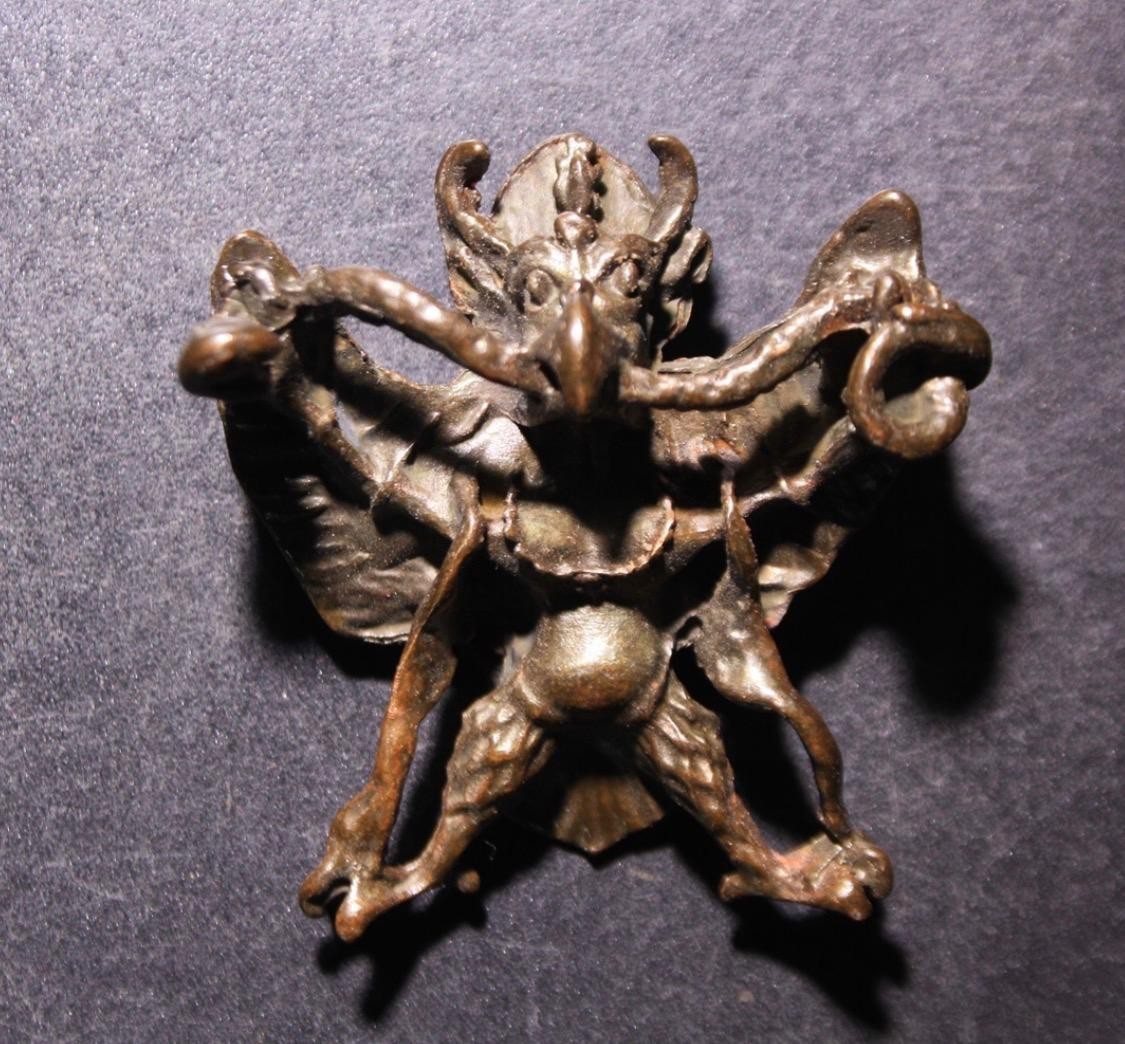
Yet spread across this tiny piece are the wings of one of the most powerful creatures to travel from ancient Indian mythology into the Buddhist world of Tibet and imperial China.
A fierce face.
A beaked nose.
Arms thrown outward.
Taloned legs spread beneath the body.
And behind everything—
two enormous wings.
This is the 金翅大鹏鸟.
The Golden-Winged Great Bird.
Garuda.
The Story — A Mythological Creature Travels Across Asia
Garuda did not begin in China.
Its origins lie much further west and south, in the religious traditions of ancient India.
There, Garuda emerged as an immense divine bird associated particularly with Vishnu.
As Buddhism travelled across Asia, however, Garuda travelled with it.
The creature entered Buddhist cosmology.
Its imagery moved northward.
Across the Himalayas.
Into Tibet.
And eventually into the religious art of imperial China.
The result was a fascinating artistic transformation.
Indian Garuda became Tibetan Khyung and entered Chinese Buddhist terminology as 金翅鸟, literally the:
“Golden-Winged Bird.”
Christie\'s describes a large Tibeto-Chinese Garuda from circa 1800 with wings and arms outstretched, a ferocious face, third eye, horns and flaming hair—features demonstrating the highly developed form Garuda assumed in Himalayan Buddhist art. Christie\'s
Look Closely
Despite measuring less than four centimeters high, this miniature preserves a surprising amount of iconography.
The wings dominate the composition.
Individual feather divisions radiate outward from the center of the back.
From the front emerges a fierce hybrid creature—not simply a bird, and not simply a human.
Its arms extend dramatically to either side.
The legs spread beneath it.
The torso projects forward.
The face terminates in a prominent beak.
This combination of avian and anthropomorphic features is fundamental to representations of Garuda.
Its maker had to compress that complicated iconography into an extraordinarily small space.
Why Is Garuda So Fierce?
Because Garuda is not intended to be gentle.
Within Buddhist visual culture, fierce appearances do not necessarily represent evil.
Quite the opposite.
Terrifying forms can embody protective power.
Garuda became particularly associated with overcoming the nāgas—serpent beings whose relationship with Garuda derives from much older Indian mythology.
That struggle between bird and serpent became an extraordinarily persistent motif.
The mighty bird above.
The serpent below.
Sky against earth.
Wings against coils.
Garuda\'s ferocious appearance therefore carried protective associations within Himalayan Buddhist culture.
From Tibet to the Qing Court
The Qing emperors ruled a vast multiethnic empire.
Tibetan Buddhism occupied an important position within Qing religious and political culture, and the imperial workshops produced sophisticated Buddhist sculpture combining Tibetan iconography with Chinese metalworking traditions.
Surviving Qing Sino-Tibetan bronzes demonstrate this fusion clearly.
A monumental 17th–18th-century Tibeto-Chinese Garuda sold in 2026 was described as combining established Tibetan prototypes with sophisticated Chinese casting techniques. Galerie Zacke
The Asian Art Museum likewise preserves Qing Chinese Buddhist bronze work from approximately 1700–1800, illustrating the sophisticated production of Buddhist objects in China during this period. Search Collection
Your miniature belongs—according to its Bao Cui attribution—to this broader Qing historical environment.
A Tiny Object With an Unanswered Question
And this is perhaps the most fascinating part.
What exactly was it made for?
At only:
36.7 mm high
15.3 g
this is clearly not comparable in scale with the great Garuda altar sculptures preserved in museums and major collections.
Its compact openwork construction suggests something much more intimate.
A fitting?
A protective object?
Part of a larger ritual assemblage?
An amuletic ornament?
Small religious objects played important roles in Tibetan Buddhist material culture. Protective gau, for example, were portable shrines traditionally carried close to the body and could incorporate Garuda-related protective imagery. Buddha Tooth Relic Temple
But without its original context, His Story Collections will not invent an original function that cannot now be demonstrated.
That mystery remains part of the artifact.
Bao Cui Certification
This object is encapsulated and certified by Bao Cui Rating / 保粹评级.
The certification identifies it as:
Period attribution: 清 — Qing Dynasty
Identification: 黄传金翅大鹏鸟
Grade: 极美88
Height: 36.7 mm
Weight: 15.3 g
Certification Number: B002060460
The certification number has also been checked through Bao Cui\'s online database.
The database displays photographs corresponding to the front and reverse of this artifact.
Attribution disclosure
The Qing Dynasty attribution presented in this listing follows the accompanying Bao Cui certification.
His Story Collections has not independently scientifically dated the object or performed metallurgical testing.
No claim of imperial manufacture, Qianlong-period manufacture, temple provenance or original ritual function is made unless separately documented.
Condition
The artifact displays a predominantly dark brown/bronze surface with lighter highlights across raised areas.
The wings retain clearly defined feather divisions.
Wear and surface variation are visible and should be evaluated from the photographs.
Because the piece remains inside its certified holder, it has not been cleaned or altered by His Story Collections.
Please examine all photographs carefully.
The certified object photographed is the exact artifact offered for sale.
Why His Story Collections Chose This Piece
History does not always survive as monumental statues.
Sometimes it survives in something smaller than the palm of your hand.
This object weighs barely half an ounce.
Yet its imagery travelled thousands of miles.
From the mythology of ancient India—
through Buddhism—
across the Himalayas—
into Tibet—
and into the cultural world of Qing China.
Empires changed.
Languages changed.
Artists changed.
Yet the great bird kept its wings.
More than two thousand years of Asian religious imagination are compressed into a figure only 36.7 millimeters high.
That is why size can be deceptive.
Some objects are physically small—
but historically enormous.
Carry History With You.
His Story Collections