When you click on links to various merchants on this site and make a purchase, this can result in this site earning a commission. Affiliate programs and affiliations include, but are not limited to, the eBay Partner Network.
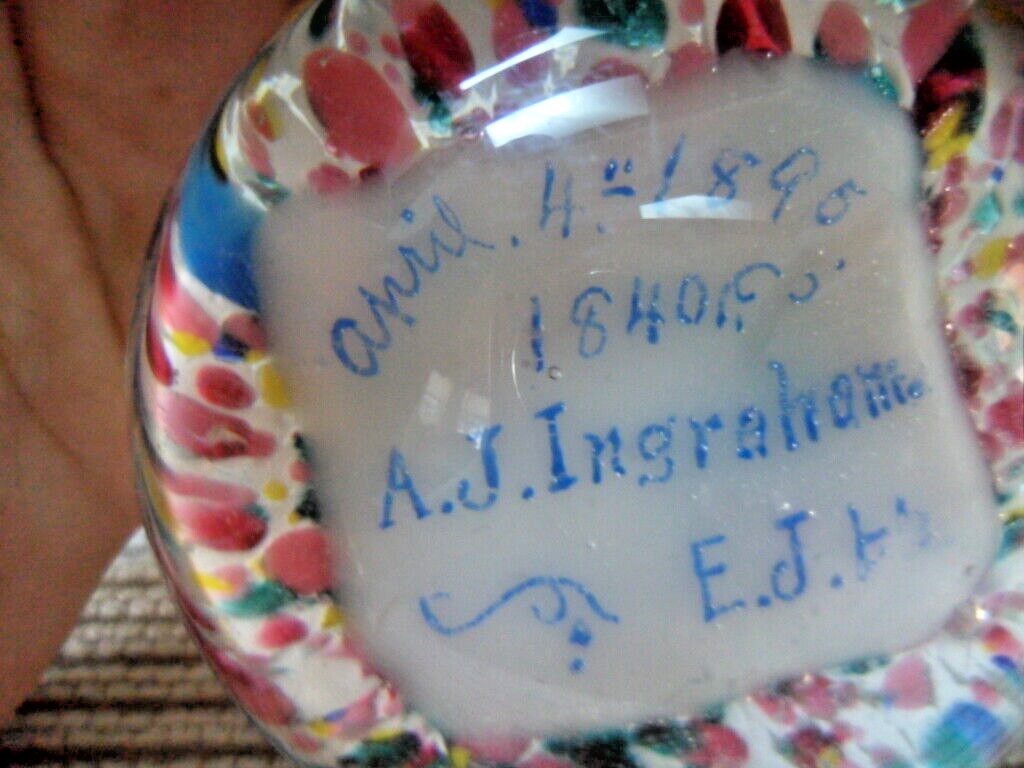
IMPORTANT VICTORIAN MEMORIAL/MOURNING PAPERWEIGHT INSCRIBEDA.J. INGRAHAM (B. 1840- D. April 4, 1895) and E.J.H. I purchased this historical paperweight manyyears ago from a civil war collector.I am now passing it on... to the nextgeneration; if the decedent could speak; he certainly witnessed quite abit of history during his short 55 years of life. Other than some minor superficial bruises to thesurface of the crystal...It isincredible that this piece has survived the test of time. All VintageItems sold "as is".
- Extremely rare and Important Victorian Memorial/Mourning paperweight inscribed on interior glass milk banner in blue “glass powder” lettering “A.J. Ingraham (1840-April 4, 1895)” and then initialed at the bottom right with a family members initials of (“E.J.H”). Paperweights such as these were utilized by Family members of the Victorian Era after the death of a loved one as a memorial to their life (“in glass”), or with jewelry “weaved with the decedent’s hair”.
- This historical paperweight has a white rectangular memorial glass banner [inscribed with the decedent’s name and birthdate of 1840 and death date of April 4, 1895 in blue lettering] resting on top of a multi-colored frit ground with the entire paperweight encased in crystal glass. There is some minor superficial bruising of the glass on one side of the paperweight not obstructing the historical dates and lettering; Incredible that such a historical heirloom survived a plethora of turbulence - during one of the most important and turbulent periods that shaped our American History.
- Many confederate soldiers are listed as A.J. Ingraham or A. J. Ingram in ancestry.com; including Maj. August John Ingraham of the 12th Cavalry Alabama during the Civil War; also spelled A.J. Ingram in military documents according to my research. Nonetheless, whether or not this person served in the Civil War or any other bloody battle fought by our forefathers during his life, this person, A.J. Ingraham, and his family member with initial E.J.H, were physically present at a time of history that shaped the world for its progenitors. A.J. Ingraham having been born in 1840; was born just a few months “after” the births of Famous Americans such as George Armstrong Custer, (b. Dec. 1839); the famous American Cavalry Officer remembered for “Custer’s Last Stand” and an earlier birth of Oil Magnate John D. Rockefeller in July of 1839; We can only imagine and read about what Ingraham and his family actually witnessed and lived through from the date of his birth in 1840 until his death in 1895 at the early age of 55. Just imagine what this person and his family members experienced; see some historical excerpts below:
- In 1840 during the year of A.J. Ingrahams birth, the Lexington steamship burned and sank resulting in over 150 deaths of passengers and crew members; William Henry Harrison won the presidency and Queen Victoria married Princess Albert;
- In 1841, when A. J. was one year old, William Henry Harrison won the presidency of the USA on March 4th and then passed away on April 4th, just after serving only four weeks in office from pneumonia. In November, Queen Victoria’s first son was born, Edward VII.
- In 1842, when A.J. Ingraham was in his terrible twos, P.T. Barnum of Circus Show Business Fame introduced Tom Thumb to the public.
- When A.J. was three, a mass westward migration via the Oregon Trail ensued.
- When A.J. was four years of age, Sam Morse sent the first “morse code” telegram to Baltimore from the U.S. Capital; with the infamous phrase “What hath God Wrought”. In November, James Polk defeated Henry Clay and
- when A.J. turned five, James Polk was inaugurated as President of the United States in March of 1845; the same month that the Republic of Texas was “annexed” to the United States; while far off our shores The Irish “Great Potato Crop Famine” raged on…lasting through “Black 1847”;
- When A.J. was “six years of age”, Showman and Western Scout “Buffalo Bill Cody” was born in Iowa; a couple of months later, in April of 1846, tensions flared between the nations of Mexico and the US, when Mexican troops ambushed and killed a US soldier patrol culminating in Congress “declaring war against Mexico” in May of 1846.
- when A.J. was “seven”… In Feb. and March of 1847, Generals Zachary Taylor and Winfield Scott’s troops defeated the Mexican armies at the Battle of Buena Vista and Veracruz in the midst of the Mexican War, which finally concluded when US Troops invaded Mexico City in September of the same year. In December of 1847, Abraham Lincoln commenced a two year term as a U.S. House Representative. A month later,
- when A.J. turned “eight”, a northern California gentleman by the name of James Marshall discovered “gold” in California (1848)-- setting off the infamous “California Gold Rush”; Sadly, former President and Congressman John Quincy Adams passed away in February; while on a happier note, General Zachary Taylor was nominated President elect of the United States in November.
- when A.J. turned “nine” …Zachary Taylor was elected as the 12th President of the United States in March of 1849.
- When A.J. turned “Ten”, President Zachary Taylor passed away while in Office in July of 1850; with his Vice President, Millard Fillmore ascending into his Vacancy. Regretably and sorrowfully, Abraham and Mary Todd Lincoln’s little boy, “Eddie” passed away at the tender age of four in Illinois in the same year.
- When A.J. reached the age of “eleven”; Queen Victoria and her husband Prince Albert attended “The Great Exhibition” in London where enormous strides in technology were displayed including the “reaper” invention by Cyrus McCormick; The first issue of the “New York Times” was published by Journalist Henry Raymond and the timeless novel “Moby Dick” written by Herman Melville was published in November of 1851.
- By A.J.s “twelfth” birthday in 1852, Harriet B. Stowe published “Uncle Tom’s Cabin”; while Henry Clay and Daniel Webster passed Away; and the United States welcomed a new President Elect, Franklin Pierce.
- When A.J. became at teenager at the “age of 13” in 1853, Franklin Pierce was sworn in as President of the United States; he backed the idea of purchasing some land in Southwest New Mexico and southern Arizona (Gadsden Purchase) to utilize as a railroad route from the West Coast to the American South. This strip of land completed the 48 mainlands of the United States.
- During A.J.’s “fourteenth” birthday, legislation referred to as the Kansas-Nebraska Act was enacted in 1854 to lessen growing tensions over slavery; but had an opposite effect of creating increasing tensions opening a “door” to civil war; Abraham Lincoln played a major role in opposing this Act.
- when A.J. was 15 years of age, in 1855, the first locomotive traveled from the Atlantic to the Pacific via the newly completed “Panama Railroad”.
- A.J.’s 16th birthday in 1856 witnessed the election of James Buchanan as President Elect of the United States.
- When A.J.’s turned 17, Buchanan was inaugurated in March 1857 amid rumors of an attempted presidential assassination attempt; when he fell ill at his own inauguration. Worsening tensions ensued in March 6, 1857, when the “Dred Scott Decision” was announced by the U.S. Supreme Court. The chief justice wrote a controversial decision ruling that “Dred Scott”, or any other slave, or descendant of a slave, could not be a citizen of the United States setting off a firestorm.
- When A.J. reached the age of 18, in 1858; Abraham Lincoln and Stephen Douglas held several debates in Illinois during their run for a U.S. Senate Seat. Although Douglas won the U.S. Senate Seat, the public debates increased Lincoln’s anti-slavery view to national standing.
- when A.J. turned 19 years of age, in 1859, John Brown, renown abolitionist launched a raid against the U.S. arsenal at Harper’s Ferry and was hung for treason six weeks later, with his death energizing Northern sympathizers, who referred to him as a martyr for the cause; and Pennsylvania drilled its first successful 70’ well; and struck “oil”.
- A.J. now 20 years of age in 1860, witnessed a time when a lawyer from Springfield, Illinois, Abraham Lincoln, was elected as President of the United States; with his anti-slavery rhetoric igniting a firestorm between the North and the South; ultimately opening a door to Civil War with the slave states opposing Lincoln’s anti-slavery views and eventually seceded from the Union; but on a lighter note, A.J. and family must have enjoyed the sharpshooter antics of the timeless entertainment personality of the 1860’s “Annie Oakley”.
- At A.J.’s 21st year of birth, Abraham Lincoln was inaugurated as the Republican President of the United states in March, 1861; meanwhile, the Confederates were attacking Fort Sumter in April of the same year which began “The Civil War”; Union forces were defeated at the “Battle of Big Bethel” in June and “Bull Run” in July of the same year; Confederates won battles at Wilson’s Creek in August, and the Battle of Balls Bluff in October; Union forces captured Hatteras Inlet; and Prince Albert, husband of Queen Victoria passed away at the young age of 42;
- A.J. , Age 22, 1862, Writer Henry David Thoreau, author of Walden dies;
- Battles raged during 1862, one of the most tumultuous periods of American History:
- The Battle of Antietam "America's Bloodiest Day; Battle of Mill Springs Battle of Fort Donelson; Battle of Val Verde; Battle of Pea Ridge; ironclad battle between the USS Monitor and CSS Virginia; First Battle of Kernstown; Battle of Glorieta Pass; Major General Ulysses S. Grant won the Battle of Shiloh; Siege of Yorktown; Union forces capture Fort Pulaski; Great Locomotive Chase takes place in northern Georgia; Flag Officer David G. Farragut captures New Orleans for the Union; The Battle of Williamsburg is fought during the Peninsula Campaign; Battle of McDowell; First Battle of Winchester; Battle of Cross Keys in theShenandoah Valley; Battle of Port Republic; Battle of Oak Grove; Battle of Beaver Dam Creek (Mechanicsville); Battle of Gaines' Mill; Battle of Savage's Station; Battle of Glendale (Frayser's Farm); Battle of Malvern Hill; Battle of Cedar Mountain; General Robert E. Lee wins a stunning victory at the Second Battle of Manassas; Battle of Chantilly; Battle of Harpers Ferry; Battle of South Mountain; Battle of Iuka; Second Battle of Corinth; Battle of Perryville; Battle of Prairie Grove; Battle of Fredericksburg; Battle of Chickasaw Bayou; Battle of Stones River
- President Abraham Lincoln delivered the Gettysburg Address in November of 1863 and dedicated a military cemetery at the site of the Battle of Gettysburg.
·Union and Confederate forces clashed at the Battle ofStones River from Dec 31, 1862 thru Jan. 2 of 1863
·Confederate forces won a stunning victory atthe Battle ofChancellorsville in May of 1863; but were beaten at the Battle ofRaymond during the Vicksburg Campaign
·In May through July of 1863, Union forces wonkey victories at the Battle ofChampion Hill; the Battle of Big Black River Bridge; the Siege ofVicksburg and the Siege of Port Hudson
·Union forces under Maj. Gen. George G.Meade win the Battle of Gettysburgin July of 1863 and turn the tide in the East
·July 4, 1863 - After asix-week siege, the Confederate stronghold of Vicksburgfalls to Union troops under Maj. Gen. Ulysses S. Grant
·September 18-20, 1863 - GeneralBraxton Bragg wins the Battle ofChickamauga
·November 23-25, 1863 - Unionforces under Maj. Gen. Ulysses S. Grant win the Battle ofChattanooga
·October 13-November 7, 1863 - Union troops are thwarted in the BristoeCampaign
·November-December, 1863 - Confederate troopsconduct the KnoxvilleCampaign
·November 26-December 2, 1863 - Union andConfederate troops fight the Mine RunCampaign
·December 31, 1862-January 2, 1863 - Union andConfederate forces clash at the Battle ofStones River
·May 1-6, 1863 - Confederate forces win astunning victory at the Battle ofChancellorsville
·May 12, 1863 - Confederate forces are beaten atthe Battle of Raymondduring the Vicksburg Campaign
·May 16, 1863 - Union forces win a key victoryat the Battle ofChampion Hill
·May 17, 1863 - Confederate forces are beaten atthe Battle of BigBlack River Bridge
·May 18-July 4, 1863 - Union troops conduct the Siege ofVicksburg
·May 21-July 9, 1863 - Union troops under Maj. Gen. Nathaniel Banksconduct the Siege of PortHudson
·June 9, 1863 -Cavalry forces fight the Battle ofBrandy Station
·July 1-3, 1863 - Union forces under Maj. Gen.George G. Meade win the Battle ofGettysburg and turn the tide in the East
·July 4, 1863 -After a six-week siege, the Confederate stronghold of Vicksburgfalls to Union troops under Maj. Gen. Ulysses S. Grant
·September 18-20, 1863 - GeneralBraxton Bragg wins the Battle ofChickamauga
·November 23-25, 1863 - Union forces under Maj. Gen. Ulysses S. Grantwin the Battle ofChattanooga
·October 13-November 7, 1863 - Union troops are thwarted in the BristoeCampaign
·November-December, 1863 - Confederate troops conduct the KnoxvilleCampaign
·November 26-December 2, 1863 - Union and Confederate troops fight the Mine RunCampaign
·
·1864
·A.J. now24 ; The first burial took place at ArlingtonNational Cemetery on May 13, 1864.
·Abraham Lincoln won a second term aspresident on November 8, 1864:, defeating General GeorgeMcClellan in the election of 1864.
·February 17, 1864 - USS Housatonic becomes the first ship sunk bya submarine when it is attacked by H.L. Hunley
·February 20, 1864 - Confederate troops win the Battle ofOlustee in Florida
·April 8, 1864 -Union troops are beaten at the Battle ofMansfield
·May 5-7, 1864 -The Overland Campaign starts with the Battle of theWilderness
·May 8-21, 1864 - Union and Confederate forces fight the bloodyBattle ofSpotsylvania Court House
·May 23-26, 1864 - Union and Confederate forces meet at the Battle ofNorth Anna
·May 11, 1864 - Union cavalry wins the Battle ofYellow Tavern
·May 13-15, 1864 - In the opening fight of the Atlanta Campaign,Union and Confederate troops meet at the Battle ofResaca
·May 23-26, 1864 - Union and Confederate forces meet at the Battle ofNorth Anna
·May 31-June 12, 1864 - Union troops are repulsed at the Battle ofCold Harbor
·June 5, 1864 -Union forces in the Shenandoah Valley win the Battle ofPiedmont
·June 9, 1864-April 2, 1865 - Union and Confederate forces fight the Siege ofPetersburg
·June 27, 1864 -Union forces are repulsed at the Battle ofKennesaw Mountain
·June 10, 1864 -Confederate troops win the Battle ofBrice's Cross Roads
·June 11-12, 1864 - Union cavalry fights the Battle ofTrevilian Station
·June 19, 1864 -USS Kearsargesinks the Confederate raider CSS Alabama
·June 21-23, 1864 - Union and Confederate forces fight the Battle ofJerusalem Plank Road
·July 9, 1864 -Union forces delay the Confederates at the Battle ofMonocacy
·July 20, 1864 -Union troops win the Battle ofPeachtree Creek near Atlanta
·July 28, 1864 -The Confederates are turned back at the Battle ofEzra Church
·July 22, 1864 -Confederate forces lose the Battle ofAtlanta
·August 18-21, 1864 - Maj. Gen. Gouverneur K. Warren wins the Battle ofGlobe Tavern
·August 31-September 1, 1864 - Union forces win the Battle ofJonesboro (Jonesborough)
·September 2, 1864 - Union troops under Maj. Gen. William T.Sherman capture Atlanta
·September 19, 1864 - Confederate forces are defeated at the Third Battleof Winchester (Opequon)
·September 21-22, 1864 - Union troops win the Battle ofFisher's Hill in the Shenandoah Valley
·October 2, 1864 - Union and Confederate forces fight the Battle ofPeebles Farm
·October 19, 1864 - Union troops recover to win the Battle ofCedar Creek
·October 27-28, 1864 - The Battle ofBoydton Plank Road is fought south of Petersburg, VA
·November 29, 1864 - Union troops escape after the Battle ofSpring Hill
·November 30, 1864 - GeneralJohn Bell Hood loses the Battle ofFranklin
·December 15-16, 1864 - The Army of Tennessee is effectivelydestroyed at the Battle ofNashville
·
·1865
·A.J. now25 lived when General William Tecumseh Shermanissued Special Field Orders, No. 15, which was interpreted as a promise toprovide "fortyacres and a mule" to each family of freed slaves in 1865.
·Witnessed the ThirteenthAmendment being passed in January of 1865, which abolished slaveryin America, issued by the United States Congress.
·Abraham Lincoln was inaugurated for his secondterm as president of the United States. On March 4, 1865 with Lincoln'ssecond inaugural address being remembered as one of his most notablespeeches.
·PresidentAbraham Lincoln was shot at Ford's Theatre By Booth on April 14,1865 and died the next morning, leaving his beloved Mary Todd a widow.
·January 13-15, 1865 - Union troops capture FortFisher
·February 5-7, 1865 - Battle of Hatcher's Runis fought near Petersburg.
·March 16, 1865 - Union and Confederate forces meet at Averasborough
·March 19-21, 1865 - Union forces win the Battle ofBentonville
·March 25, 1865 - Confederate forces are beaten at the Battle ofFort Stedman
·April 1, 1865 -Major GeneralPhilip Sheridan wins the Battle ofFive Forks for the Union
·April 2/3, 1865 - After a ten-month siege, Union forces capturePetersburg, VA, compelling General Robert E. Lee to retreat west
·April 6, 1865 -Union forces triumph at the Battle ofSayler's Creek
·April 9, 1865 -Gen. RobertE. Lee surrendersto Lt. Gen. Ulysses S. Grant at Appomattox Court House, VA
·April 26, 1865 - Gen. Joseph E. Johnston surrenders to Maj.Gen. William T. Sherman at Durham, NC
·
·1866
·A.J. now26 when in the Summer of 1866 The Grand Army ofthe Republic, an organization of Union veterans, was formed.
·Congress passes a bill to expand the authorityof the Freedmen's Bureau over President Andrew Johnson's Veto.
·AndrewJohnsonofficially declares the war has ended in Alabama,Arkansas, Florida, Georgia, Louisiana, Mississippi, North Carolina, SouthCarolina, Tennessee, and Virginia.
·The Civil Rights Bill of 1866 is passed overAndrew Johnson's veto. It is meant to ensure that blacks are given their rightsafter the passage of Black Codes in southern states.
·Tennessee becomes the first state to ratifythefourteenthamendment.
·
·1867
·A.J. now27 years of age
·
·Black males are granted suffrage in WashingtonD.C.In addition, suffrage is given to any male over 21 in US territories.
·Nebraska becomes the 37th state to be admittedto the union.
·The FirstReconstructionActis passed after Congress overrides Johnson's veto. It divides the southernstates into five military districts. In addition, in order for a state to bereadmitted to the union it has to ratify the fourteenth amendment.
·
·
·
·1868
·A.J. now28 years of age; Tenureof Office Act is passed in Congress. This denies the president the right toremove any officials from office who Congress has approved. This will becomeimportant later when impeachment proceedings are brought against Johnson. Inaddition, the Command of the Army Act is passed stating that all militaryorders from the president have to go through the General of the Army.
·Alaska is purchased from the Russians for$7,200,000. This is known as 'Seward's Folly' after Secretary of State Sewardwho arranged for the purchase.
·Johnson fires Secretary of WarEdwin Stantondespitethe Tenure of Office Act. He names Ulysses Grant to take his place.
·America annexes the Midway Islands in thePacific Ocean.
·The Patrons of Husbandry, later called TheGrange, is founded. It will become the mouthpiece for farmers in America.
·Secretary of WarUlysses Grantasksto step down because Senate rules will cause him to be fined for violating theTenure of Office Act. Stanton once again becomes the Secretary. When Johnsonagain asks for Stanton's resignation, he is brought up on impeachmentcharges.
·President Andrew Johnson is tried inimpeachment proceedings. However, his fails when Edmund Ross votes no.
·The First Sioux War ends with the Treaty ofFort Laramie.
·PresidentJamesBuchananDies on June 1st.
·Arkansas, Alabama, Florida, Georgia, Louisiana,North Carolina, and South Carolina are al readmitted to representation inCongress after meeting all Congressional requirements.
·A treaty between the US and China is ratifiedensuring peace and allowing for free migration between the two countries.
·TheFourteenthAmendmentis officially ratified.
·The state of Georgia expels all blacks from itslegislature.
·Ulysses S. Grant wins the presidentialelection.
·Before leaving office, Andrew Johnson grantsgeneral armies to everyone involved in the rebellion against the North.
·
·1869
·
·A.J. now29 years of age; Thenumber of Supreme Court Justices increases from seven to nine.
·Thetranscontinentalrailroadis completed.
·The National Woman Suffrage Association isformed with Elizabeth Cady Stanton as its president.
·Riots begin against Chinese laborers in SanFrancisco.
·The Prohibition Party is formed inChicago.
·Black Friday occurs as the price of gold dropsconsiderably after a failed scheme to corner the gold market between Jay Gouldand James Fisk. This tarnishes Grant's reputation and is one ofmany scandalstorock his presidency.
·Wyoming gives women the right to vote.
·
·March 4, 1869: Ulysses S.Grantwas inaugurated as president of the United States ofAmerica.
·September 24, 1869: A scheme by Wall Streetoperators Jay Gouldand Jim Fiskto corner the gold market nearly took down the entire U.S. economy in whatbecame known as Black Friday.
·October 16, 1869: A weird discovery on anupstate New York farm became a sensation as the Cardiff Giant.The huge stone man turned out to be a hoax, but still fascinated a public whichseemed to want a diversion.
·
·1870
·A.J. now30 years of age;
·Standard Oil Company is formed.
·Virginia, Mississippi, and Texas are grantedreadmission to the Union.
·Congress creates the Department of Justice.
·The US and Great Britain sign a treaty to stopthe worldwide African slave trade.
·General Robert E. Lee dies.
·TheFifteenthAmendmentwas ratified giving black males the right tovote.
·The last fourSouthern statesthatfought for the confederacy were readmitted to Congress. These were Virginia,Mississippi, Texas, and Georgia.
·The first black Senator, Hiram E. Revels,assumed the seat of Jefferson Davis.
·The Enforcement Act was passed. This wasallowed for federal intervention against the Ku Klux Klan.
·A California case,White v. Flood,set the precedent for schools to be segregated by race.
·
·1870: Thomas Nast,star political cartoonist of Harper's Weekly, began a campaign of lampoon thecorrupt "ring" that secretly ran New York City. Nast's biting depictions ofthe Tweed Ringhelped bring down Boss Tweed.
·February 3, 1870: The 15th Amendment to theU.S. Constitution, which gave the right to vote to black males, became law whenthe required number of states ratified it.
·June 9, 1870: CharlesDickens, British novelist, died at the age of 58.
·July 15, 1870: Georgia became the last of theConfederate states to return tothe Union.
·October 12, 1870: Robert E. Lee, Confederategeneral in the Civil War, died at the age of 63 at Lexington, Virginia.
·1871
·A.J. now31 years of age;
·The Indian Appropriations Act was passed. Thismade all Native Americans as wards of the state.
·"Boss"Tweedpolitical machine was exposed by the New York Times.
·The greenback becomes legal tender.
·US reached theAlabamasettlementwith England over the aid it gave to the Confederacy in building warships.England paid $15.5 million in damages.
·The Great Chicago Fire occurred.
·Summer 1871: Photographer William HenryJackson takes a number of photographs on the YellowstoneExpedition. The scenery he captured was so remarkable that it led tothe creation ofthe National Parks.
·July 15, 1871: Thomas"Tad" Lincoln, the son of Abraham Lincoln, died in Chicagoat the age of 18. He was buried beside his father in Springfield, Illinois.
·
·
·1872
·A.J. now32 years of age; 1872
·March 1, 1872: YellowstoneNational Park was established as the first National Park in theUnited States.
·April 2, 1872: Samuel F.B. Morse, Americanartist and inventor ofthe telegraph and Morse Code, died at the age of 80 in New YorkCity.
·November 5, 1872: PresidentUlysses S. Grant wins a second term in the election of1872, defeating legendary newspaper editor turned candidate HoraceGreeley.
·November 29, 1872: HoraceGreeley, who weeks earlier lost the presidential election, died inNew York City.
·
·1873
·A.J. now33 years of age;
·March 4, 1873: Ulysses S.Grant took the oath ofoffice for the second time as he began his second term as Presidentof the United States.
·April 1, 1873: The steamshipAtlantic struck rocks on the coast of Canada and at least 500passengers and crew perished in one of the worst maritime disasters of the 19thcentury.
·September 1873: A stock market crashed sets offthe Panic of 1873, one of the great financialpanics of the 19th century.
·The Panic of 1873 occurred, caused by rampantrailroad speculation.
·TheGilded Agewas written by Mark Twain and CharlesDudley Warner.
·
·1874
·A.J. now34 years of age;
·The Woman's Christian Temperance Union wasfounded.
·January 17, 1874: Chang and Eng Bunker,conjoined twins who became famous as the Siamese Twins, died at the age of 62.
·March 11, 1874: Charles Sumner, Massachusettssenator who in 1856 had been beaten in theU.S. Capitol in an event leading up to the Civil War, died at theage of 63.
·March 8, 1874: MillardFillmore, former president of the United States, died at the age of74.
·November 1874: The GreenbackParty was established in the United States. Its constituency werethe farmers and workers adversely affected by the Panic of 1873.
·1875
·
·1875
·A.J. now35 years of age;
·The Whiskey Ringscandaloccurredduring President Grant's administration. A number of his associates wereindicted.
·The Civil Rights Act of 1875 was passed byCongress. It established penalties for those who denied citizens equalemployment and the use of inns, theaters, and other places.
·April 21, 1875: CharlesStewart Parnell, Irish political leader, was elected to the BritishHouse of Commons.
·May 19, 1875: Mary ToddLincoln, widow of Abraham Lincoln, was judged to be insane in atrial instigated by her son, Robert ToddLincoln.
·July 31, 1875: AndrewJohnson, who became president following the assassinationof Abraham Lincoln, died at the age of 66.
·
·1876
·A.J. now36 years of age;
·The Lakota Sioux are ordered toreservations. In their resistance, the Sioux led by Sitting Bull and CrazyHorse defeatGeneral Custerandhis men at the Battle of Little Big Horn.
·Alexander Graham Bell patentedthe telephone.
·Samuel J. Tilden defeatedRutherford B.Hayesin the popular vote. However, the electoral vote isthrown into the House of Representatives
·1876
·March 10, 1876: Alexander Graham Bell made thefirst successful telephone call, saying, "Watson, come here, I needyou."
·June 25, 1876: Indian Wars: The US 7th Cavalryunder Lt. ColonelGeorge A. Custer is routed at the Battle of theLittle Bighorn; GeneralGeorge Armstrong Custer, commander of the 7th Cavalry, is killed,along with more than 200 of his men, at the Battle of theLittle Bighorn.
·July 4, 1876: The United States celebrated itscentennial with celebrations in cities and towns across the country.
·August 2, 1876: Wild BillHickok, gunfighter and lawman, was shot and killed while playingcards in Deadwood, Dakota Territory.
·August 25, 1876: The firstcrossing of the unfinished Brooklyn Bridge was accomplished by itsmaster mechanic, E.F. Farrington, riding on a wire strung between its towers.
·November 7, 1876: The United States presidentialelection of 1876 was disputed and became the most controversialAmerican election until the election of 2000.
·.
·
·1877
·A.J. now37 years of age;
·The Compromise of 1877 occurred giving Hayesthe presidency.
·Federal troops were removed from the Southernstates.
·Early 1877: An electoral commission was formedto settle the disputedpresidential election of 1876 results in the Compromise of1877. Rutherford B. Hayes was declared the winner of the election,and Reconstruction was effectively brought to an end.
·March 4, 1877: Rutherford B.Hayes wasinaugurated as president, and comes into office undera cloud of suspicion, being called "His Fraudulency."
·May 1877: Sitting Bull ledfollowers into Canada to escape the U.S. Army, and Crazy Horse surrendered toU.S. troops.
·June 21, 1877: Leaders of the MollyMaguires, a secret society of coal miners in Pennsylvania, wereexecuted.
·July 16, 1877: A strike in West Virginia setoff the GreatRailroad Strike of 1877, which spread nationwide and spurred violentclashes in American cities.
·September 5, 1877: Crazy Horsewas killed at an army base in Kansas.
·
·1878
·A.J. now38 years of age;
·February 19, 1878: Thomas A.Edison patented the phonograph, which would rank as one of his most importantinventions.
·April 12, 1878: WilliamM."Boss" Tweed, the legendary head of Tammany Hall,died in jail in New York Cityat the age of 55.
·Summer 1878: The head of theStatue of Liberty was displayed in a park in Paris during aninternational exhibition.
·.
·1879
·A.J. now39 years of age;
·
·
·April 30, 1879: Sarah J. Hale, a magazineeditor who urged President Lincoln to make Thanksgivingan official holiday, died at the age of 90.
·
·1880
·A.J. now40 years of age;
·
·July 1880: The French-American Union announcedthat enough money had been raised to complete the constructionof the Statue of Liberty, though money would still have to be raisedto construct its pedestal in New York.
·November 2, 1880: JamesGarfield defeated Winfield Hancock in the U.S. presidentialelection.
·December 1880: Inventor Thomas A.Edison used electricChristmas lights for the first time, hanging them outside his lab inMenlo Park, New Jersey.
·
·1881
·A.J. now41 years of age;
·January 19, 1881: John Sutter,who owned the sawmill where a gold discovery began the CaliforniaGold Rush, died in Washington, D.C.
·March 4, 1881: JamesGarfield was inaugurated as president of the United States.
·May 21, 1883: The American Red Cross wasincorporated by Clara Barton.
·July 2, 1881: PresidentJames Garfield was shot by Charles Guiteau at a Washington, D.C.train station.
·July 14, 1881: Outlaw Billy theKid was shot and killed by lawman Pat Garrett in New Mexico territory.
·September 19, 1881: President James Garfielddied after being wounded in a shooting 11 weeks earlier. The vice president, Chester A. Arthur,became president.
·October 26, 1881: The Gunfight atthe O.K. Corral took place in Tombstone, Arizona.
·
·1882
·A.J. now 42 years old
·April 3, 1882: Outlaw Jesse Jameswas shot and killed by Robert Ford.
·April 12, 1882. CharlesDarwin, author of On the Originof Species, died in England at the age of 73.
·April 27, 1882: Ralph WaldoEmerson, influential American writer and Transcendentalist,died at the age of 78.
·September 5, 1882: The firstcommemoration of Labor Day was held in New York City when 10,000workers held a march.
·December 1882: The firstChristmas tree with electric lights was created by Edward Johnson,an employee of Thomas Edison.
·December 10, 1882: PhotographerAlexander Gardner, who took notable photographs of the Civil War,died at the age of 61.
·
·1883
·A.J. now43 years old
·March 14, 1883: Philosopher Karl Marx died atthe age of 64.
·May 24, 1883: The BrooklynBridge was opened with an enormouscelebration after more than a decade of construction.
·July 15, 1883: General TomThumb, famous entertainer discovered and promoted by the greatshowman Phineas T.Barnum, died at the age of 45.
·
·1884
·A.J. now44 years old
·Mark Twain published The Adventures ofHuckleberry Finn.
·August 6, 1884: The cornerstonefor the Statue of Liberty's pedestal was placed on Bedloe's Island in NewYork Harbor.
·November 4, 1884: In the presidential election of1884 Grover Cleveland, despite a paternity scandal, defeated JamesG. Blaine, whose gaffe about "rum, Romanism, and rebellion" probablycost him the presidency.
·
·1885
·A.J. now45 years old
·March 4, 1885: GroverCleveland was inaugurated as president of the United States.
·June 19, 1885: Thedisassembled Statue ofLiberty arrived in New York aboard a French freighter.
·July 23, 1885: Ulysses S. Grant,former president and hero of the Civil War, died at the age of 63. Anenormous funeralprocession for Grant in New York City seemed to signal the end of anera.
·September 7, 1885: Labor Daycelebrations were held in cities across America, with tens ofthousands of workers participating in marches and other commemorations.
·October 29, 1885: George B.McClellan, who had been the Union commander at the Battle ofAntietamand challenged President Lincoln in the election of1864,died at the age of 58.
·
·1886
·A.J. now46 years old
·March 25, 1886 - IndianWars: Apache leader Geronimosurrenders to General NelsonMiles
·May 15, 1886: American poet Emily Dickinsondied at the age of 55.
·June 2, 1886: PresidentGrover Cleveland married Frances Folsom in the White House, thusbecoming the only president to be married in the executive mansion.
·October 28, 1886: The Statue ofLiberty was dedicated in New York Harbor.
·November 18, 1886: Chester A.Arthur, former president, died in New York City at the age of 57.
·
·1887
·A.J. now47 years old
·November 2, 1887: Jenny Lind,Swedish opera singer, whose tour promotedby Phineas T. Barnum had been a sensation in America in 1850, diedat the age of 67.
·November 19, 1887: Poet Emma Lazarus, whosepoem "The NewColossus" would help make the Statue ofLiberty a symbol of immigration, died in New York City at the age of38.
·December 1887: The character of Sherlock Holmesmade his first appearance in a story Arthur ConanDoyle published in a magazine, Beeton's Christmas Annual.
·
·1888
·A.J. now48 years old
·
·March 11, 1888: The GreatBlizzard of 1888 struck the East Coast of the United States.
·November 6, 1888: President Grover Clevelandlost his offer for reelection to BenjaminHarrison.
·
·1889
·A.J. now49 years old
·March 4, 1889: BenjaminHarrison took the oath of office as president and gave an upliftinginaugural address.
·May 31, 1889: The JohnstownFlood occurred in Pennsylvania when a poorly constructed dam burst.
·November 14, 1889: Nellie Bly,star reporter for JosephPulitzer's New York World, left on her 72-day racearound the world.
·December 1889: Pierre deCoubertin, who would eventually organize the modern Olympic games,visited the campus of Yale University to study its athletic programs.
·December 6, 1889: JeffersonDavis, former president of the Confederate States of America, diedat the age of 81.
·
·1890
·A.J. now50 years old
·
·July 2, 1890: The ShermanAnti-Trust Act became law in the United States.
·July 13, 1890: John C.Frémont, American explorer and political figure, died in New YorkCity at the age of 77.
·July 29, 1890: Artist Vincent Van Gogh died inFrance at the age of 37 after shooting himself two days earlier.
·October 1, 1890: At the urging of John Muir,The U.S. Congress designated Yosemite a National Park.
·December 15, 1890: Sitting Bull,legendary Sioux leader, died at the age of 59 in South Dakota.
·December 29, 1890: The Wounded Knee Massacretook place in South Dakota when U.S. Cavalry troopers fired on Lakota Sioux whohad gathered.
·
·1891
·A.J. now51 years old
·February 14, 1891: William Tecumseh Sherman,Civil War general, died in New York City at the age of 71.
·March 17, 1891: The St. Patrick'sDay parade in New York Citybegan using the traditional route up Fifth Avenue.
·April 7, 1891: American showman Phineas T.Barnum died in Bridgeport, Connecticut at the age of 80.
·May 5, 1891: Carnegie Hall opened in New YorkCity.
·June 25, 1891: The character Sherlock Holmes,created by Arthur ConanDoyle, appeared in The Strand magazine for the first time.
·September 28, 1891: HermanMelville, author of Moby Dick,died in New York City at the age of 72.
·
·1892
·A.J. now52 years old
·March 26, 1892: American poet Walt Whitmandied in Camden, New Jersey at the age of 72.
·May 28, 1892: Writer and naturalist John Muirfounded the Sierra Club.
·July 6, 1892: The HomesteadSteel Strike in western Pennsylvania turned into a ferociousday-long battle between Pinkerton men and townspeople.
·August 4, 1892: Andrew Borden and his wife weremurdered in Fall River, Massachusetts and his daughter Lizzie Bordenwas accused of the gruesome crime.
·November 8, 1892: GroverCleveland won the U.S. presidential election, becoming the onlypresident to serve two non-consecutive terms.
·
·1893
·A.J. now53 years old
·January 17, 1893: Rutherford B.Hayes, who became president following the disputedelection of 1876, died in Ohio at the age of 70.
·February 1893: Thomas A.Edison finished building his first motion picture studio.
·March 4, 1893: GroverCleveland was inaugurated as president of the United States for thesecond time.
·May 1, 1893: The 1893 World's Fair, known asthe Columbian Exposition, opened in Chicago.
·May 1893: A decline in the New York stockmarket triggered the Panic of 1893,which led to an economic depression second only to the Great Depression of the1930s.
·June 20, 1893: Lizzie Bordenwas acquitted of murder.
·
·1894
·A.J. now54 years old
·March 25, 1894: Coxey's Army,a march to protest unemployment that was largely the result of the Panic of1893, departed from Ohio on its way to Washington, D.C.
·April 30, 1894: Coxey's Army reachedWashington, D.C. and its leaders were arrested the next day.
·May 1894: The PullmanStrike began, and spread throughout the summer before being put downby federal troops.
·September 1894: The U.S. Congress designatedthe first Monday of September as a legal holiday, Labor Day,to mark the contributions of labor, in part as a peace offering to the labormovement following the crackdown on the Pullman Strike.
·
·1895
·A.J. now55 years old Passes Way on April 4, 1895
·
·February 20, 1895: Abolitionist author FrederickDouglass died in Washington, D.C. at the age of 77.
·April 4, 1895 A.J. Ingraham,subject of this memorial Paperweight passed away at the age of 55
·December 1895: President Grover Clevelandarranged for a White HouseChristmas tree lit with Edison electric bulbs.
·
·Sources: militaryhistoryabout.com; history1800sabout.com; Wikipedia
“HEIRLOOMHUNTER101” PUTS GREAT EFFORT IN DISCOVERING AND LISTING"UNCOMMON TREASURES" FROM ANCIENT TIMES TO THE PRESENT AT AFFORDABLEPRICES. PLEASE TAKE A LOOK AT OUR OTHER ITEMS, INCLUDING NATIVE AMERICAN INDIANTURQUOISE AND STERLING SILVER JEWELRY; TRADE DOLLS, ANCIENT VESSELS, VICTORIANERA HEIRLOOMS; PAPERWEIGHTS; PERIOD GLASS; AND OTHER "OUT OF THE ORDINARY"OFFERINGS. FEEL FREE TO EMAIL SELLER WITH ANY QUESTIONS OR SPECIAL REQUESTS.ITEMS ARE VERY CAREFULLY PACKAGED AND USUALLY SHIPPED OUT THE SAME DAY OFPAYMENT. HEIRLOOMHUNTER101 VALUES AND APPRECIATES ITS CUSTOMERS. PLEASE ADD USTO YOUR SAVED SELLERS LIST AS NEW ITEMS ARE LISTED DAILY