When you click on links to various merchants on this site and make a purchase, this can result in this site earning a commission. Affiliate programs and affiliations include, but are not limited to, the eBay Partner Network.
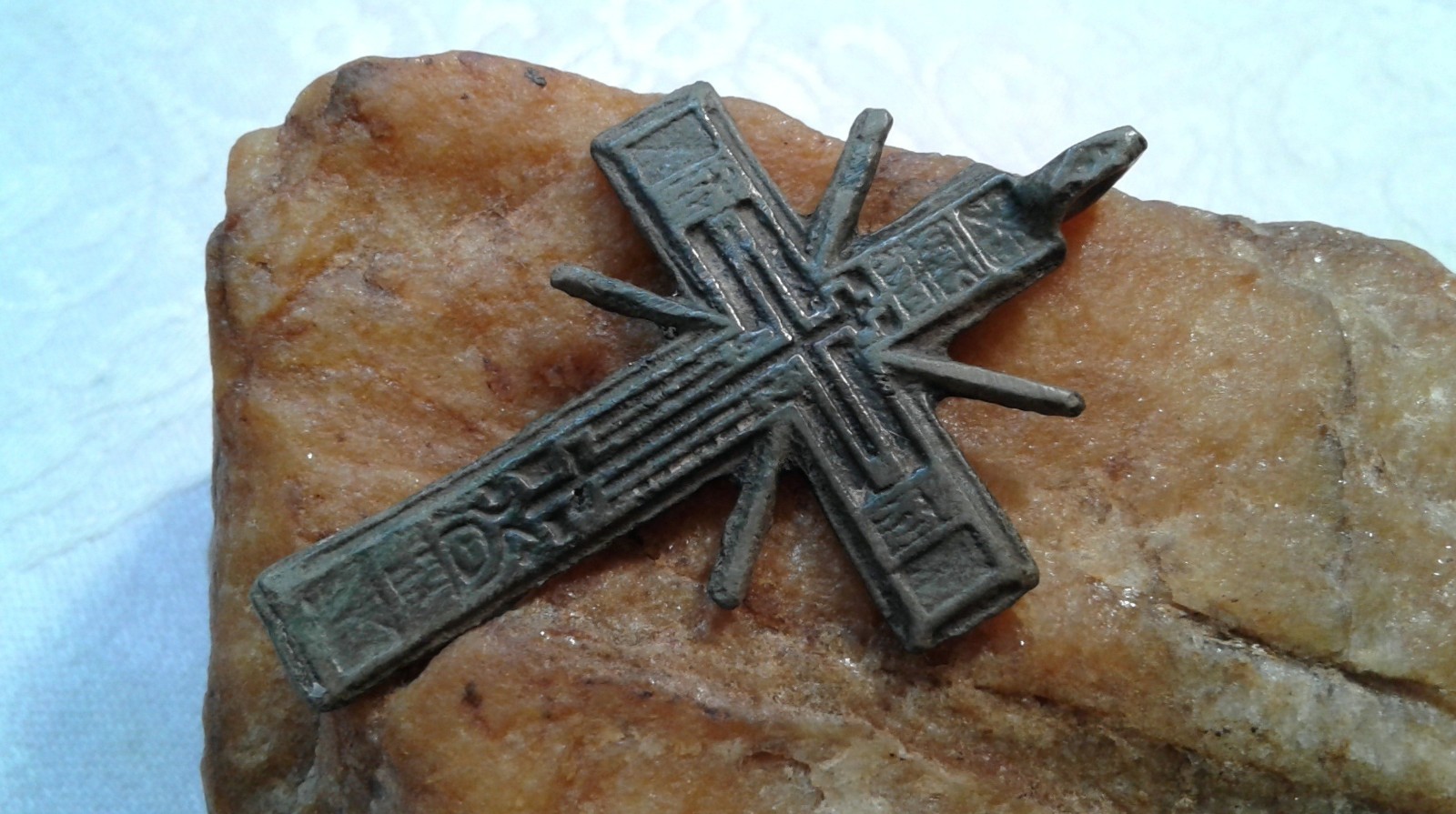
Antique large and sturdy (approx. 2" tall with solid baleloop; weight approx. 5.9 g) Orthodox Cross pendant featuring plain andhumble right-angled "Old Believers" design with image of thethree-bar Savior's Cross flanked by the two Instruments of the Passion over theskull (Adam's head), and with four additional, diagonal crossbeams likelyreferring to the cross of Saint Andrew the Apostle. Alternatively,the diagonal crossbeams might depict the rays of light symbolizing Jesusas "the sun of righteousness" (Malachi 4:2) and His preaching,"I am the light of the world. Whoever follows me will never walk indarkness" (John 8:12). While most of the surviving crosses of this type havetheir thin diagonal crossbeams deformed or partially lost, this is a rare specimenwith the original X-shaped position of crossbeams well preserved. In addition,there is an uncommon design of the reverse displaying floral motif symbolically representing the sprouting vine, an attributeof the Holy Precious and Life-Giving Cross. It might symbolizeits life-giving power, and also refer to the preaching of Christ: "I amthe vine; you are the branches" (John 15:5). The Cross appears to have been hand made from ahistorical bronze or similar copper-based metal alloy of unknowncomposition. It shows distinct marks from the maker's grinding file tools.The metal frame was originally decorated with enamel inlays, which are largely worn out andshowing only small traces of remaining light-colored enamel around the Savior’sCross. Origin likely c. late 17th- 18th century Russia (based on similar items listed in available catalogs;please see the last picture with an example matching the floral pattern on thereverse for a reference). The item shows significant visible signs of wearand aging consistent with its centuries-old age, such as deformations of itsoriginal shape, dents, chipped off particles of metal and enamel, and original partially cleaned patina. Thesuperficial layer of its original thick patina with some spots of powderyoxidation and local corrosion has been removed using gentle manual cleaning andpolishing. There is no wax or any other protective coating on top of metal. The size and weight of the Cross are shown on the photographs for thislisting.
The obverse bears an image of the three-bar Suppedaneum cross. Thethree-bar cross is venerated as the true Savior's Cross in the Eastern Orthodoxand some Eastern Catholic churches. Such a cross has three horizontalcrossbeams: the top one represents the "INRI" nameplate, and thebottom one, a footrest. The footrest crossbeam is depicted pointing up, towardHeaven, on Christ's right hand side where the Penitent thief, St. Dismas wascrucified.
The top end of the vertical crossbar of thependant shows a Church Slavonic abbreviation meaning "King of Glory", a traditional part of theOrthodox title of Jesus inscribed on the Savior's Cross. The left and right side “boxed” ends of thehorizontal crossbar bear Sacred Name of Jesus Christ inscribed as the "ICXC" Greek Christogram, the "IC" on the left, and the"XC" on the right.
Parallel to the vertical crossbar of the Savior's Cross, there areimages of the two Instruments of the Passion which are subjects to adorationalong with the Cross, the Holy Lance (spear) of a Roman soldier and theHoly Sponge attached to the end of a cane.
A symbolic image of the skull, or Adam's head, buried below theSavior's Cross refers to Golgotha (Calvary), the elevated site where Jesus wascrucified, which the Bible says means "the place of the skull" inHebrew. An ancient tradition of Catholic and Orthodox Churches held thatit was also the burial place of Adam, thus symbolizing the ultimate victory ofChrist over sin and death.
Just below the skull image,the “boxed” bottom end of the vertical crossbar displays inscription “HIKA”, a Cyrillicversion of the ancient Greek "NIKA" symbol meaning the“Conqueror” or "Victorious" which is often used as a part of thetitle of Jesus to glorify His victory over sin and death achieved on the Cross.
Please examine all photographs carefully and do your own research if necessary. Please note that photographs are an important part of the item's description. The measuring meter and electronic scale are not for sale, and might be photographed with the item in order to provide a size and weight reference.Please ask all questions before making a purchase.There are no guarantees with the listing because most items are original vintage or antique objects that are quite old and could be fragile. All items are sold "as is" with no returns because of a change of mind offered. Will ship to the USA only.