When you click on links to various merchants on this site and make a purchase, this can result in this site earning a commission. Affiliate programs and affiliations include, but are not limited to, the eBay Partner Network.
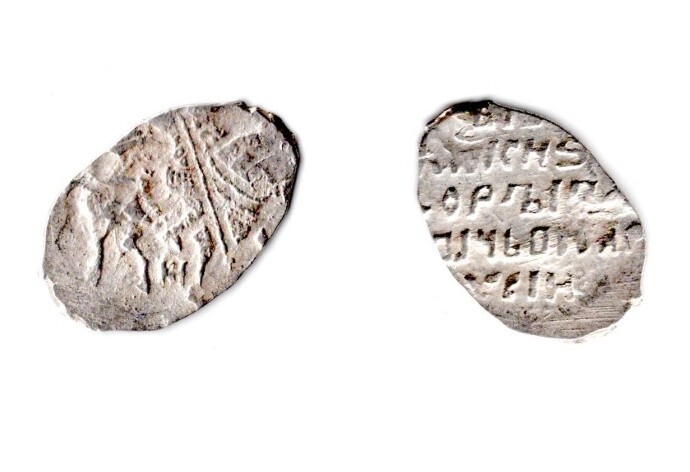
RussianXVIIth c. Silver Coin RARE!!! SUPER!!!!
RUSSIA.
Russia. Dmitry Pozharsky. Yaroslavl!!! 1612-1613. RRR!
KG # 318.
Russian XVIIth century Silver Wire Kopeck Coin under thename of FedorIoannovich Rurikovich, was produced at the Moscow Temporary Mint in November 1612 - January 1613.
The total number ofthis type coins 120. Only few coins are known to be in private collections.The rest are found in government museums (The Hermitage, Moscow Historical Museum, etc.) *.
Extremely RARE.
Dmitry Mikhaylovich Pozharsky (Russian: Дмитрий Михайлович Пожарский) (November1, 1578 - 20 (?) April 1642) was a Rurikid prince who helped bring the Time ofTroubles to an end and obtained from the tsar an unprecedented title of the Saviourof Motherland.
Pozharsky was descended from adynasty of sovereign princes which ruled the town of Starodub-on-the-Klyazmanear Suzdal. At one point in the 15th century their family patrimony burned tothe ground, in consequence of which event they assumed the name of Pozharsky(from pozhar, the Russian word for conflagration). It is interesting tonote that Dmitry\'s mother came from the Beklemishev family, just like themother of Mikhail Kutuzov, who would be credited with saving Russia preciselytwo centuries after him.
The family was never particularlyprominent, and Pozharsky\'s early career was not documented until he took partin the Zemsky sobor which elected Boris Godunov to the throne in 1598. Fouryears later, he was attested as a stolnik. When the Time of Troubles broke outupon Godunov\'s death, he was present at the defense of Kolomna (1608) andhelped Vasily IV during the Siege of Moscow in 1609. Later that year, he routedthe Bolotnikov Cossacks at the Pekhorka River. In 1610, Pozharsky was incommand at the defense of Zaraysk against the forces of False Dmitry II.
By that time, the popularindignation against abuses of the Polish aggressors had gained momentum. After ProkopyLyapunov rallied the first Volunteer Army in Ryazan, Pozharsky promply joinedthe cause of rebels. He took a prominent part in the first Moscow Uprising butwas wounded on 19 March 1611 while defending his house at Lubyanka Square andwas transported by his adherents to the Trinity for convalescence.
In autumn 1611, when Pozharskywas recuperating at his Puretsky patrimony near Suzdal, he was approached by adelegation of burghers who offered him to assume command of the secondVolunteer Army then gathered in Nizhny Novgorod. The prince agreed on conditionthat he will be assisted by Kuzma Minin, a representative of the Nizhegorodmerchants.
In late 1611, prince DmitryPozharsky was asked to lead the public opposition against the Poles, organizedby the merchants\' guild of Nizhny Novgorod, with the respected town butcher(literally, a meat-trader) Kuzma Minin overseeing the handling of the fundsdonated by the merchants to form create the Second Volunteer Army (Russian: Второе народное ополчение). When part of the Polish army mutinied inJanuary 1612 due to unpaid wages. and retreated from Russia towards the Commonwealth,the forces of the Second Volunteer Army strengthened the other anti-PolishRussian forces in Moscow. The 9,000-strong Polish army under hetman Jan KarolChodkiewicz attempted to lift the siege and clashed with Russian forces,attempting to break through to Polish forces in the Kremlin on 1 September. ThePolish forces used cavalry attacks in the open field, exercising tactics thatwere new to them: escorting a mobile tabor fortress through the city. Afterearly Polish successes, the Russian Cossack reinforcements had forcedChodkiewicz\'s forces to retreat from Moscow.
Russian reinforcements underprince Pozharsky eventually starved the Commonwealth garrison (there werereports of cannibalism) and forced its surrender on the 1 November (though somesources give 6 November or 7 November) after the 19-month siege. A historian(Parker) writes vividly of the Polish soldiers: \"First they ate grass andoffal, then they ate each other, and the survivors finally surrendered. TheMoscow Kremlin fell on 6 November 1612.\" On November 7, the Polishsoldiers withdrew from Moscow. Although the Commonwealth negotiated a safepassage, the Russian forces massacred half of the former Kremlin garrisonforces as they left the fortress. Thus, the Russian army recaptured Moscow.
The Polessurrender the Moscow Kremlin to Prince Pozharsky in 1612. Painting by ErnestLissner.
On June 2, 1611 Smolensk hadfinally fallen to the Poles. After enduring 20 months of siege, two harshwinters and dwindling food supplies, the Russians in Smolensk finally reachedtheir limit as the Polish-Lithuanian troops broke through the city gates. ThePolish army, advised by the runaway traitor Andrei Dedishin, discovered aweakness in the fortress defenses and on 13 June 1611 Cavalier of Malta BartłomiejNowodworski inserted a mine into sewer canal. The explosion created a largebreach in the fortress walls. Jakub Potocki was the first on the walls. Thefortress fell on the same day. The remaining Russian soldiers took refuge in acathedral and blew themselves up with stores of gunpowder to avoid death at thehands of the invaders. Although it was a blow to lose Smolensk, the defeatfreed up Russian troops to fight the Commonwealth in Moscow, and the Russiancommander at Smolensk, Mikhail Borisovich Shein, was considered a hero forholding out as long as he had. He was captured at Smolensk and remained aprisoner of Poland-Lithuania for the next 9 years.
sale guideline evaluation: $RRR.
Thank you for your interest. Check my other sales that Ihave on now! Happy offerding!