When you click on links to various merchants on this site and make a purchase, this can result in this site earning a commission. Affiliate programs and affiliations include, but are not limited to, the eBay Partner Network.
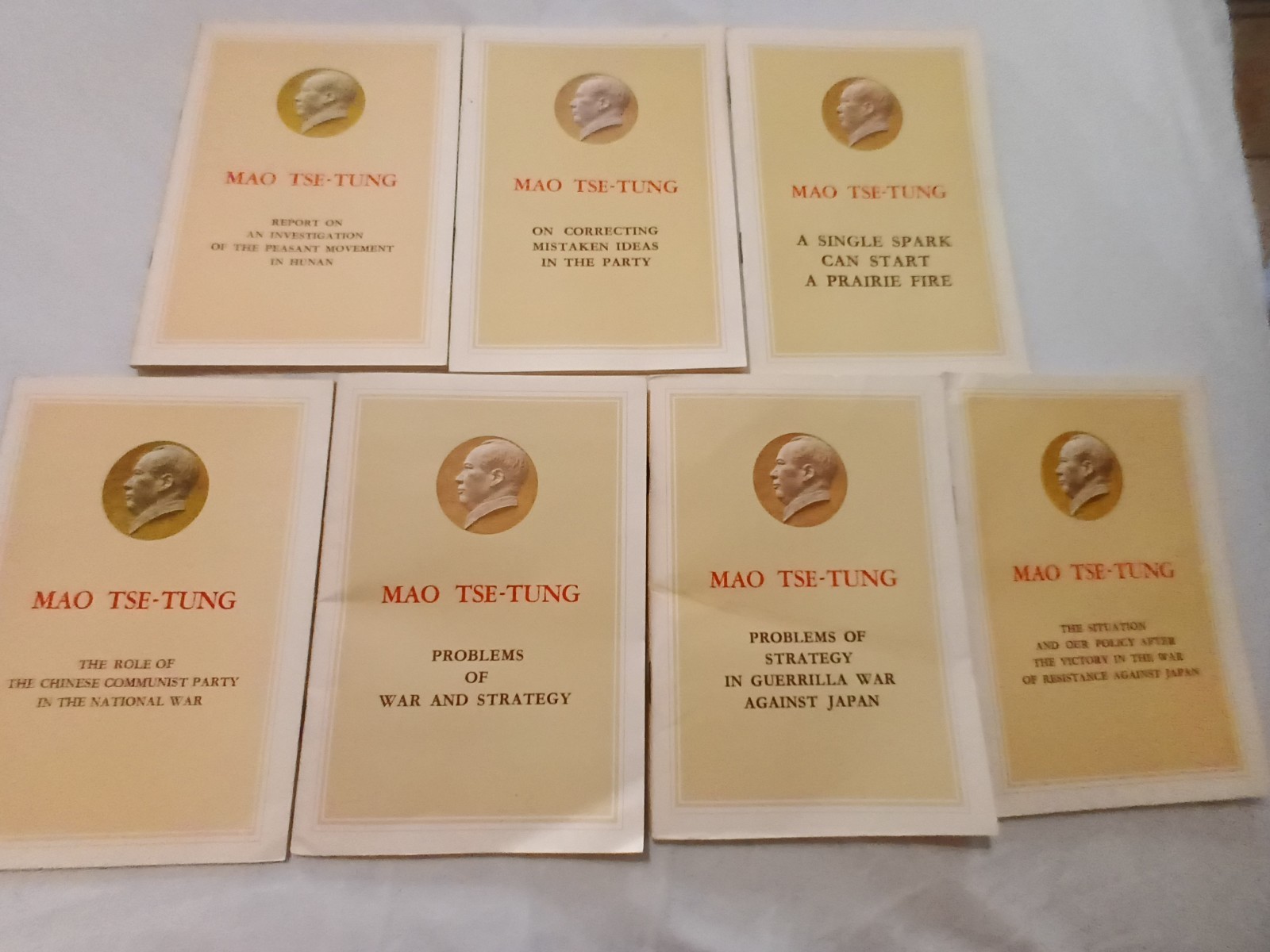
This set of books is a collection of seven of Mao Tse-Tung\'s most important works, printed in English in 1966 - 1967 by the Foreign Languages Press in China. The books cover topics such as history, politics, World War II, communism, imperialism, war, and social revolution, making them a valuable addition to any collector\'s library. These vintage paperbacks carry special attributes like being in mint condition. With a total savings of 71% over buying the books individually, this set offers a unique opportunity to delve into the thought and writings of one of the most significant figures in world history during key moments during the first half of the 20th Century
The books cover key writings by Mao as he led the Chinese Communist Part at major crossroads in the Chinese Communist Party\'s march from a small group facing military eradication to military victory over Imperialist Japan. The victory over Japan marked the beginning of the end of the United Front in China against Japan, and resumption of the Civil War between the KMT Party and the CCP.
This collection includes the following works by Mao:
1. REPORT ON AN INVESTIGATION OF THE PEASANT MOVEMENT IN HUNAN - This book is a basic text in Marxist literature. It shifted the strategy from urban factories to the rural countryside. Written after a 32 day field study in the Hunan Provence countryside witnessing rural revolts, Mao robustly defends the spontaneous violence of poor peasants against local gentry, corrupt officials, and landlords, famously asserting that \"a revolution is not a dinner party\" but rather an act of violence by which one class overthrows another. He details \"Fourteen Great Achievements\" of the newly formed peasant associations which effectively dismantled centuries-old feudal, clan, religious, and patriarchal authorities. By fiercely refuting critics inside and outside the Chinese Communist Party (CCP) who labelled the uprisings as unruly \"excesses\", Mao established the rural peasantry -- rather than the urban proletariat -- as the true vanguard of China\'s transformation. Ultimately, this influential text marked a profound break from orthodox Soviet Marxism and provided the tactical and ideological blueprint for the successful agrarian strategy of the Chinese Communist Revolution.
52 pages.
2. ON CORRECTING MISTAKEN IDEAS IN THE PARTY - Also known as the Gutian Resolution, submitted and adopted at a Congress of the armed wing of the Chinese Communist Party, later to become the People\'s Liberation Army (PLA). Adopted in December, 1929, the Resolution outlines strategies to eradicate non- proletarian mentalities - - such as pure militarism, individualism, and vagabond ideologies - - by intensifying ideological education and reforming the military\'s social composition.
15 pages.
3. A SINGLE SPARK CAN START A PRAIRIE FIRE - This short book originally was a letter written by Mao on January 5th 1930 in criticism of certain pessimistic views then existing in the Chinese Communist Party. The letter critiques pessimistic and overly cautious attitudes within the early Communist Party. Mao argued that widespread peasant uprisings were imminent, providing the theoretical foundation for armed, rural guerilla base areas instead of traditional urban insurrections.
The title is drawn from an ancient Chinese philosophical concept that warns how small, seemingly insignificant rebellions can rapidly spread into uncontrollable national revolutions. In the text, Mao famously analyzes the chaotic localized conflicts tearing through China, comparing the frustrated masses to dry kindling waiting for a single spark to ignite into a massive prairie fire.
Historically published as an independent pamphlet and included in Mao\'s \"Selected Works,\", this document outlines the blueprint for the rural dash focused agrarian Revolution that eventually led to the founding of the People\'s Republic of China. The phrase has since become a globally recognized metaphor for how localized grassroots movements can spark systemic, large - scale political change.
18 pages.
4. PROBLEMS OF STRATEGY IN GUERILLA WAR AGAINST JAPAN - written in May, 1938, this work by Mao outlines how a technologically inferior nation can defeat a stronger occupying force. It details vital tactics like establishing rural base areas, coordinating with regular armies, and maintaining popular support - - famously comparing guerillas to \"fish\" and the populace to \"water\".
52 pages.
5. THE ROLE OF THE CHINESE COMMUNIST PARTY IN THE NATIONAL WAR - Written by Mao during an important party conference in late 1938 during the second Sino-Japanese War, this work is a fundamental political text arguing that the Chinese Communist Party must take an active vanguard role in the anti-Japanese national liberation struggle. It emphasizes that Chinese patriotism and national defense are inseparable from broader global proletarian liberation. Mao asserts that to successfully unite the nation, fight enemy agents, and build a new China, the party must maintain the anti-japanese National United Front while strictly preserving its own ideological, political, and organizational independence.
25 Pages.
6. PROBLEMS OF WAR AND STRATEGY - This work is the concluding speech, on November 6th, 1938, at the same important Chinese Communist Party Congress at which Mao\'s Work, THE ROLE OF THE CHINESE COMMUNIST PARTY IN THE NATIONAL WAR (Book 5, immediately above), was distributed. PROBLEMS OF WAR AND STRATEGY outlines Marxist-Leninist military doctrine emphasizing that political power grows out of the barrel of a gun. It explores armed struggle, protracted warfare, and revolutionary tactics while also highlighting how to mobilize the masses and execute guerrilla warfare.
7. THE SITUATION AND OUR POLICY AFTER THE VICTORY IN THE WAR OF RESISTANCE AGAINST JAPAN - This Work was delivered at a meeting of cadres in Yenan on August 13, 1945, two days before Japan publicly announced surrender and acceptance of the Terms of Surrender. Following the victory over Japan in 1945, the armed forces of the Chinese Communist Party, soon to be renamed the People\'s Liberation Army (PLA), seized on the debilitated state of Chiang Kai-shek\'s Nationalist government to rapidly expand Communist controlled areas. Both Communist and Nationalist policy shifted from temporary wartime cooperation to all-out Civil War, ultimately culminating four years later in the founding of the People\'s Republic of China in 1949. This book discusses the possibilities for the future of China as the Japanese occupation ended, the Anti-Japanese United Front no longer was necessary, and China teetered on the edge of resumption of its prior all-out Civil War between the Red Liberation forces and the Nationalist government, a full-scale Civil War which resumed in 1946.
21 pages.