When you click on links to various merchants on this site and make a purchase, this can result in this site earning a commission. Affiliate programs and affiliations include, but are not limited to, the eBay Partner Network.
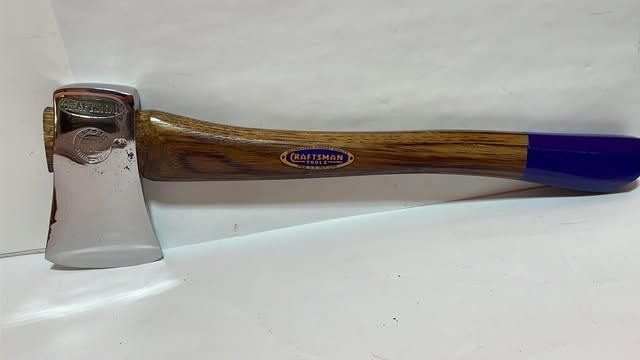
I personally restored this Craftsman/Sears Golden Jubilee hatchet to as close to original as I could other than the black walnut stain on the hexagon handle. New hickory handle, era correct hexagon shape. I polished the head to a mirror shine, treated the handle with boiled linseed oil, black walnut stain, Patriot Blue paint on the end, and tung oil.
Now, for a history lesson, this is what AI told me about the history, I trust this history and have vetted it but here it is for your reading pleasure if you care to learn about the hatchet\'s history:
Craftsman “Golden Jubilee” Hatchet — What It Is and What We Actually Know
Short answer: it’s a commemorative Craftsman hatchet produced for Sears, Roebuck & Co.’s Golden Jubilee (1886–1936). It was not a regular catalog tool, it was not mass-produced like standard Craftsman hatchets, and exact production numbers were never published.
Now the real breakdown.
What the “Golden Jubilee” Mark Means
The “Sears Golden Jubilee 1886–1936” stamp was used by Sears to commemorate 50 years since Richard W. Sears founded the company. During this period (mid-1930s), Sears commissioned special-run promotional and commemorative items across multiple product categories:
Tools
Appliances
Housewares
Advertising giveaways
The Craftsman Golden Jubilee hatchet falls squarely into that category.
Where It Was Sold (and How)
This hatchet was not a standard retail shelf item like a normal Craftsman axe or hammer.
Most evidence points to it being:
Sold through Sears catalogs as a commemorative offering, or
Distributed as a promotional item, employee recognition piece, or special order accessory
Possibly tied to store openings, sales milestones, or Jubilee marketing campaigns
Collectors generally agree it was not widely available in every Sears store, which is why examples surface far less often than standard Craftsman hatchets from the same era.
Who Made It
Sears did not manufacture tools themselves.
During the 1930s, Craftsman edged tools were commonly produced by:
Kelly Axe Manufacturing Co.
Plumb
True Temper (early involvement)
Other contracted American forges
The mirror-polished head, crisp stampings, and high-quality handle suggest a top-tier OEM, likely Kelly or Plumb, but no factory attribution survives in Sears records.
How Many Were Made?
Here’s the honest collector answer:
No surviving Sears documentation lists production quantities.
However, based on:
Frequency of surviving examples
Comparison to other Sears Jubilee items
sale appearances over decades
Most serious tool collectors estimate production in the low tens of thousands at most, not hundreds of thousands.
In collector terms: