When you click on links to various merchants on this site and make a purchase, this can result in this site earning a commission. Affiliate programs and affiliations include, but are not limited to, the eBay Partner Network.
189x58cm/74x23 in
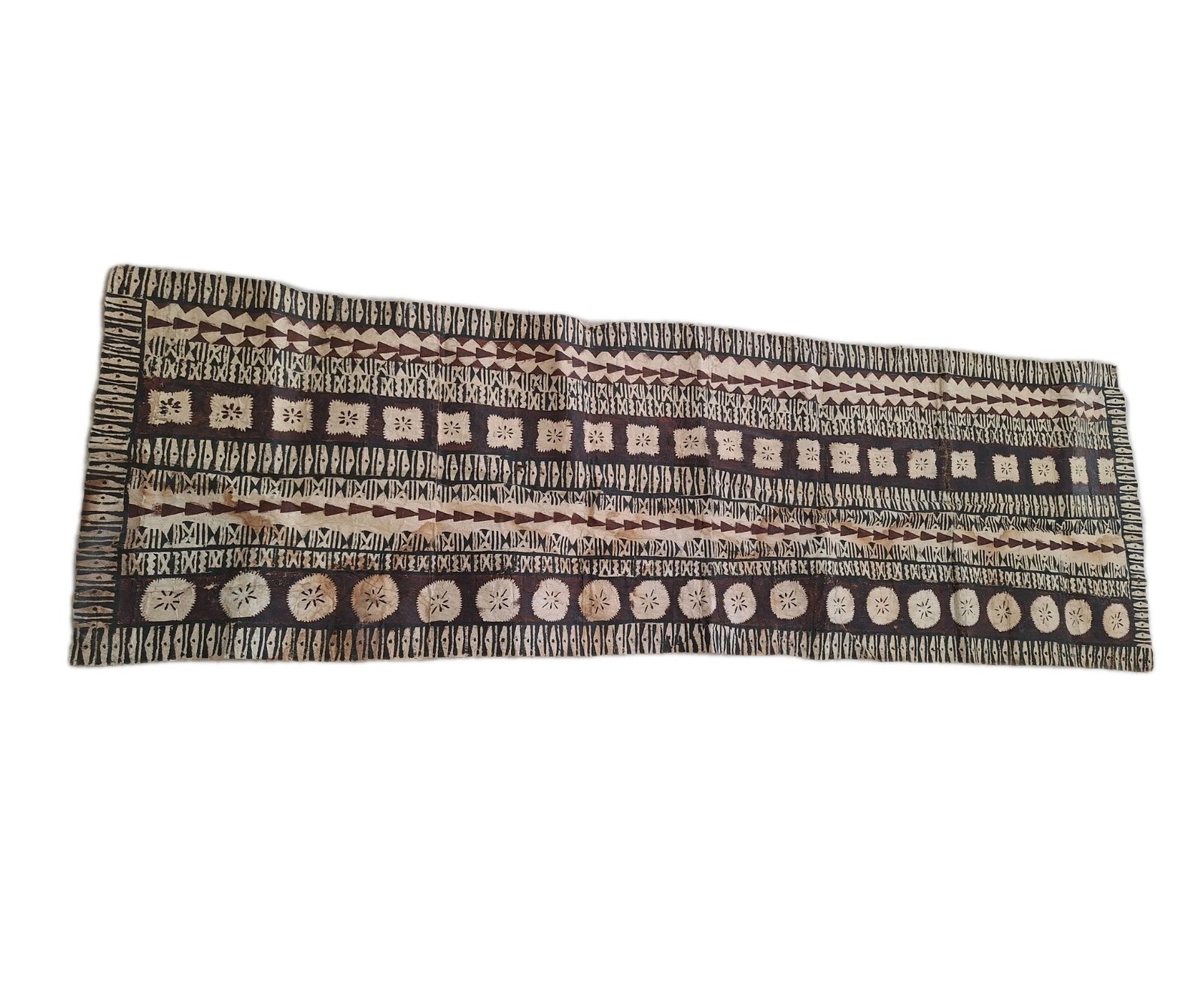
Great traditional tapa from the 20th century 1960s
(more precisely a *ngatu* if we refer to the style of the motifs of the Tonga islands, or a *masi* of Fiji). It is a fabric of beaten plant bark, typical of the cultures of Oceania (Polynesia and Melanesia). with tattoo designs
Material: It is made from the inner bark (the bast) of the paper mulberry (*Broussonetia papyrifera*). The bark is beaten for a long time using wooden beaters on an anvil to soften it, stretch it and agglomerate the fibers to form a non-woven textile piece.
The Texture the fibrous, irregular and slightly parchment-like appearance characteristic of this plant material.
Patterns and Dyes
The ornamentation is structured in horizontal and vertical bands (friezes) with repetitive geometric patterns struck or painted by hand (using stencils or relief matrices):
Colors: A traditional two-tone/tri-color palette composed of natural pigments (black from charcoal or candlenut soot, and brown-brown/ocher from paints made from clay or tree sap).
Decors:
* Strips of triangular shapes pointing downwards or arranged in a chevron pattern.
* A line of circular medallions with fringes evoking suns, flowers or sea urchin motifs
* Patterns of notched squares containing small crosses or stars
* A striated geometric border that frames the entire perimeter of the fabric
The item shows authentic signs of age and handling and creases from folded storage.
Historically, these tapa fabrics had great social and sacred value. They were used as ceremonial clothing, blankets, currency or gifts during important ceremonies (weddings, funerals). Today, they are particularly sought after as wall art and decorative objects.
(more precisely a *ngatu* if we refer to the style of the motifs of the Tonga islands, or a *masi* of Fiji). It is a fabric of beaten plant bark, typical of the cultures of Oceania (Polynesia and Melanesia). with tattoo designs Material: It is made from the inner bark (the bast) of the paper mulberry (*Broussonetia papyrifera*). The bark is beaten for a long time using wooden beaters on an anvil to soften it, stretch it and agglomerate the fibers to form a non-woven textile piece. Colors: A traditional two-tone/tri-color palette composed of natural pigments (black from charcoal or candlenut soot, and brown-brown/ocher from paints made from clay or tree sap). Historically, these tapa fabrics had great social and sacred value. They were used as ceremonial clothing, blankets, currency or gift