When you click on links to various merchants on this site and make a purchase, this can result in this site earning a commission. Affiliate programs and affiliations include, but are not limited to, the eBay Partner Network.
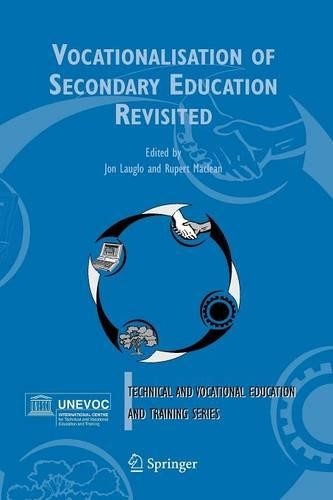
Vocationalisation of Secondary Education RevisitedAuthor(s): Jon Lauglo, R. Maclean
Format: Paperback
Publisher: Springer, Netherlands
Imprint: Springer
ISBN-13: 9789048167708, efforts at diversifying its secondary school curriculum, and the lessons that might be learnedfrom this experience. The report focuses on the vocationa- sation policy of the 1987 education reforms. Not muchhas been written about the impact of vocationalised secondary education inGhana with the resultthat there is very little documentation on issues pertinent to TVE at that level. D- cussions with Ministry of Education (MOE) of?cialsrevealed that investment inthe technicalinstitute and polytechnic sector is currentlyof more immediate concern than investment in vocational secondary education-an indication of perhaps growing dissatisfaction with the vocationalised secondary education policies of the 1987 reforms. Ministry of?cials feltthat a few senior secondary with the rest concentrating on providing general education. Furthermore, they argued that thiswould facilitate specialfunding of specially designated TVE secondary schoolsand thus improve theiref?ciency and effectiveness. A f- still too narrowly focused on university requirements, thus undermining their ability to address the practical goalsof TVE.
Some of the information sought by the terms of reference (TOR) of this study was not readily available partly because vocational secondary education had not attracted as much interest as, for example, basic education where s- eral reviews and studies have been conducted. Recent policy literature on TVE in Ghana re?ects concerns with the informal and formal vocational schools sector (Japan International Cooperation Agency/MOE, 2001). Also, docum- tation on implementation stages of vocational policies is dif?cult to ?nd.