When you click on links to various merchants on this site and make a purchase, this can result in this site earning a commission. Affiliate programs and affiliations include, but are not limited to, the eBay Partner Network.
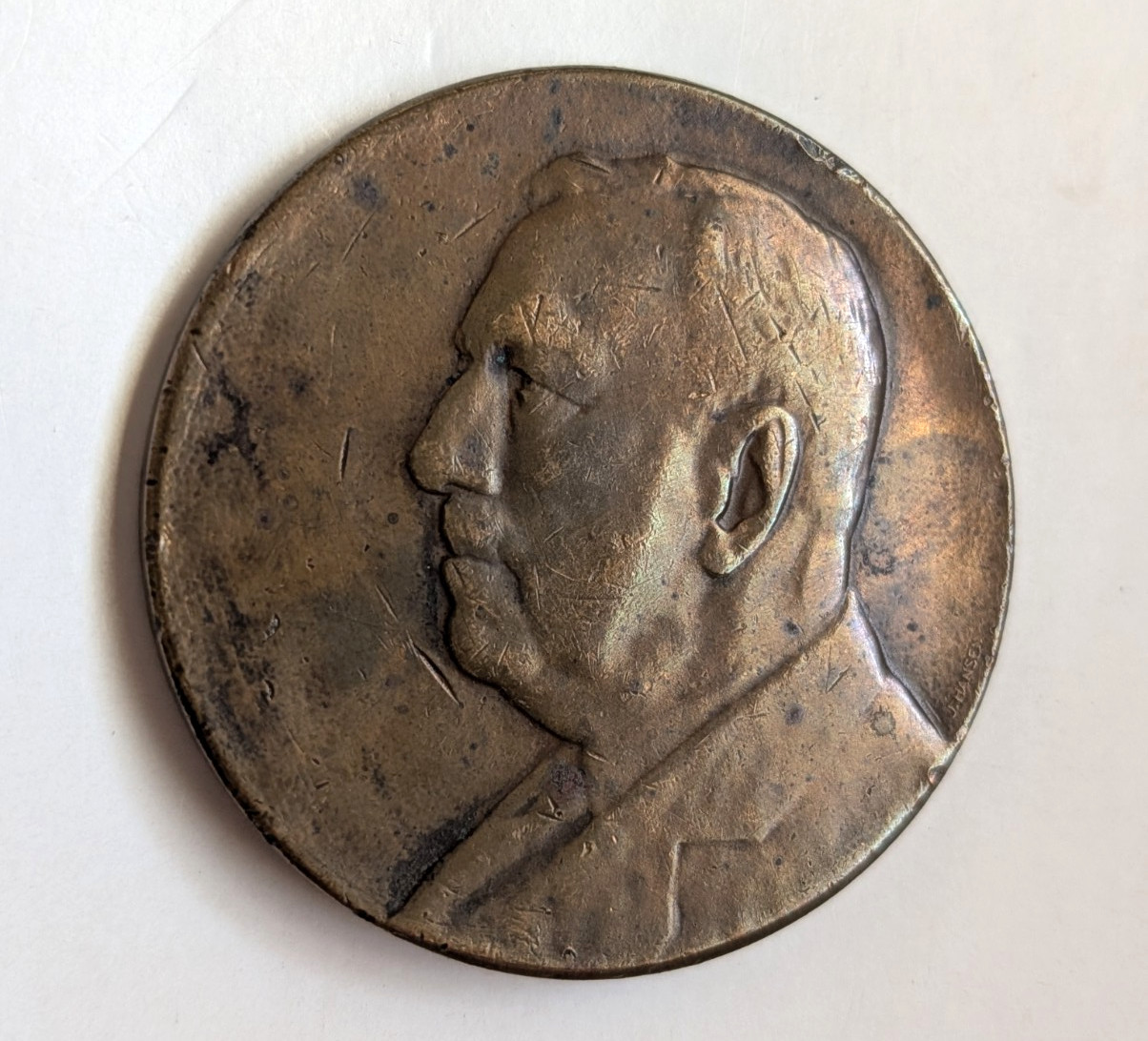
This is a sculpted bronze medal struck in honor of Dr. Frank Billings and dated 1924. It is 102 years old. The word \"Bronze\" appears on the edge of the medallion, as does the maker\'s mark, J.F. Newman, Inc., and abbreviations for New York, Chicago and San Francisco. The medallion is 63 mm (about 2.48 inches) in diameter. By sculpted, I mean that the medal (medallion) has a 3-D effect, with Billings\' face in relief on one side and the following on the reverse:
Frank BillingsSc.D, M.D.Dean of the FacultyRush Medical CollegePhysician TeacherHumanitarian1924Frank Billings, born in Wisconsin on April 2,1854, was one of the giants of American medicine. In 1881, he received his medical degree from Northwestern University. He continued his medical studies in Vienna, Paris, and London, 1885-1886, before returning to Chicago. Billings was an attending physician at Mercy Hospital, 1890-1898; St. Luke’s Hospital, 1890-1906; Cook County Hospital, 1890-1901; and Presbyterian Hospital, 1898-1920. He served as Dean of Rush Medical College, 1900-1920. He introduced residents and the clerkship system to Presbyterian Hospital.
Dr. Frank Billings, circa 1905Billings served as president of the Chicago Medical Society, 1891; the American Medical Association, 1902-1903; the Association of American Physicians, 1906; the National Association for the Study and Prevention of Tuberculosis, 1907; and the Institute of Medicine, 1922. He was an advocate for better medical care and a dedicated educator. He was instrumental in securing funds for fellowships and the construction of many buildings, including the Rawson Laboratory of Medicine and Surgery on the Rush Medical College campus and the Albert Merritt Billings Hospital at the University of Chicago. Billings\' contributions to medical literature include writings on topics such as anemia, pneumococcic infections, and heart disease.A portrait of Dr. Frank Billings, dean of faculty at Rush Medical College, and Dr. Wilbur Post, physician and professor of Medicine at Rush Medical College, wearing scholarly robes, standing in front of a building in Chicago, Illinois. 1927He was the longtime dean of Rush Medical College during its affiliation with the University of Chicago. (Contrary to common belief, the university’s Billings Hospital is named for A.M. Billings, no relation).Billings knew all of Chicago’s prominent families. One of his acquaintances was young Ernest Poole, later a Pulitzer Prize-winning novelist. Poole delighted in re-telling a story of Dr. Frank’s medical school days.The laws of the time made it difficult to get cadavers for classroom instruction. Medical students sometimes solved the problem by digging up fresh corpses from the county Potter’s Field. One night Billings and two Northwestern classmates set out in a wagon to retrieve the mortal remains of a murderer who’d recently been hanged. On the way, they came upon a brightly lit tavern.Parked outside the tavern was a wagon belonging to Rush Medical College. A figure wrapped in blankets was propped up in the driver’s seat. The Rush students had gotten to the murderer\'s cadaver first. Now they were inside the tavern celebrating.
Billings and his two friends transferred the body to their own wagon. Just then the tavern door opened. Telling his colleagues to get away, Billings quickly wrapped himself in the blankets. He climbed into the Rush wagon and assumed the dead man’s place.
One by one, the Rush students staggered out of the tavern. The first man got into the wagon and checked the corpse. “Hey fellas,” he shouted, “this stiff don’t feel as cold as he ought to be!”“And neither would you be, if you were burning in hell like I am!” Billings announced in a spooky voice.The terrified Rush student tumbled out of the wagon. With that, Billings grabbed the reins and drove off in the Rush wagon, laughing all the way.Billings died of a gastric hemorrhage on September 20, 1932, and buried at Graceland Cemetery, Chicago.J. F. Newman, Inc.was a historic, high-end manufacturer of official fraternity and sorority jewelry, college seals, rings, and medals. Founded in New York City in the late 19th century, the firm grew to become one of the premier collegiate and Greek-letter jewelers in the United States, competing with other historic makers like Balfour.
The firm is highly regarded today by collectors of vintage jewelry and fraternal memorabilia. Items stamped with the J.F. Newman hallmark—such as antique 14k gold enameled badges, watch fobs, and class rings—are deeply tied to early American collegiate history.