When you click on links to various merchants on this site and make a purchase, this can result in this site earning a commission. Affiliate programs and affiliations include, but are not limited to, the eBay Partner Network.
ATH#220277.16
AWESOME - TRULY A TREASURE TO OWN
Please spend two minutes reading about her below before offerding
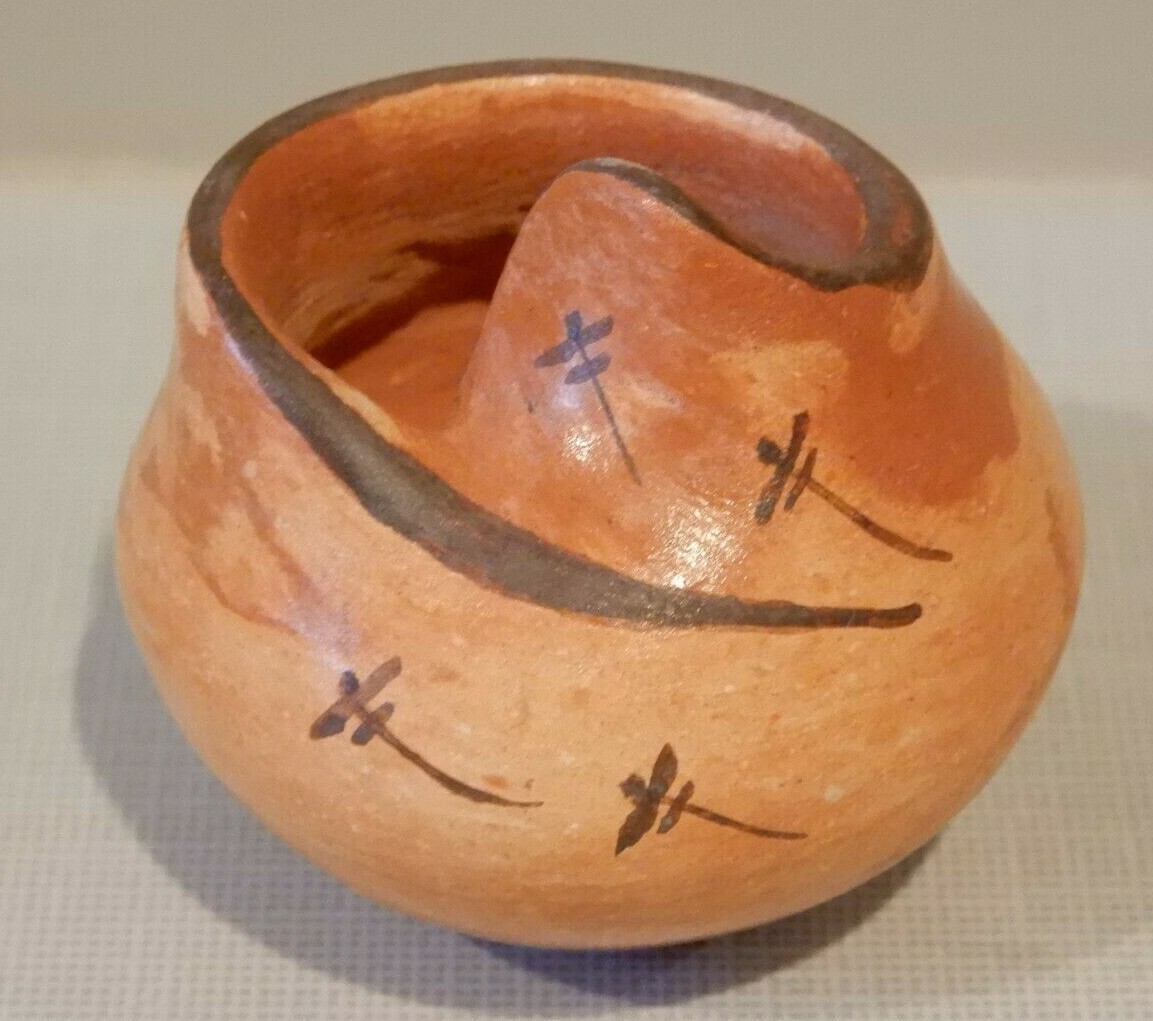
Vintage Hopi Spirit Jar
about 2" Tall x 2" Wide
Organic opening, Broken Line
byDelaine Dee Tootsie Chee
she also goes by "Sand Girl"
she adds a picto of a Roadrunner to her signature
Excellent pre-owned condition.
Smoke free home.
Do see my pictures.
FROM THE INTERNET.
Through allthe hard times in Delaine Tootsie-Chee’s life, pottery has been the thing thatgot her through. Passed down from family members in her clan, forming earthinto beautiful painted pottery has been her calling since she was a young girl.
Even thoughshe’s held other jobs, including a dental technician for children with specialneeds, Tootsie-Chee said she’s always come back to the pottery.
It’s notjust artwork, it’s a way of life, from digging the natural clay out of theground, making the pigments and shaping the pots with her hands and tools thathave been passed down through generations. Nampeyo, the famous potter whoresided at Hopi house in the 1900s, is her ancestor, and Tootsie-Chee carrieson the tradition as closely as possible.
All of hermaterials are natural, and with few exceptions, she gathers them herself.
“I dig theclay — it comes in a hardened rock — then I grind it down and add water untilit becomes soft and workable,” she said. The clay comes in shades of white,
gray, redand yellow, with white and yellow varieties also serving as the paint she willuse later in the process.
Tootsie-Cheeuses the Hopi’s traditional coil method, shaping and smoothing it with herhands and a rough sandstone tool before beginning the finer polishing process.To polish the pieces, she uses river stones with different levels ofsmoothness. The stones she uses have been handed down to her through manygenerations of her clan. She burnishes each piece with only water and stoneuntil it’s perfectly smooth and polished to a bright shine.
Once thepiece is polished, Tootsie-Chee begins designing and painstakingly paintingintricate Hopi symbols and artwork. Her pigments are also natural, mostlydistilled from wild spinach and cedar greens. To get the pigments, she boilsthe plants until they release their natural liquid, which she then boils downfurther until it thickens and becomes resin-like. She then takes the pigmentand scoops it into corn husks to dry for later use. When it’s time to paint,she breaks off a small piece of the dried pigment and mixes it with water tomake a liquid resembling coffee. She then takes a rock and rubs raw hematiteinto the paint.
“The rawhematite gives it a richer color, a nice dark brown,” she said.
The wildspinach pigment is nearly block, while the cedar greens give a softer brown andthe white or yellow clay give faint pigments of their natural color. The redpaint comes from her Grand Canyon neighbors, the Havasupai. The red pigmentcomes from a rock found in Havasupai Canyon, which they then trade to the Hopi.
Tootsie-Chee,like her ancestors, doesn’t use a typical paintbrush on the intricate designs —she uses a fiber from the yucca plant. By grinding it between her teeth,Tootsie-Chee teases out the fibers one by one until the strand she uses topaint with is no thicker than a small blade of grass.
“We wouldtake the yucca leaf and chew it, grind it in our teeth, separating it,” shesaid. “There are some who can get strands as thin as a camel’s hair.”
With yuccafiber in hand, Tootsie-Chee dips it in her pigment and drags it over thesurface of the pot, letting the lines and swirls form organically. It’s hoursand hours of work and contains meaningful and intricate figures of lightning,Orion’s belt or the swirling vortex that leads to the home of the god Maasaw.
Once she’sfinished, she fires the decorated pottery in a traditional sheep’s dung kiln,which will be used only once. The result is a soft, light tan colored treasure,which Tootsie-Chee says are meant to be used as spirit bowls.
Spirit bowlsare a form of comfort in Hopi families, as well as a way of honoring loved oneswho have passed on.
“The spiritbowls are a way of taking your burdens and releasing them,” Tootsie-Cheeexplained. “When dinner is served, before the family eats, they take smallpieces of food and put them in a bowl for lost loved ones who are no longer atthe table.”
When themeal is finished, that bowl is then taken outside to the west side of theproperty and released back to the Earth, where it will nurture and feed otherliving creatures.
In the sameway, Tootsie-Chee explained, the spirit bowls can help ease one’s burdens — yousimply push your worries into the spirit bowl and then release the negativitywith a focused mind. Each of Tootsie-Chee’s spirit bowls has a broken line, infact, so that negativity can be released.
It’s aprocess she explains to those who come to visit as she works outside the HopiCultural Center in Polacca.
“I want themto know what they’re buying,” she said. “I want them to see how much goes intocreating these things.”
We love to combine shipping. Check my store for more Native American artists.
Let us know when you are done shopping, we will
pull it, pack it, get the new combined weight and send you an
invoice to pay from.
International Buyers – PleaseNote:
Import duties, taxes, and charges are not included in the item price orshipping cost. These charges are the buyer's responsibility.
Please check with your country's customs office to determine what theseadditional costs will be prior to offerding or buying.
ARIZONA TREASURE HUNTERS. L.L.C.
**BRINGING YOU THE BEST OF THE PAST**
WE WANT YOU TO ENJOY YOUR BUYING EXPERIENCE
EXPERT PACKING