When you click on links to various merchants on this site and make a purchase, this can result in this site earning a commission. Affiliate programs and affiliations include, but are not limited to, the eBay Partner Network.
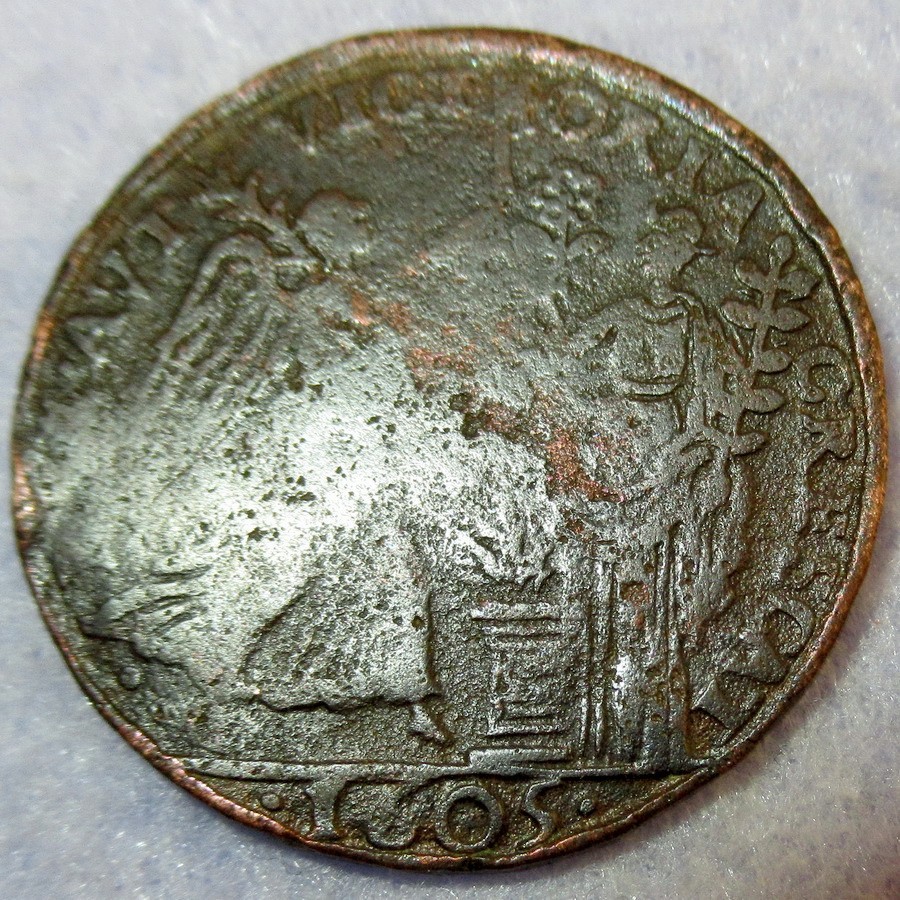
1605 Spain Archduke Albert and Infanta Isabella Spanish Netherlands Copper Penny, wish for peace
Infanta of Spain and Portugal Isabella
1605 Spanish Netherlands Copper Penny, wish for peace
Albrecht & Isabella (Albert & Isabelle)
This coin is accompanied by a Certificate of Authenticity!
Size: 26.4 mm Weight: 4.5 grams Material: Copper
Spanish Netherlands Copper Jeton Penny, 1605
Counter of the Southern Netherlands, struck in Antwerp, wish for peace.
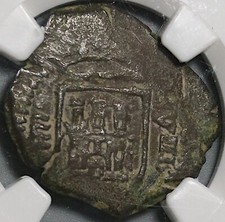
Obv. crowned arms of the Spanish Habsburgs in the chain of the order of the golden fleece.
* CALCuli. RATIionum. (fleece) . FINANCIARVM
- counter of the chamber of accounts of finance, hand (mintmark of Antwerp).
Rev: Victoria (attribute: palm branch) standing right, offering a key (the key to close the temple of Janus, which symbolises peace) to Pax (attribute: olive branch), walking left. Centre background: a burning fire altar. In the exergue 1605.
PAX. AVT VICTORI A CRESCAT - May (either) peace or Victory increase.
In 1605, both the Habsburgs and the Republic were war-weary, but neither trusted the other enough for serious peace negotiations. The counter refers to a land campaign underSpinola, who had already taken Lochem, Groenlo and Rijnberk and was marching towards Oldenzaal, which he would take in 1605. He was stopped only in 1606 at the battle of Berkumerbrug.
Meanwhile, the fleet of the Republic dealt a punishing blow to the Spanish fleet in thebattle of Gibraltar. These events indeed convinced both parties that neither could win. Negotiations ended up in 1609 in atruceonly, which held for 12 years. Peace had to wait until 1648.
Archduke Albert of Austria and Infanta Isabella Clara Eugenia of Spain rule the Habsburg Netherlands as sovereigns from 1598 to 1621. The Habsburg Netherlands was a geo-political entity covering the whole of the Low Countries from 1482 to 1556/1581 and solely the Southern Netherlands from 1581 to 1794. After 1581, it was also known as the Spanish Netherlands or the Austrian Netherlands.
It was held by the Duke of Burgundy (1506-1555), the King of Spain (1555-1706) and the Archduke of Austria (1716-1794), all from the house of Habsburg. It was ruled on their behalf by a governor.
It briefly revolted against the Habsburgs from January to December 1790 to join the United States of Belgium, at the end of which it reverted back to the Habsburg Netherlands. It finally ceased to exist in 1794 when it was annexed by the First French Republic.
Commemorative Penny/ Jeton Penny / Rekenpenning
During the Dutch Revolt (1568 - 1609) this pattern changed and by both parties, the North in front, about 2,000 different, mostly political, jetons (Dutch: Rekenpenning) were minted depicting the victories, ideals and aims. Specifically in the last quarter of the 16th century, where \"Geuzen\" or \"beggars\" made important military contributions to the Dutch side and bookkeeping was already done without counters, the production in the North was just for propaganda.
The mints and treasuries of the big estates in Central Europe used their own jetons and then had a number of them struck in gold and silver as New Year gifts for their employees who in turn commissioned jetons with their own mottoes and coats-of-arms. In the sixteenth century, the Czech Royal Treasury bought between two and three thousand pieces at the beginning of each year.
Use as Money
It is clear that an important part of a nicety by the frost given early count pennies as currency in circulation was brought, and the subsequent annual excess computational tokens of the clerks - and perhaps even the \"bosses\" - or in the case of silver specimens processing by silversmiths or the mint\'s products. Which this is demonstrated by the large numbers of heavily worn and therefore not collectable count pennies left in the soil found or that have been preserved, after at least after our currency reform in the mid-19th century no longer pay could be used. Using an abacus, or put on the cloth would not use a few years of wear.
As an example below, a heavily worn token of 1620 from the Southern Netherlands. This token was about as heavy and as big then as a \"groot\", a copper coin from two doits. Also the picture of Albert and Isabella became a sort of authorization to use money as suggested.
The jetons described in this chapter just give a small impression of more than a thousand different Dutch jetons. After 1600 increasingly less Dutch jetons were struck. The change from the counters to pen-reckoning was not the only reason, for France and the Spanish Southern Netherlands just went on striking jetons for collectors. In Holland the interest in buying and making presents of jetons disappeared because a new kind of medal appeared on the market, the big silver history-medal. The Dutch name for jeton, legpenning (laid-penny) remained to indicate a small history-medal.
The jetons of the Netherlands were, just like in France, struck in the official mints by government order. The moneyer had to stick to the design appointed by the government. However, there were no objections against using old dies again in order to meet the needs of collectors.
THE DUTCH REVOLT
The first part of the Dutch Revolt provides a splendid example of the political use of jetons. From 1572 till 1609 many jetons were used as a part of the psychological warfare, comparable with the issue of pamphlets and prints. The war started in 1568 with a revolt against the Spanish king Philip II who was also lord of the Low Countries. The causes were both religious and economic.
The undermentioned review of the history of the Dutch Revolt is far from complete and meant just as context for the Dutch jetons of this period.
Charles V, great-great-grandson of duke Philip the Good, inherited vast territories - the Burgundian state and the Netherlands, Spain with the Italian possessions and the New World, and Austria - and was elected Emperor of the Holy Roman Empire of the German Nation. In his vast power, the Netherlands were but an item. They had to be subservient to the great aims of the Emperor. Their national interests were sacrificed to those of Spain and the Empire.
When Philip II succeeded his father Charles V, in 1555, the consequences of this policy were already apparent. The Netherlands, as the Low Countries were called now, asked for home rule. The general discontent was dangerously complicated by the religious unrest and the economic crisis. Philip tried to resolve the problems by sending the Duke of Alva to the Netherlands in 1567. The Protestants were prosecuted and often executed. In 1568 the leaders of the rebellion had to flee or were arrested. Prince William of Orange was able to escape to Germany, but the two other leaders, the counts Egmont and Hornes were executed by Alva in Brussels.
In 1572, the revolt began again in Holland and Zeeland after the conquest of Den Briel. In addition to the prestige of the Prince of Orange and the loathing of the Spanish soldiers who regarded all Dutchmen, whether Roman Catholic or Protestant, as heretical scum, the success of the rebellion must be attributed to the actions of the anti-Catholic \"watergeuzen\" (sea-beggars) and to the return of the Protestant exiles, who formed the hard core of resistance against the tyranny of the Duke of Alva.
This had consequences for the Dutch Catholics. In 1573 the Estates of Holland prohibited the public worship of Roman Catholicism but there was still freedom of conscience. The Dutch regents had objections to both the rigid contra-reformatory Catholicism according to the model of Trent and the strict Calvinism of Geneva.
The articles of the Union of Utrecht of 1579 gave body to the new Dutch state. In 1786, James Madison and his friends used these articles as a model for the \"Articles of Confederation.\" As William Grayson, the Virginian anti-Federalist wrote to Madison in that Year: \"It is no wonder our Government should not work well, being formed on the Dutch model where circumstances are also materially different.\"
In 1581, Philip II was declared no longer to be sovereign. After the murder of William of Orange in 1584, his son Maurice took charge of the field army and captured many important cities with large-scale artillery support and extensive blockades. The death of Philip II in 1598 made no difference in the struggle. The formal end came with the peace of Munster in 1648.
*** AUTHENTICITY GUARANTEED FOR LIFE ***
Shipping policy:
Economy Regular mail shipping: 3.99 Euro worldwide (buyer\'s risk for lost by post!)
If the total value is above 50 Euro, Registered mail is required for safety reasons.
Registered mail shipping:
11.99 Euro within Europe, 14.99 Euro worldwide, Combined shipping accepted.