When you click on links to various merchants on this site and make a purchase, this can result in this site earning a commission. Affiliate programs and affiliations include, but are not limited to, the eBay Partner Network.
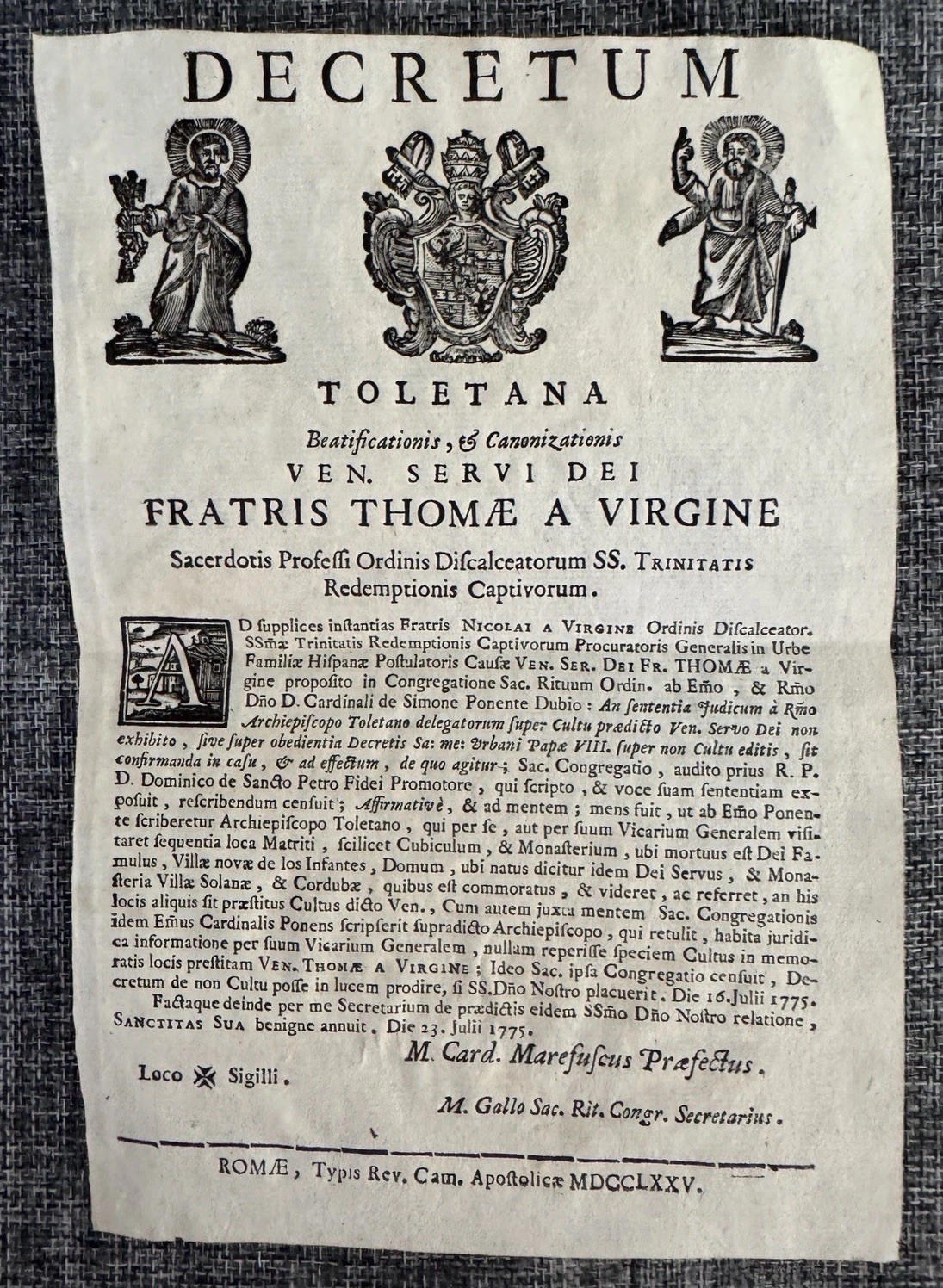
This is an authentic 18th-century papal decree issued by the Sacred Congregation of Rites (Sacrorum Rituum Congregatio) in Rome, dated July 23, 1775. Printed on classic laid paper with visible chain lines and type impression, it measures approximately 9.5 inches by 7.25 inches.
Bibliographical & Historical Analysis
Subject Matter: The document concerns the beatification and canonization process (Beatificationis, & Canonizationis) of the Venerable Servant of God, Fr. Thomæ a Virgine (Thomas of the Virgin), a professed priest of the Discalced Trinitarians (Ordinus Discalceatorum SS. Trinitatis Redemptionis Captivorum). The decree addresses a legal/theological query regarding whether a formal cult or public veneration existed for him, specifically within the Archdiocese of Toledo (Toletana), Spain.
Signatories & Authority: * Mario Cardinal Marefoschi (M. Card. Marefuscus Præfectus), a prominent Vatican prelate who served as the Prefect of the Sacred Congregation of Rites.
Monseigneur Gallo (M. Gallo Sac. Rit. Congr. Secretarius), serving as Secretary.
Imprint: Published in Rome by the Vatican's official printing house: ROMÆ, Typis Rev. Cam. Apostolicæ MDCCLXXV (Rome, Printing House of the Reverend Apostolic Chamber, 1775).
Iconography: The head of the sheet features three excellent woodcuts/copperplate engravings: St. John of Matha or St. Felix of Valois (founders of the Trinitarians) holding chains/shackles representing the redemption of Christian captives, the coat of arms of Pope Pius VI (who ascended the papal throne earlier in 1775), and St. Peter holding the keys and sword. A fine historiated initial "A" begins the main body text.
Condition Report
The document is in very good antiquarian condition. It remains as a full, untrimmed sheet with natural deckled edges. The rag paper shows characteristic light, age-appropriate toning and horizontal/vertical folding lines from historical storage or dispatch. The ink remains deeply struck with strong, clean contrast, and there is no evidence of destructive foxing, worming, or brittle edge los