When you click on links to various merchants on this site and make a purchase, this can result in this site earning a commission. Affiliate programs and affiliations include, but are not limited to, the eBay Partner Network.
The Iliad of Homer, translated by Alexander Pope. Complete in two volumes. London, 1820.
An attractive early nineteenth-century edition of Homer\'s Iliad in Alexander Pope\'s celebrated English translation, preserved as the complete two-volume set in handsome period leather bindings.
Printed in London by W. Wilson, 4 Greville Street, for J. Bumpus, Holborn Bars; Sharpe, King-Street, Covent-Garden; Samms, Pall Mall; Warren, New Bond-Street; and Reilly, Lord-Street, Liverpool, in 1820, exactly as stated on the title pages.
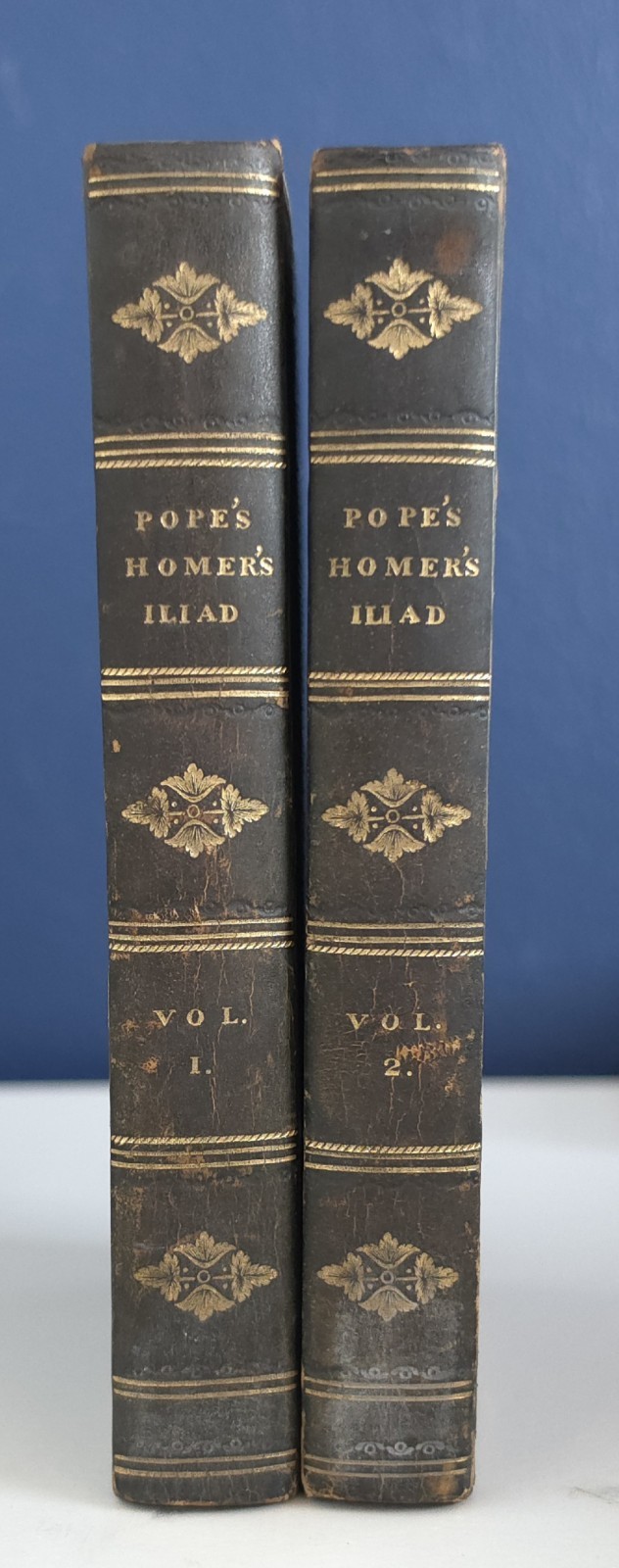
Both volumes are bound in dark full leather with gilt rules and decorative gilt tooling to the spines. The spine compartments are lettered “POPE\'S HOMERS ILIAD” with individual volume numbers beneath.
The work includes engraved material, including an attractive additional engraved title incorporating a classical scene, signed Westall del. and Freeman sculp.
Alexander Pope\'s translation of Homer was one of the most influential English versions of the Iliad. Produced originally during the early eighteenth century, Pope rendered Homer\'s epic into heroic couplets, and his translation remained enormously influential throughout the eighteenth and nineteenth centuries.
A particularly attractive example for the collector because the two matching volumes have survived together in their period bindings.
Bibliographical details:
Homer.
The Iliad of Homer.
Translated by Alexander Pope, Esq.
In Two Volumes.
London: Printed by W. Wilson, 4 Greville-Street, for J. Bumpus and others.
1820.
Binding: Full leather, gilt decorated.
Volumes: Two – complete.
Language: English.
Illustrations: Engraved material, including designs after Richard Westall.
Publication place: London.
Date: 1820.
Condition: Complete two-volume set in contemporary full leather bindings with gilt-decorated spines and gilt borders. General rubbing, scuffing, marks and wear consistent with age, including wear to corners and spine extremities and some cracking/creasing to the leather. Internally generally well preserved for a book more than 200 years old, with age toning and scattered foxing, heavier in places and particularly evident to some endpapers and engraved leaves. Please study the photographs carefully for the exact condition.