When you click on links to various merchants on this site and make a purchase, this can result in this site earning a commission. Affiliate programs and affiliations include, but are not limited to, the eBay Partner Network.
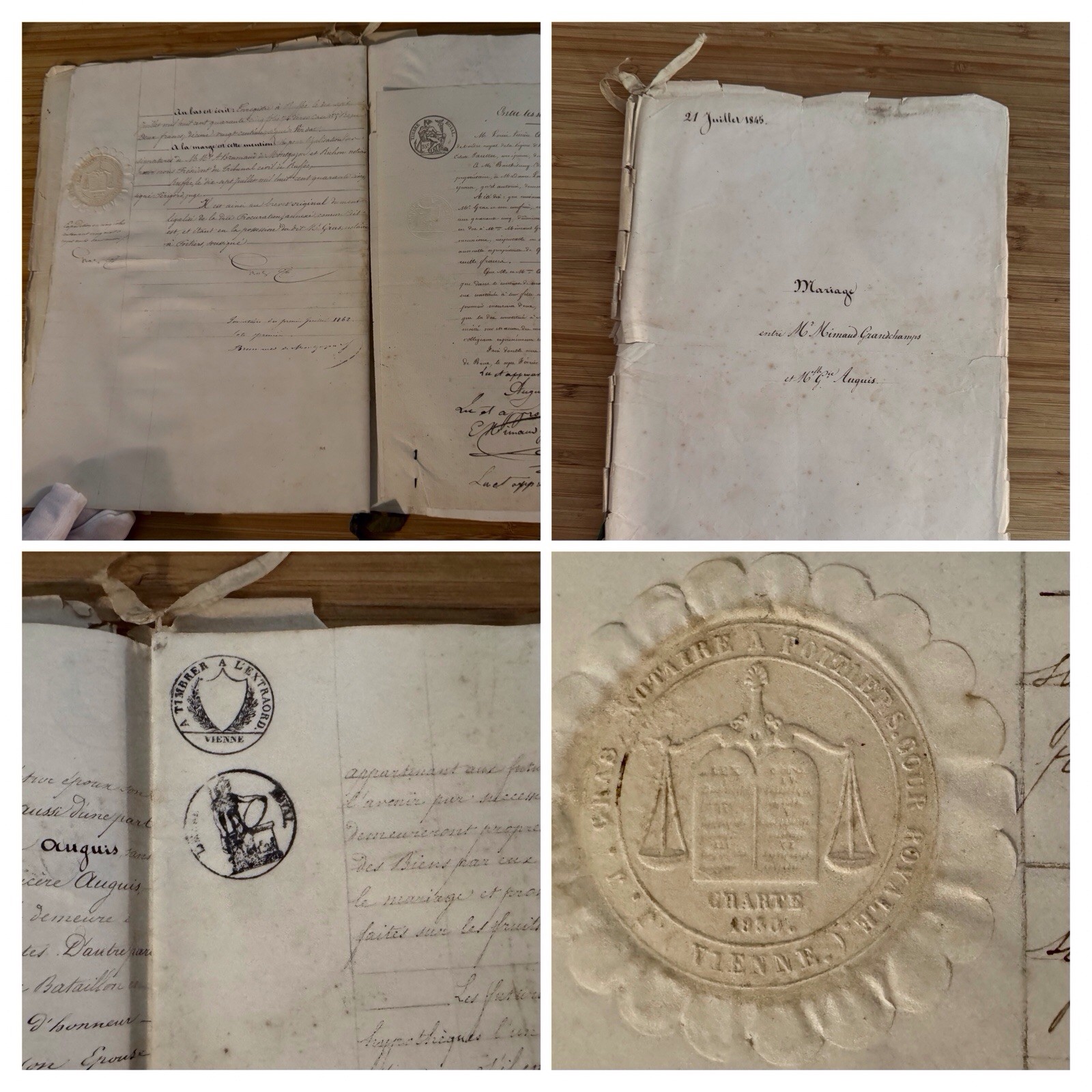
1845 French Marriage Contract Manuscript – Poitiers, France – Legion of Honor, Royal Stamps & Embossed Seals
An exceptionally attractive original French marriage contract, dated July 21, 1845, originating from Poitiers in the Vienne department of France, during the reign of King Louis-Philippe and the July Monarchy (1830–1848).
An extensive 16-page French manuscript marriage contract, handwritten on eight leaves of period laid paper, with original legal provisions and decorative fiscal impressions
This substantial, multi-page handwritten legal manuscript records the marriage arrangements between Barthélemy Édouard Mimaud Grandchamps and Françoise Auguis, documenting the financial, legal, and familial obligations associated with their marriage.
Beautifully executed in flowing nineteenth-century French cursive, the manuscript features graceful penmanship, carefully arranged paragraphs, decorative headings, and elegant handwritten flourishes. The individual contractual provisions are organized into numbered articles, giving the document an especially attractive and formal presentation.
Of particular historical interest is the connection to the French military and the prestigious Legion of Honor. The manuscript identifies a member of the bride’s family as a retired French military officer, formerly a chef de bataillon (battalion commander), and a member of the Legion of Honor, France’s distinguished national order of merit established by Napoleon Bonaparte in 1802.
The contract addresses numerous aspects of nineteenth-century French marriage law, including matrimonial property, inheritance rights, financial provisions, and the respective obligations of the bride and groom. It provides a fascinating glimpse into French family relationships, property ownership, and legal customs during the mid-nineteenth century.
Notable Features
* Original French manuscript dated July 21, 1845.
* Originating from Poitiers, Vienne, France.
* Substantial multi-page marriage contract written entirely in French.
* Beautiful nineteenth-century handwritten calligraphy with decorative flourishes.
* Historical association with a French military officer and member of the Legion of Honor.
* Multiple original official revenue and registration stamps, including an attractive royal stamp.
* Impressive embossed judicial seal featuring the scales of justice.
* Original handwritten signatures, including a particularly elaborate signature with sweeping ornamental flourishes.
* Numbered contractual articles detailing matrimonial property, inheritance, and financial arrangements.
* Original ribbon-bound construction, retaining its historic green ribbon.
Condition
Original nineteenth-century condition, displaying age-related toning, scattered foxing, light staining, fold lines, edge wear, and small tears and irregularities along portions of the paper edges. The manuscript retains its original ribbon-bound arrangement, although the binding and outer edges show wear consistent with age.
Some passages exhibit considerable fading of the original brown ink, while other sections remain beautifully legible, with darker lettering, prominent signatures, and striking decorative details. The official stamps and embossed seal remain attractive features.
Historical and Collectible Interest
This manuscript represents an appealing example of French legal and social history from the July Monarchy, combining the artistry of nineteenth-century penmanship with the formal traditions of French marriage contracts.
Its military association, original official stamps, embossed judicial seal, decorative signatures, and surviving ribbon binding make it especially interesting to collectors of French historical documents, Napoleonic-era military heritage, European legal manuscripts, genealogy, and nineteenth-century calligraphy.
A distinctive historical document, offering both visual beauty and a tangible connection to French family life, military distinction, and legal traditions in 1845.