When you click on links to various merchants on this site and make a purchase, this can result in this site earning a commission. Affiliate programs and affiliations include, but are not limited to, the eBay Partner Network.
DISCLAIMER
This description has been created to the best of our ability, and mayoccasionally contain errors. You are purchasing the exact item shown in thephotos. Please review all pictures carefully, as they serve as the primarydescription of the item's current condition, features, and details.
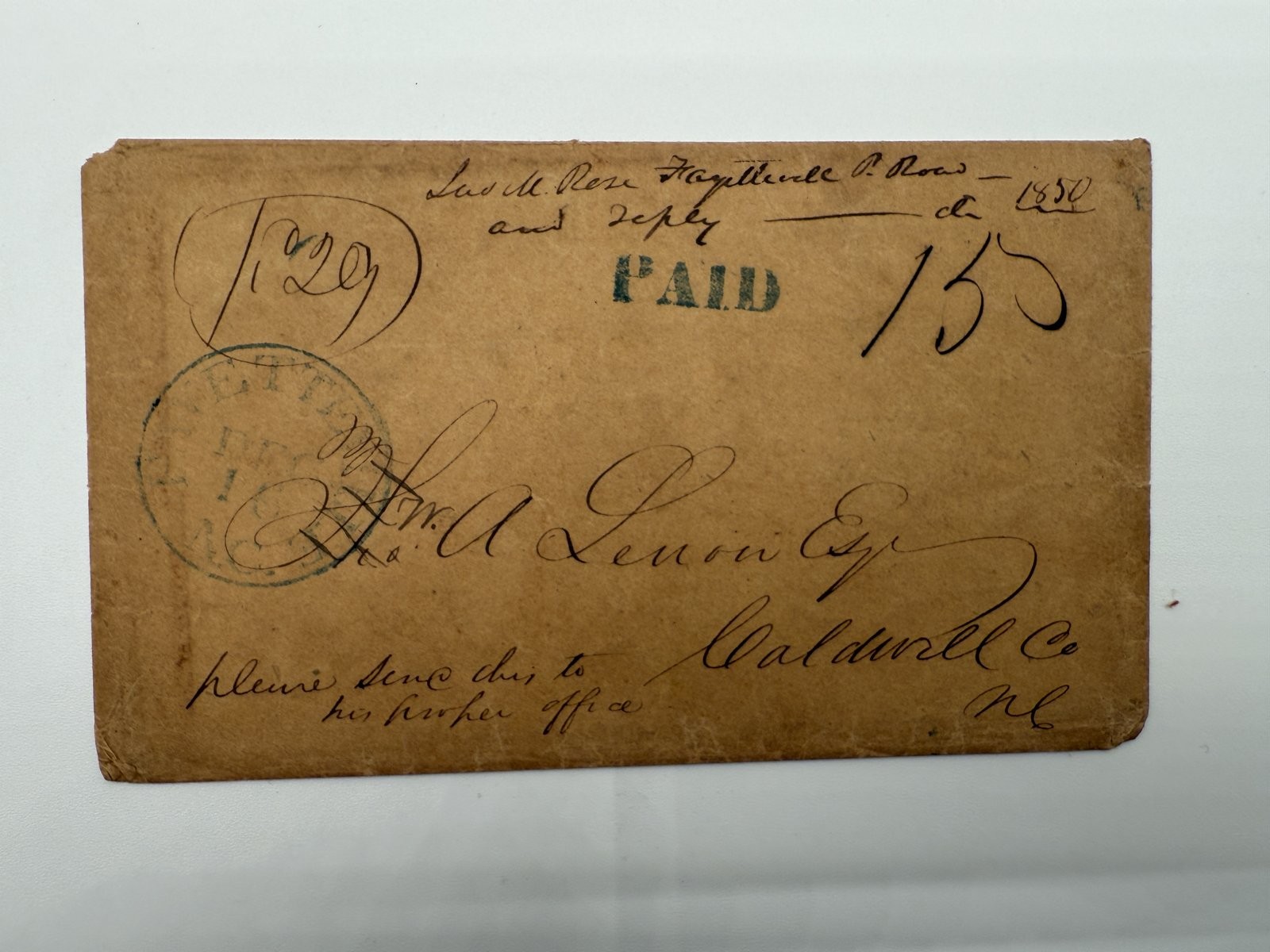
A December 1850 stampless cover struck in deep blue at Fayetteville, North Carolina, addressed to W. A. Lenoir, Esq. of Caldwell County — a member of the Lenoir family of Fort Defiance, whose correspondence is one of the best documented groups in nineteenth-century North Carolina postal history. The sender, not knowing which back-country office actually served him, asked the postal clerks in writing to "please send this to his proper office."
1. Postal Markings & Operational Analysis
The Format: A folded-flap envelope of heavy buff-tan rag paper, measuring approximately 5 1/4 x 3 1/8 inches against the ruler, with a plain triangular back flap, opened and now without contents. There is no adhesive stamp: this is a true stampless cover from the last years before prepayment by stamp became compulsory.
The Origin Postmark: A blue circular datestamp reading FAYETTEVILLE / N.C. is struck at the left, with a December date in the center. The strike is complete in outline but partly light and is crossed by the heavy flourish of the address, so the day of the month does not read with full certainty; the docketing along the top edge supplies the year, 1850. Fayetteville in 1850 was the head of navigation on the Cape Fear River and the commercial gateway to the western Piedmont. The Fayetteville and Western Plank Road, described as the longest plank road in the state and running 129 miles from Fayetteville to Bethania near Salem, was being driven west from the town in exactly these years and was completed in October 1854. Mail for the mountain counties moved out of Fayetteville along this same western corridor by stage and horse.
Payment Status & Postal Rates: A bold straight-line "PAID" handstamp in matching blue appears at the top center, showing that the writer prepaid the postage in cash at the counter rather than sending the letter collect. Under the Act of March 3, 1845 (effective July 1, 1845), a single-weight letter travelling under 300 miles cost 5 cents, and one going farther cost 10 cents. Fayetteville to the Caldwell County seat is roughly 160 miles in a straight line and about 200 by road, placing this letter squarely in the 5-cent bracket. No separate numeral rate marking was applied — a common shortcut on a plain single-rate letter, where the PAID handstamp alone recorded the clerk's work.
Manuscript Notations: At the upper left is a circled manuscript number, read as "129," and at the upper right a large bold manuscript figure read as "15." Both are in the same black ink as the docketing and appear to be the recipient's or a clerk's filing notations rather than postal rate marks. Across the top in a fine hand is the recipient's docket naming the correspondent and the year 1850, with a second line recording the reply.
The Destination Address & Forwarding Instruction: The cover is addressed in a large, confident clerical hand:
W. A. Lenoir Esqr.
Caldwell Co.
N.C.
Because no post office is named — only the county — the sender added a polite appeal at the lower left: "please send this to his proper office." A written forwarding request of this kind is a genuine operational artifact, showing the mails leaning on a postmaster's local knowledge to finish the delivery.
2. Historical Significance
The Recipient: "W. A. Lenoir" of Caldwell County is William Avery Lenoir (1808–1862) of Fort Defiance. The University of North Carolina's Lenoir Family Papers identify him as a son of Thomas Lenoir and Selina Louisa Avery Lenoir of Fort Defiance, and one of four brothers — with Rufus, Thomas Isaac (1817–1882) and Walter Waightstill Lenoir — whose surviving letters form the core of that family archive. His grandfather was General William Lenoir (1751–1839), the Revolutionary officer who fought at Kings Mountain and later served as Speaker of the North Carolina Senate, and who died at Fort Defiance in Caldwell County; the town of Lenoir, the county seat, carries his name. Through his mother the family connected to Waightstill Avery, lawyer, legislator and a signer of the Mecklenburg Declaration.
Why Collectors Care: The Lenoir correspondence is well known in the specialist literature — the North Carolina Postal History Society devoted a feature article, "Fort Defiance, NC, and the Lenoir Family: Postal Operations and Correspondence," to this family and the offices that served it. A Lenoir-addressed stampless cover with a clean blue Fayetteville town mark and PAID strike therefore slots directly into a recognized and actively collected North Carolina postal history group rather than being an anonymous survivor.
The Sender: The docket names the correspondent as what reads as "Jas. M. Rose" of Fayetteville. Rose was an established Fayetteville surname in this period, but research did not confirm a specific documented individual behind this letter, and the docket hand is heavily abbreviated; the name should be taken as a reading of the manuscript rather than a proven identification.
3. Transcription
No contents are present; the following transcribes the writing on the cover itself, with uncertain readings in brackets.
Docket, upper edge:
Jas. M. Rose [Fayetteville] [P. Row] ——— 1850
and reply ——————— do.Address panel:
W. A. Lenoir Esqr.
Caldwell Co.
N.C.Lower left, to the postal clerk:
please send this to
his proper officeHandstamps: FAYETTEVILLE / DEC / N.C. circular datestamp in blue; PAID in blue.
Condition: Toned tan paper with light overall age soiling, a small nick and short split at the upper right corner, minor wear at the lower corners, and light creasing visible on the reverse. The handstamps and all manuscript remain legible as described. Sold exactly as shown in the photographs.
ABOUT ELECTRO ANTIQUES
At Electro Antiques, we are dedicated to rescuing, rediscovering, andrestoring this history of electronics and computing, reviving andpreserving it for future generations.
We also specialize in signs, advertising, and some ephemera.
All of our items are genuine, vintage or antique items, unless they areotherwise noted as a reproduction.
We want you to be absolutely happy with your purchase.
PAYMENT
Payment must be made within three (3) calendar days of sale close.
Non-paying buyer Cases are automatically opened after 7 days ofnon-payment.
SHIPPING
We ship via USPS on most items.
We only ship to confirmed U.S. addresses, or international through's international shipment program.
Please message us through the platform if any of your purchasesarrive damaged, or you have any questions about our items we havelisted.
CUSTOMER SERVICE
Please message us through 's message system.