When you click on links to various merchants on this site and make a purchase, this can result in this site earning a commission. Affiliate programs and affiliations include, but are not limited to, the eBay Partner Network.
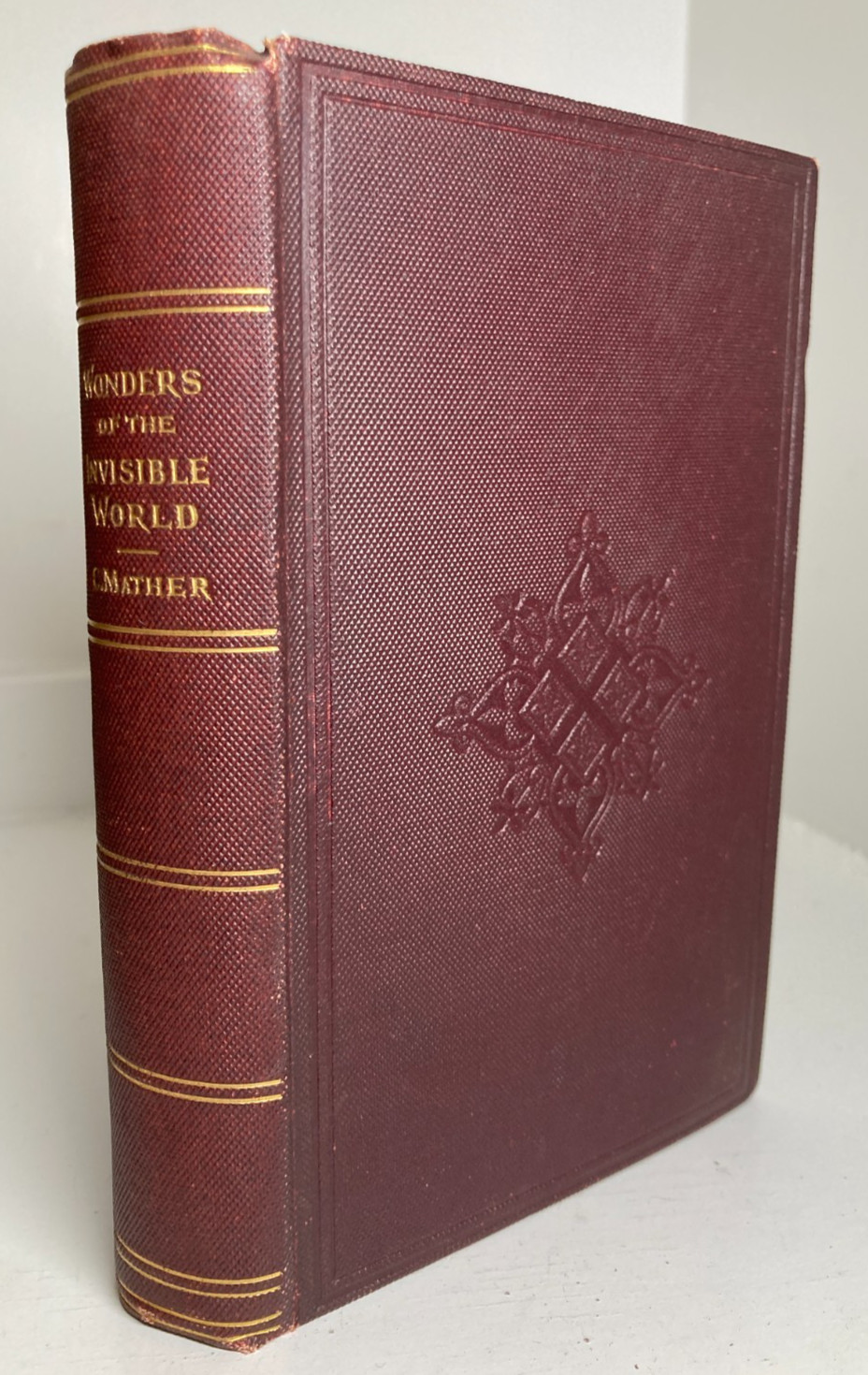
COTTON & INCREASE MATHERTHE WONDERS OF THE INVISIBLE WORLDSalem Witch TrialsLondon, 1862First Edition ThusOriginal Publisher’s Decorated ClothCotton Mather PortraitContemporary Accounts of the Salem ProceedingsCarroll Alton Means Provenance
MATHER, Cotton; MATHER, Increase. The Wonders of the Invisible World. Being an Account of the Tryals of Several Witches Lately Executed in New-England. To Which Is Added A Farther Account of the Tryals of the New-England Witches.
London: John Russell Smith, Soho Square, 1862.
First edition of this important nineteenth-century collected reprinting. Octavo. xvi, 291 pages. Portrait frontispiece of Cotton Mather. Publisher’s original burgundy cloth with blind-stamped borders and central ornaments, gilt-lettered spine, pale yellow endpapers, and untrimmed edges. Issued in John Russell Smith’s Library of Old Authors series.
An unusually attractive copy of one of the most important nineteenth-century editions of the primary contemporary writings on the Salem witch trials of 1692–93.
A MAJOR EARLY SOURCE FOR THE SALEM WITCH TRIALS
Cotton Mather’s Wonders of the Invisible World was originally published in 1693 in the immediate aftermath of the Salem prosecutions and remains one of the principal contemporary printed sources for the events.
Mather recounts alleged supernatural manifestations, accusations, testimony, examinations, and trials, including those of:
George Burroughs
Bridget Bishop
Susanna Martin
Elizabeth How
Martha Carrier
The work provides extraordinary direct evidence of the theological assumptions and evidentiary arguments through which witchcraft was understood and prosecuted in late-seventeenth-century New England.
This 1862 edition was the first substantial nineteenth-century English reprinting of these scarce seventeenth-century texts and is explicitly described in the volume’s introduction as bringing together works that were already considered very rare.
MULTIPLE SALEM TEXTS IN ONE VOLUME
The importance of the volume extends well beyond Cotton Mather’s title work.
It includes:
Cotton Mather — The Wonders of the Invisible World
A Farther Account of the Tryals of the New-England Witches
Deodat Lawson — contemporary narrative of the disturbances at Salem Village
Increase Mather — Cases of Conscience Concerning Evil Spirits Personating Men, Witchcrafts, Infallible Proofs of Guilt in Such as Are Accused with That Crime
The 1862 edition’s contents confirm the inclusion of Lawson’s narrative beginning at page 201 and Increase Mather’s Cases of Conscience beginning at page 219.
The inclusion of Increase Mather is especially significant. His Cases of Conscience addresses the problem of unreliable evidence and the danger that an innocent person might be represented or impersonated by an evil spirit. Read alongside Cotton Mather’s account, the texts preserve differing contemporary responses to the evidentiary crisis produced by the Salem prosecutions.
FIRST EDITION THUS — JOHN RUSSELL SMITH, 1862
The edition was published in London by John Russell Smith in 1862 as part of his Library of Old Authors. Bibliographic records confirm the xvi, 291-page format and publication by John Russell Smith.
The volume reproduces early title pages and incorporates decorative headpieces and initials, intentionally presenting the seventeenth-century material in an antiquarian format.
ORIGINAL PUBLISHER’S BINDING
Especially desirable in its original Victorian binding:
Original burgundy / plum publisher’s cloth
Blind-stamped multiple-rule borders
Central interlaced ornamental device to both boards
Gilt-lettered spine
Paired gilt spine rules
Original pale-yellow coated endpapers
Untrimmed edges
The binding remains notably attractive, with deep cloth color and strong gilt. Many surviving copies of nineteenth-century antiquarian works of this type have been rebound; preservation of the original decorated cloth materially enhances the appeal of this example.
PROVENANCE — CARROLL ALTON MEANS
The front pastedown bears the pictorial Ex Libris Carroll Alton Means bookplate, depicting printers operating an early hand press.
A handsome piece of bibliophilic provenance particularly appropriate to a volume devoted to the recovery and reprinting of early texts.
Additional neat bookseller’s pencil notations and an old price notation appear on the front free endpaper.
CONDITION
Very Good+
A particularly attractive copy in the original publisher’s binding.
Binding square and firm. Cloth remains richly colored, with only minor rubbing and shelf wear at the extremities. Slight softening and very small losses at the head of the spine, with light wear at the corners and spine foot.
Spine gilt remains clear and bright.
Inner hinges firm. Tiny area of surface-paper loss beside the front endpaper fold.
Contents generally clean and fresh, with normal light age toning, occasional minor spotting, and some offsetting around the portrait frontispiece and title page.
No significant tears, underlining, or modern ink annotations observed.
Complete through page 291, with:
Portrait frontispiece of Cotton Mather
General title page
Facsimile / reproduced seventeenth-century title pages
Complete text
Carroll Alton Means bookplate to front pastedown.
Please examine the photographs carefully, as they form an integral part of the condition description.