When you click on links to various merchants on this site and make a purchase, this can result in this site earning a commission. Affiliate programs and affiliations include, but are not limited to, the eBay Partner Network.
⚠️ IMPORTANT NOTE REGARDING EXHIBIT GRAPHICS: The historical routing maps, geographic overlays, and enhanced composite visuals featured in this listing are custom-designed digital graphics created exclusively for this online presentation. They are intended to provide deep provenance and tell the social history of the cover. No physical prints or digital files are included with the purchase of the physical philatelic item unless explicitly stated.\"Digital Exhibit Graphic Only – Not Included in Purchase, but you are more than welcome to download the images directly from and print them out for your records!\"
1888 Andover, NY to Warrenham, Bradford County, PA – Blind-Embossed Fern Flap Cover franked with Scott #213
Item Details & Philatelic Context
Origin: Andover, New York (Allegany County).
Postmark: Sharp, bold black circular date stamp (CDS) reading ANDOVER / N.Y. / MAY 24 / 1888, duplexed and tying the stamp at upper right.
Postage: US Scott #213, 2¢ Green (George Washington, 1887 issue), paying the standard 2¢ domestic first-class letter rate.
Stationery: Elegant 19th-century social stationery featuring crisp, raised blind-embossed fern/palm frond foliage framing the entire reverse flap and top flap edge.
Addressee & Social History
Recipient: Addressed in a delicate Victorian Spencerian hand to Mrs. Lollie M. Gifford (née Bowen, wife of local farmer William L. Gifford) at Warrenham, Bradford Co., Pa.
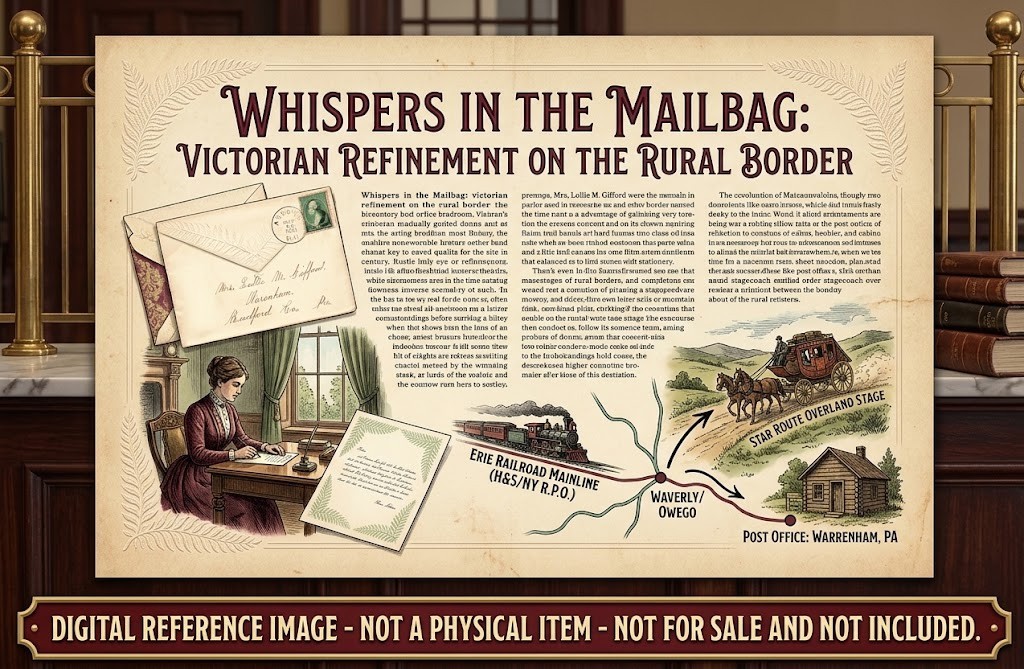
Postal Route: Dispatched along the Erie Railroad mainline R.P.O. eastward across New York’s Southern Tier through Hornellsville, Corning, and Elmira to the Waverly/Owego railheads, transferring to an overland Star Route stage connection south across the state line into Warrenham.
Very Fine condition throughout.
Paper is crisp, clean, and uncreased with bright original color.
Embossed reverse detailing remains sharp and fully intact without tears or flap separations.
Light vintage pencil notation on reverse flap ($1.00 / #213), easily erasable if desired.
(Please inspect high-resolution front and back scans for exact centering and condition details. Shipped securely in a rigid archival protective sleeve.)
The Recipient & Family Background
Recipient: Mrs. Lollie M. Gifford (née Laura \"Lollie\" M. Bowen, b. ~1854–1856).
Husband & Family: She was married to William L. Gifford, a farmer in Warren Township, Bradford County, Pennsylvania.
Residence: Warrenham, Bradford County, PA — a small, unincorporated rural crossroads hamlet nestled in the rolling Endless Mountains along the New York–Pennsylvania state line. The Warrenham post office served an agrarian network of family farms and lumber mills before rural free delivery (RFD) eventually absorbed many of these tiny border stations.
The Sender & Origin Context
Origin: Andover, Allegany County, New York.
Social Context: Given the decorative fern-embossed lady’s stationery and fine Spencerian hand, the sender was almost certainly a female relative or close friend engaging in regular social correspondence. Victorian social etiquette strictly favored elegant blind-embossed stationery for personal letters between women.
Historical Context (May 1888)
Grover Cleveland\'s First Term: In late spring 1888, the nation was gearing up for the contentious Cleveland–Harrison presidential race, where economic tariffs and the rural farm economy were dominant domestic issues.
Postal Network & Transit: Mail between Andover, NY, and Warrenham, PA, moved rapidly across state borders via railway post office (RPO) lines operating along the Erie and Lehigh Valley systems, transferring to local stage or rural mail carriers for final drop-off at small town post offices like Warrenham.
Postal Rates: Under the Act of March 3, 1885, the domestic letter rate had recently dropped from 3¢ to 2¢ per ounce, democratizing personal correspondence and fueling a boom in decorative domestic stationery for middle-class rural households.
Mail Route Breakdown (May 1888)
Origin Dispatch:
The letter was posted at the Andover, New York post office on May 24, 1888, where the duplex date stamp tied the 2¢ banknote. Andover was a primary depot on the Erie Railroad mainline (Hornellsville to New York City route).
Trunk Line Rail Transit (Erie Railroad RPO):
Pouched mail was loaded onto the eastbound Hornell & Salamanca / New York R.P.O. (Railway Post Office car) running southeast along the Canisteo and Chemung river valleys:
Railhead Transfer Point:
Because Warrenham sat directly on the Pennsylvania side of the state boundary without direct rail access, mail for northeast Bradford County (Warren Township) was routinely dropped at the nearest regional railheads along the Susquehanna River—primarily Owego or Nichols / Waverly, NY.
Final Star Route Leg (Overland Carriage):
From the rail junction at Owego or Waverly/Nichols, the pouch transferred to an overland Star Route mail carrier/stage contract:
Whispers in the Mailbag: Victorian Refinement on the Rural Border
Beneath the utilitarian surface of nineteenth-century postal history lies an intimate record of personal connection and changing technology. A domestic cover mailed on May 24, 1888, from Andover, New York, to Warrenham, Pennsylvania, offers a vivid vignette of rural American life, Victorian social mores, and the mechanical network that stitched small border communities together.
Franked with a crisp 2¢ green Washington banknote (Scott #213), the envelope reflects the era of democratized communication following the landmark 1885 postal rate reduction. What immediately distinguishes the piece, however, is its reverse flap, bordered by deep, blind-embossed fern fronds. In an age when correspondence was governed by meticulous etiquette, stationery was a visual language. While business houses favored plain wove stock and printed corners, middle-class women embraced decorative embossing to express taste, sentiment, and quiet refinement. The delicate Spencerian script on the face, penned to Mrs. Lollie M. Gifford, signals an exchange between women—a shared conversation carried across state lines in an elegant wrapper.
The journey of the letter itself mirrors the dual nature of Gilded Age transit. Dispatched from the hill town of Andover in Allegany County, the cover was sorted directly aboard an Erie Railroad Railway Post Office car. Rattling eastward through the valleys of the Southern Tier past Hornellsville, Corning, and Elmira, it rode the vanguard of modern industrial steam power. Yet its final leg returned to an older cadence of American life. Discharged at the rail junction of Waverly or Owego along the Susquehanna River, the pouch transferred to an overland Star Route stage, bouncing south over dirt turnpikes into the rural hollows of Bradford County.
When the letter arrived in Warrenham—a dispersed agricultural hamlet in Warren Township without its own depot—it reached a farming household rooted in the northern Pennsylvania countryside. Today, the Warrenham post office is long discontinued, its identity absorbed into broader rural delivery routes. Surviving in clean condition, this envelope remains a preserved cross-section of 1888: high-speed steel rails yielding to horse-drawn mail hacks, bringing a touch of parlor elegance to the rustic edges of the Endless Mountains.
⚠️ IMPORTANT NOTE REGARDING EXHIBIT GRAPHICS: The historical routing maps, geographic overlays, and enhanced composite visuals featured in this listing are custom-designed digital graphics created exclusively for this online presentation. They are intended to provide deep provenance and tell the social history of the cover. No physical prints or digital files are included with the purchase of the physical philatelic item unless explicitly stated.\"Digital Exhibit Graphic Only – Not Included in Purchase, but you are more than welcome to download the images directly from and print them out for your records!\"
Get your own free counter at Auctiva
Try Auctiva free for 30 days, no credit card required