When you click on links to various merchants on this site and make a purchase, this can result in this site earning a commission. Affiliate programs and affiliations include, but are not limited to, the eBay Partner Network.
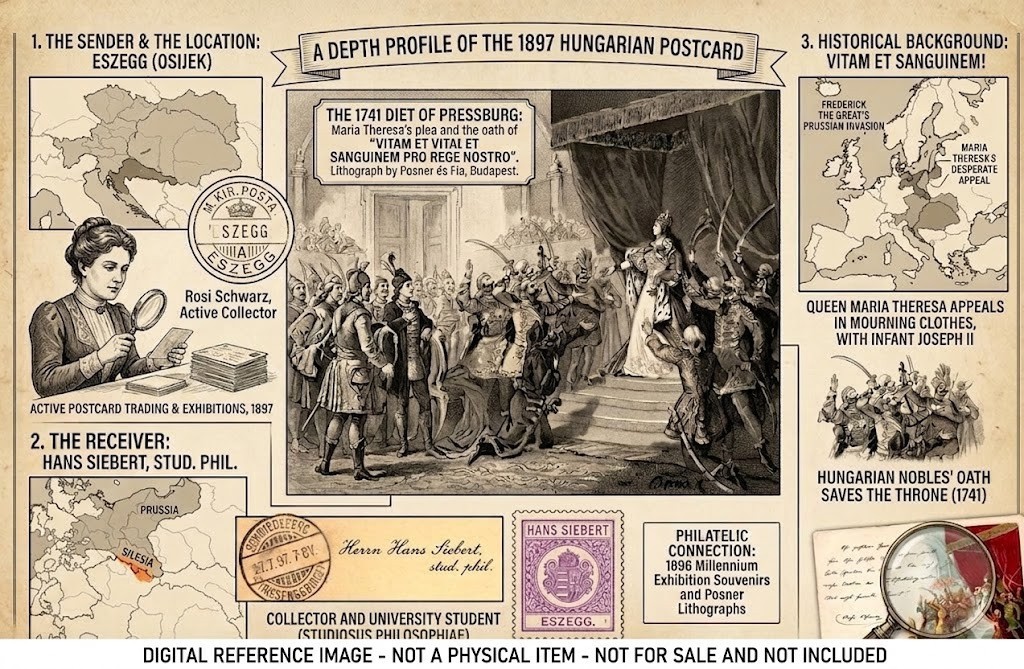
⚠️ IMPORTANT NOTE REGARDING EXHIBIT GRAPHICS: The historical routing maps, geographic overlays, and enhanced composite visuals featured in this listing are custom-designed digital graphics created exclusively for this online presentation. They are intended to provide deep provenance and tell the social history of the cover. No physical prints or digital files are included with the purchase of the physical philatelic item unless explicitly stated.
\"Digital Exhibit Graphic Only – Not Included in Purchase, but you are more than welcome to download the images directly from and print them out for your records!\"
Premium 1897 Austro-Hungarian Pioneer Lithographic Postal CardBilingual Eszegg (Osijek, Croatia) Cancel to Schmiedeberg (Prussian Silesia) – Superb Cross-Border Student Correspondence
Up for sale is an exceptional, investment-grade example of late 19th-century social philately and historical lithography. This official 2-kreuzer orange Royal Hungarian postal stationery card (Levelezo-Lap) features a stunning, crisp multi-color lithograph by the legendary Budapest printing house Posner es Fia. It documents a fascinating line of cross-border postal communication between a female sender at a regional exhibition and a Prussian academic collector.
HISTORICAL ILLUSTRATION BACKGROUND:The face of the card depicts the legendary 1741 Diet of Pressburg (Bratislava), a pivotal moment in the War of the Austrian Succession. Facing an invasion by a coalition led by Prussia, the young Empress Maria Theresa appealed directly to the fractious Hungarian nobility for defense. Clad in mourning garments and cradling her infant son (the future Joseph II), her emotional plea moved the magnates to unsheathe their sabers and thunderously declare: \"Vitam et sanguinem pro rege nostro Maria Theresa!\" (Our lives and blood for our King, Maria Theresa!). This military mobilization successfully turned back the French and Bavarian forces, preserving the Habsburg crown.
POSTAL HISTORY & TRANSIT TIMELINE:
Origin Postmark: Bold, clear bilingual circular date stamp (CDS) reading \"ESZEGG VAROSI GOR. GR.\" (Eszegg/Osijek, capital of the autonomous Kingdom of Croatia-Slavonia under the Hungarian Crown). Dated 97 JUL 25 N 5 A (July 25, 1897, 5:00 PM).
Arrival Postmark: Crisp target circular date stamp from SCHMIEDEBERG (RIESENGEBIRGE) (Prussian Silesia, Germany; today Kowary, Poland). Dated 27.7.97. 7-8V. (July 27, 1897, 7:00–8:00 AM).
Transit Efficiency: An incredible ~38-hour cross-border journey from the Balkans to the Giant Mountains of Prussia.
Collector Attributes: Addressed to Herrn Hans Siebert, designated with the historic academic title \"stud. phil.\" (University Philosophy/Humanities student). The face features his neat personal purple collector/dealer identifier cachet: \"Hans Siebert / Schmiedeberg / Pr. Schles.\"
GERMAN TEXT TRANSCRIPTION & TRANSLATION:Handwritten in a clean, elegant late 19th-century Kurrentschrift script by a female sender:\"Sehr geehrter Herr! Fur Ihre hubsche Karte meinen Dank. Bitte schreiben Sie mir da Sie noch mehr Karten der Ausstellung wollen. Mit recht freundl. Gruss! Rosi Schwarz — Eszegg den 25/7. 1897.\"
Translation: \"Honored Sir! My thanks for your pretty card. Please write to me if you want more cards from the exhibition. With very friendly greetings! Rosi Schwarz — Eszegg, July 25, 1897.\"
CONDITION REPORT:Excellent, near-pristine condition for a pioneer postcard of this vintage. Corners are exceptionally sharp with minimal shelf wear. The lithographic inks remain intensely vibrant with flawless registration. Cancel strikes are dark, legible, and non-destructive to the underlying graphics. A beautiful, problem-free showpiece for any advanced collector of Austrian/Hungarian Empire history, Croatian ephemera, or European postal stationery.
Value Drivers
The Lithograph & Printer : High-quality, multi-color historical lithographs from premier Budapest printers like Posner és Fia command a premium over standard landscape or greeting postcards. The \"Diet of Pressburg\" military theme attracts both thematic history collectors and Hungarian/Austrian regional specialists.
Postal History & Condition : The clean, crisp dual-monarchy cancellations—specifically the bilingual ESZEGG (Osijek, Croatia) origin and the swift 40-hour transit to Prussian Silesia—elevate it above unposted stock. The inclusion of the recipient\'s personal purple collector stamp adds minor social philately appeal.
Base Postal Stationery: The underlying 2-kreuzer orange pre-printed card itself is relatively common for the era, meaning the value resides almost entirely in the illustration, the historical story, and the clear postmarks.
Based on the precise transit timestamps, this card followed a highly optimized North–South transit corridor across Central Europe. To move from the Balkan borderlands to the Prussian mountains in under 40 hours required a connection through three major rail networks: the Hungarian Royal State Railways (MÁV), the Austrian State Railways (kkStB), and the Royal Prussian State Railways (K.P.E.V.).
Here is the exact step-by-step mail route this card traveled between July 25 and July 27, 1897:
Step 1: The Slavonian Feeder Line (July 25, Evening)
Collection: The card was dropped at the main office in Eszegg (Osijek) and received its cancellation strike at 5:00 PM on Sunday, July 25.
Rail Transfer: It was immediately transferred to the Eszegg railway station and loaded onto a regional Bahnpost (railway mail) sorting car.
Route: The mail train traveled north out of Croatia-Slavonia, crossing the Drava River into proper Hungary via Villány and Pécs, running along the MÁV lines to connect with the central Hungarian rail hub.
Step 2: The Budapest Connection & The Moravian Gate (July 25, Night – July 26, Day)
Budapest Hub: By midnight or early morning on July 26, the card reached the sorting tables at one of the massive Budapest terminals (likely Budapest-Nyugati). Mail bound for Germany was immediately sorted into bags destined for the northern border exchanges.
The Northern Route: The card traveled northwest along the primary international line through Pozsony (Pressburg / Bratislava) and crossed from Hungarian administration into Austrian Imperial territory.
In-Transit Sorting: It flew north through Moravia along the Kaiser Ferdinands-Nordbahn (Emperor Ferdinand Northern Railway), passing through the critical junction of Prerau (Přerov) and moving toward the Austro-Prussian border.
Step 3: The Oderberg Exchange & Prussian Entry (July 26, Night)
The Border Hand-off: Late on July 26, the mail arrived at Oderberg (Bohumín), the bustling international frontier station separating the Austrian Empire from the Kingdom of Prussia.
Prussian Bahnpost: Under international treaty, the Austro-Hungarian mail bags were transferred directly onto a waiting Royal Prussian Bahnpost sorting car.
Into Silesia: The Prussian mail train steamed north through the border, passing through Cosel (Kędzierzyn) and running up the Oder River valley to the provincial capital of Breslau (Wrocław), arriving in the dead of night.
Step 4: The Silesian Mountain Railway (July 27, Early Morning)
The Mountain Line: At the Breslau central hub, the card was sorted onto the early morning connection for the Schlesische Gebirgsbahn (Silesian Mountain Railway), which serviced the industrial and resort towns at the foot of the Giant Mountains (Riesengebirge).
The Final Spur: The train ran southwest through Hirschberg (Jelenia Góra), where regional mail was shifted down a short local spur line directly into the valley town of Schmiedeberg.
Arrival: The mail pouch was opened at the Schmiedeberg post office, where the card received its final backstamp between 7:00 AM and 8:00 AM on July 27—a spectacular logistical feat for 1897.
Transnational Ties and Imperial Logistics: An Anatomy of an 1897 Austro-Hungarian Postcard
In the closing years of the nineteenth century, Europe was bound by a paradox: a continent fractured by intense nationalistic rivalries, yet profoundly unified by unprecedented networks of infrastructure, commerce, and hobbyist exchange. This duality is vividly preserved in a single, remarkable artifact from July 1897—a multi-color lithographic postal card (Levelező-Lap) sent from a female correspondent in Eszegg, Croatia-Slavonia, to a university student in Schmiedeberg, Prussian Silesia. Beneath its charming, golden-age exterior lies a dense intersection of imperial politics, advanced transit logistics, and the deeply personal habits of the late-Victorian collector class.
The Image: Mobilizing Myth in the Dual Monarchy
The visual centerpiece of the card is a vibrant, multi-color lithograph produced by the prominent Budapest printing firm Posner és Fia. It captures one of the defining foundational myths of the Habsburg Empire: the 1741 Diet of Pressburg (Bratislava). Facing the War of the Austrian Succession—a crisis sparked by European powers seeking to dismantle her realm—the young Empress Maria Theresa fled to Hungary to appeal to its famously defiant nobility. Clad in deep mourning attire and cradling her infant son, the future Joseph II, she cast herself upon their ancient martial virtue. Moved by the sight of their vulnerable queen, the Hungarian magnates stood, drew their sabers, and shouted their historic oath: “Vitam et sanguinem pro rege nostro Maria Theresia!” (Our lives and blood for our King, Maria Theresa!).
The reproduction of this dramatic historical scene in 1897 was far from accidental. Following the massive 1896 Millennium Exhibition celebrating a thousand years of the Hungarian state, patriotic and historical themes were driving a manufacturing boom in ephemera. By purchasing and sending a card depicting Hungary’s historical role as the heroic defender of the Crown, the sender was participating in a highly visible culture of civic pride and imperial identity.
The Routing: A Triumph of Fin-de-Siècle Postal Engineering
While the face of the card looked back to the eighteenth century, its reverse side testified to the absolute zenith of nineteenth-century industrial efficiency. Dropped into a mailbox in Eszegg at 5:00 PM on Sunday, July 25, 1897, the card arrived at its destination in the Prussian mountains by 7:00 AM on Tuesday, July 27. This astonishing ~38-hour transit across state lines and mountain ranges required the flawless synchronization of three distinct state apparatuses: the Hungarian Royal State Railways (MÁV), the Austrian State Railways (kkStB), and the Royal Prussian State Railways (K.P.E.V.).
The journey began on a regional Bahnpost (railway mail) car pulling out of Eszegg, the capital of the autonomous Kingdom of Croatia-Slavonia. Funneled north across the Drava River, the card reached the primary distribution hub of Budapest by early Monday morning. From there, it was loaded onto an international express heading northwest through Pozsony (Pressburg)—the very site depicted in the card\'s illustration—and into Austrian imperial territory.
Sprinting north along the Kaiser Ferdinands-Nordbahn through the Moravian Gate, the card reached the border station of Oderberg (Bohumín) by Monday night. Here, under strict international postal treaties, the pouch was handed over directly to a Prussian railway mail car. Traveling through the night via Breslau (Wrocław), the card was sorted onto the early morning run of the Silesian Mountain Railway (Schlesische Gebirgsbahn), arriving at the valley post office of Schmiedeberg just as the town was waking up. This rapid velocity underscores a world where national borders, though heavily policed, were thoroughly porous to the demands of commerce and communication.
The Social Network: Collectors in the \"Golden Age\"
Beyond the state logistics and grand historical narratives, the card remains a poignant monument to individual human connection. The message, written in the flowing, tightly coiled lines of German Kurrentschrift, is brief but illuminating. The sender, Rosi Schwarz, writes to her contact: “Please write to me if you want more cards from the exhibition.” This casual offer reveals Rosi as a participant in the booming global phenomenon of Ansichtskartensammler (picture postcard collecting) during its absolute \"Golden Age.\" The turn of the century saw millions of individuals trading cards across international borders, using local industrial and cultural exhibitions as hunting grounds for fresh material.
The recipient, Hans Siebert, represents the ideal consumer of this rising hobby. Addressed with the traditional academic shorthand “stud. phil.” (studiosus philosophiae), Hans was a university student studying the liberal arts or humanities in Prussia. His organized approach to his collection is left permanently on the card’s face: a neat, violet personal collector\'s cachet stamp marking his name and location in Schmiedeberg. For Hans and Rosi, the card was a token of shared intellectual curiosity and transactional goodwill.
Conclusion
To look closely at this 1897 postal card is to view a cross-section of central European life at the twilight of the nineteenth century. It seamlessly weaves together the heroic, romanticized history of the Habsburg dynasty with the ultra-modern, iron-and-steam reality of the continental rail networks. Most importantly, it elevates the quiet, everyday rhythms of social philately, reminding us that long before the digital era, human beings used technology to shrink the boundaries of geography, art, and personal friendship.
⚠️ IMPORTANT NOTE REGARDING EXHIBIT GRAPHICS: The historical routing maps, geographic overlays, and enhanced composite visuals featured in this listing are custom-designed digital graphics created exclusively for this online presentation. They are intended to provide deep provenance and tell the social history of the cover. No physical prints or digital files are included with the purchase of the physical philatelic item unless explicitly stated.\"Digital Exhibit Graphic Only – Not Included in Purchase, but you are more than welcome to download the images directly from and print them out for your records!\"
Track Page Views With
Auctiva\'s Counter