When you click on links to various merchants on this site and make a purchase, this can result in this site earning a commission. Affiliate programs and affiliations include, but are not limited to, the eBay Partner Network.
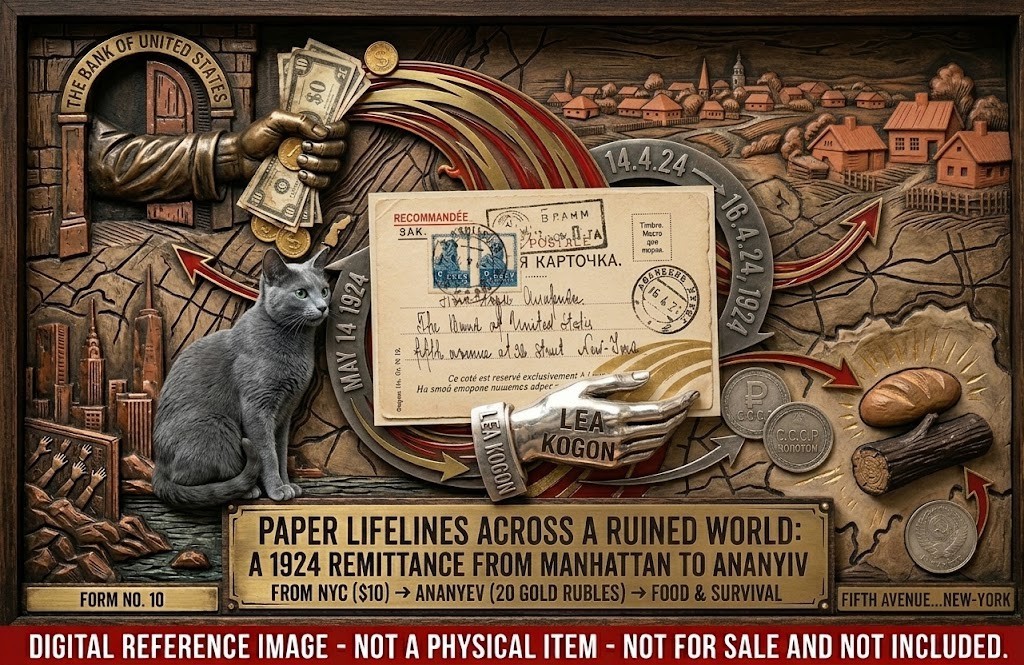
⚠️ IMPORTANT NOTE REGARDING EXHIBIT GRAPHICS: The historical routing maps, geographic overlays, and enhanced composite visuals featured in this listing are custom-designed digital graphics created exclusively for this online presentation. They are intended to provide deep provenance and tell the social history of the cover. No physical prints or digital files are included with the purchase of the physical philatelic item unless explicitly stated.\"Digital Exhibit Graphic Only – Not Included in Purchase, but you are more than welcome to download the images directly from and print them out for your records!\"
1924 Soviet Ukraine Avis de Réception (AR) Postcard to The Bank of United States, New York City
An exceptional piece of early Soviet postal and financial history from the New Economic Policy (NEP) era. This official bilingual (French/Russian) delivery advice card (Avis de Réception / Форма Ин. От. № 10) documents a $10.00 USD (valued at 20 gold rubles) international family remittance originating from Manhattan and safely delivered to a Jewish recipient in southern Ukraine.
Item Details & Postal Markings
Item Type: Official State Bank of the R.S.F.S.R. (Banque d\'État de la R.S.F.S.R.) registered delivery receipt card for an insured money letter (Lettre chargée avec valeur déclarée).
Remittance Particulars: Acknowledges receipt of $10.00 / 20 gold rubles sent via Bankus Corp. (account #45/1206) to Lea Kogon (Лея Когон) in Ananyiv, Ukraine.
Recipient Signature: Signed directly in ink by recipient Лея Когон upon delivery on April 14, 1924.
Franking: Horizontal pair of the 1923 6k blue Worker definitive overprinted «С.С.С.Р. золотом» (USSR in Gold), paying the 12-kopeck international surface advice-of-receipt fee.
Historical Significance
The NEP & \"Gold Ruble\" Era: Illustrates the early Soviet monetary stabilization period, where foreign currency remittances were officially channeled through Gosbank to bring vital hard currency into the reconstruction economy.
The Bank of United States Connection: Addressed to the landmark immigrant-founded financial institution whose catastrophic December 1930 collapse marked the largest bank failure in U.S. history and accelerated the Great Depression.
Condition: Entirely intact, structurally sound, clear signatures and markings with only standard light handling from trans-Atlantic transit. A clean, highly displayable crossover item for Russian/Soviet postal history, Judaica, and American banking history collectors.
This is an early Soviet / RSFSR bilingual (French/Russian) registered receipt of delivery (Avis de Réception / AR) postal card for an insured money remittance, returning from Ukraine to the United States.
Item Breakdown
Type: Formula AR postcard / delivery advice (Форма Ин. От. № 10) issued via the Foreign Section of the State Bank of the R.S.F.S.R. (Banque d\'État de la R.S.F.S.R.).
Franking: 12 kopecks total, franked with a horizontal pair of 1923 6k blue Worker definitive stamps overprinted/denominated in gold currency (С.С.С.Р. золотом), tied by an Ananyev, Kherson Gov. datestamp (АНАНЬЕВЪ ХЕРС. Г.) dated April 16, 1924.
Return Destination: Addressed to The Bank of United States, 5th Avenue & 32nd Street, New York City, stamped received May 14, 1924.
Condition: Clean, intact edges with faint expected postal handling; bold strikes and manuscript notations.
Value Factors
The Bank of United States became infamous because its collapse in December 1930 was the largest commercial bank failure in American history up to that point, and it served as the critical catalyst that transformed an ordinary economic downturn into the full-scale panic of the Great Depression.
Its infamy rests on several factors:
Deceptive Name and Public TrustDespite its name, it was not a central bank or a government-backed institution. It was a private, state-chartered commercial bank founded in 1913 by Joseph S. Marcus on Manhattan\'s Lower East Side. Marcus deliberately chose the name to attract newly arrived European immigrants (predominantly Jewish and Eastern European working-class families) who falsely believed the institution carried the backing and protection of the U.S. government.
Unprecedented Run and PanicBy 1930, the bank had grown rapidly into a powerhouse with more than 60 branches and over 400,000 depositors, mostly ordinary small savers and local merchants.
On December 10, 1930, after rumors spread regarding real estate losses and denied merger talks, a massive run began at its Southern Boulevard branch in the Bronx.
Depositors lined the freezing streets for blocks demanding cash. Over the course of a single day, lines swelled to thousands, and millions of dollars were pulled out.
The bank closed its doors on the morning of December 11, 1930, locking away more than $200 million in customer deposits.
The Failure of Wall Street and the Federal ReserveThe collapse is widely regarded by economic historians (including Milton Friedman and Anna Schwartz) as the fatal turning point of the Depression.
The Federal Reserve Bank of New York refused to act as a lender of last resort to rescue the bank.
The elite Wall Street banking establishment (centered around J.P. Morgan and the New York Clearing House) declined to provide a liquidity lifeline, largely driven by anti-immigrant prejudice and resentment toward the upstart Jewish-run bank.
Allowing it to fail wiped out the life savings of hundreds of thousands of working-class New Yorkers overnight, shattered nationwide confidence in the entire banking system, and triggered waves of bank runs across the country.
Corruption, Fraud, and Prison SentencesSubsequent state investigations revealed reckless speculation and internal financial manipulation. The bank\'s leadership—most notably Bernard Marcus (the founder\'s son) and Saul Singer—had created dummy affiliate companies (such as the Bankus Corporation, noted on your remittance card as Bankus c/o) to shuffle bad real estate loans and speculate in the bank\'s own stock. Both Marcus and Singer were convicted of fraud in 1931 and served prison terms in Sing Sing.
This card captures a direct human and financial lifeline running between Lower Manhattan and a Jewish shtetl in Soviet Ukraine during the chaotic aftermath of the Russian Civil War.
The Sender: Immigrant Worker via The Bank of United States (New York)
The Originating Party: While ordered through The Bank of United States / Bankus Corp. (5th Avenue at 32nd Street, New York), the real sender was almost certainly a Jewish immigrant living and working in New York City.
The Mechanism: Immigrants from the former Russian Empire flocked to The Bank of United States specifically because it offered international foreign-exchange remittances back to family in their hometowns. The bank maintained direct correspondent arrangements with the Soviet State Bank (Gosbank).
The Amount: The sender remitted $10 USD, which translated to 20 gold rubles (approx. 2 gold rubles per $1). In 1924, $10 was a modest sum in New York (roughly two or three days of factory wages), but in a war-torn Ukrainian town, it represented several months worth of basic food, fuel, and survival.
The Receiver: Lea Kogon in Ananyiv, Ukraine
The Recipient: Identified as Lea Kogon (Лея Когон), who personally signed the front receipt (Reçu personnellement par Лея Когон) upon collecting the funds at the local post office on April 14, 1924.
The Location: Ananyiv (Ананьев), located in the former Kherson Governorate / Odessa Region of southern Ukraine. Ananyiv had a substantial Jewish population (making up around one-third to nearly half of the town\'s pre-war inhabitants), centered around craft trades, agriculture, and small commerce.
Local Post Office Handstamps: Notice the postmarks on the card still read АНАНЬЕВЪ ХЕРС. Г. (Ananyev, Kherson Governorate) using old Tsarist spelling and imperial administrative names, because provincial post offices in 1924 had not yet replaced old Imperial canceling devices.
Country & Historical Context: 1921–1924
The Devastation of Ukraine (1918–1921)Before this card was sent, Ukraine had endured catastrophic upheaval: World War I, the Russian Revolution, foreign intervention, and the bloody Russian Civil War. Between 1918 and 1921, sweeping waves of anti-Jewish pogroms carried out by White armies, warlords, and rival militias killed over 100,000 Jews across Ukraine and displaced hundreds of thousands more. Combined with the catastrophic Soviet famine of 1921–1922, shtetl communities were left economically pulverized and largely reliant on remittances sent by relatives who had already emigrated to the U.S.
The NEP Era and the \"Gold Ruble\" (1923–1924)By 1924, the Soviet Union was in the middle of Vladimir Lenin’s NEP (New Economic Policy), which permitted limited private trade and stabilized the monetary system after hyperinflation:
The Bolshevik government desperately needed foreign hard currency (U.S. dollars, British pounds, gold) to finance state reconstruction.
To capture this flow, the Soviet State Bank established authorized remittance channels, converting incoming U.S. dollars into stable new chervonets/gold rubles (золотом).
The definitive stamps on the card—bearing the overprint С.С.С.Р. золотом (USSR in Gold)—were issued in late 1923 to reflect this new gold-standard currency reform, showing how rapidly the postal and banking systems were being integrated under early Soviet governance.
The postal transit on this card traces the return leg of an international delivery receipt (Avis de Réception / AR) from Soviet Ukraine to New York City, taking 28 days door-to-door:
1. Delivery & Recipient Signature (Ananyiv, Ukraine)
April 14, 1924: The insured letter containing the $10 remittance is delivered at the Ananyiv post office (Ананьев). Recipient Lea Kogon signs the receipt directly in ink (Лея Когон). Post office clerk countersigns, applying the circular date stamp АНАНЬЕВЪ ХЕРС. Г. 14 4 24 on the front.
2. Postal Dispatch & Registration (Ananyiv to Western Border)
April 16, 1924: The post office affixes a horizontal pair of 6k worker definitive stamps (12k total surface AR rate), ties them with the Ananyiv datestamp (16 4 24), applies the framed RECOMMANDÉE / ЗАК. (Registered) handstamp, and enters the card into the registered mail stream.
Domestic Rail Transit: Traveled via regional rail links through Odessa/Podolia to the western Soviet exchange border (typically Shepetivka/Zdolbuniv toward Poland, or via Negoreloe/Stolpce toward Germany).
3. Trans-European Rail Transit
Late April 1924: Carried closed-transit across Central Europe via the international rail postal network through Poland and Germany to a major Western European channel or Atlantic port (most commonly Cherbourg, Southampton, or Bremen/Hamburg).
4. Transatlantic Ocean Crossing
5. Arrival & Inward Bank Processing (New York City)
May 14, 1924: Processed through the New York registry division and delivered to The Bank of United States at 5th Avenue and 32nd Street, where it received the purple bank receiving stamp: MAY 14 1924.
Paper Lifelines Across a Ruined World: A 1924 Remittance from Manhattan to Ananyiv
In the spring of 1924, a fragile piece of tan cardstock completed a six-thousand-mile round trip between the asphalt of Midtown Manhattan and the scarred streets of a small Ukrainian market town. To the postal apparatus of the Universal Postal Union, it was simply Form Foreign Department No. 10 (Форма Ин. От. № 10)—a standardized, bilingual French-Russian Avis de Réception intended to verify that an insured piece of foreign correspondence had reached its destination. But beneath the bureaucratic print and registration ink lies a profound human record of survival, familial devotion, and the volatile convergence of two radically different economic systems in the wake of total war.
The story of the card begins on Fifth Avenue at 32nd Street, inside the bustling halls of The Bank of United States. Founded on Manhattan’s Lower East Side to cater to the influx of Eastern European Jewish immigrants, the institution traded heavily on its deceptively patriotic name. For garment workers, sweatshop laborers, and peddlers, the bank served as the primary financial artery to the world they had left behind. In early 1924, an unnamed immigrant deposited ten American dollars—hard-won wages from a New York workweek—transferred via the bank’s affiliate, the Bankus Corporation. In America, ten dollars was ordinary spending money; in Soviet Ukraine, converted at the official parity to twenty \"gold rubles,\" it was an enormous lifeline capable of purchasing months of flour, firewood, and medical care.
The intended recipient was Lea Kogon (Лея Когон), living in Ananyiv, a town nestled in the rolling steppe of southern Ukraine. Between 1918 and 1921, the region had been shattered by the Russian Civil War, famine, and vicious anti-Jewish pogroms that decimated shtetl communities. By 1924, Vladimir Lenin’s New Economic Policy (NEP) had introduced a temporary period of stabilization, reintroducing limited private trade and backing new currency with precious metals. Desperate to absorb foreign hard currency for state reconstruction, the Bolshevik State Bank (Gosbank) facilitated these immigrant remittances, funneling Western greenbacks into Soviet coffers while distributing paper gold rubles to surviving citizens.
The card itself preserves the physical moment this lifeline arrived. On April 14, 1924, Lea Kogon stood before a postal clerk in Ananyiv and signed her name in clear, flowing Cyrillic: Лея Когон. Tellingly, the post office canceled the document using imperial Tsarist-era circular steel date stamps reading АНАНЬЕВЪ ХЕРС. Г. (Ananyev, Kherson Governorate), an evocative vestige of an empire extinguished seven years prior.
Two days later, on April 16, the card was prepared for its return voyage to America to confirm delivery. Franked with a horizontal pair of 1923 six-kopeck worker definitives—stamped with the emblematic overprint С.С.С.Р. золотом (USSR in Gold)—it paid the twelve-kopeck international advice-of-receipt fee. Routed northwest across the Soviet rail network, through Central Europe, and across the Atlantic via steamship, it finally arrived back in Manhattan on May 14, 1924, struck with the purple receiving datestamp of The Bank of United States exactly twenty-eight days after leaving Ananyiv.
Today, the card carries an added layer of historical pathos. Just six years after processing Lea Kogon’s remittance, The Bank of United States imploded in December 1930, marking the largest bank failure in American history and plunging the nation into the depths of the Great Depression. Yet frozen in 1924, this postal document stands not as a monument to institutional collapse, but as a quiet testament to ordinary endurance—capturing the exact day ten American dollars crossed ocean and ideological divide to keep a family afloat in Ukraine.
⚠️ IMPORTANT NOTE REGARDING EXHIBIT GRAPHICS: The historical routing maps, geographic overlays, and enhanced composite visuals featured in this listing are custom-designed digital graphics created exclusively for this online presentation. They are intended to provide deep provenance and tell the social history of the cover. No physical prints or digital files are included with the purchase of the physical philatelic item unless explicitly stated.\"Digital Exhibit Graphic Only – Not Included in Purchase, but you are more than welcome to download the images directly from and print them out for your records!\"
Get your own free counter at Auctiva
Try Auctiva free for 30 days, no credit card required