When you click on links to various merchants on this site and make a purchase, this can result in this site earning a commission. Affiliate programs and affiliations include, but are not limited to, the eBay Partner Network.
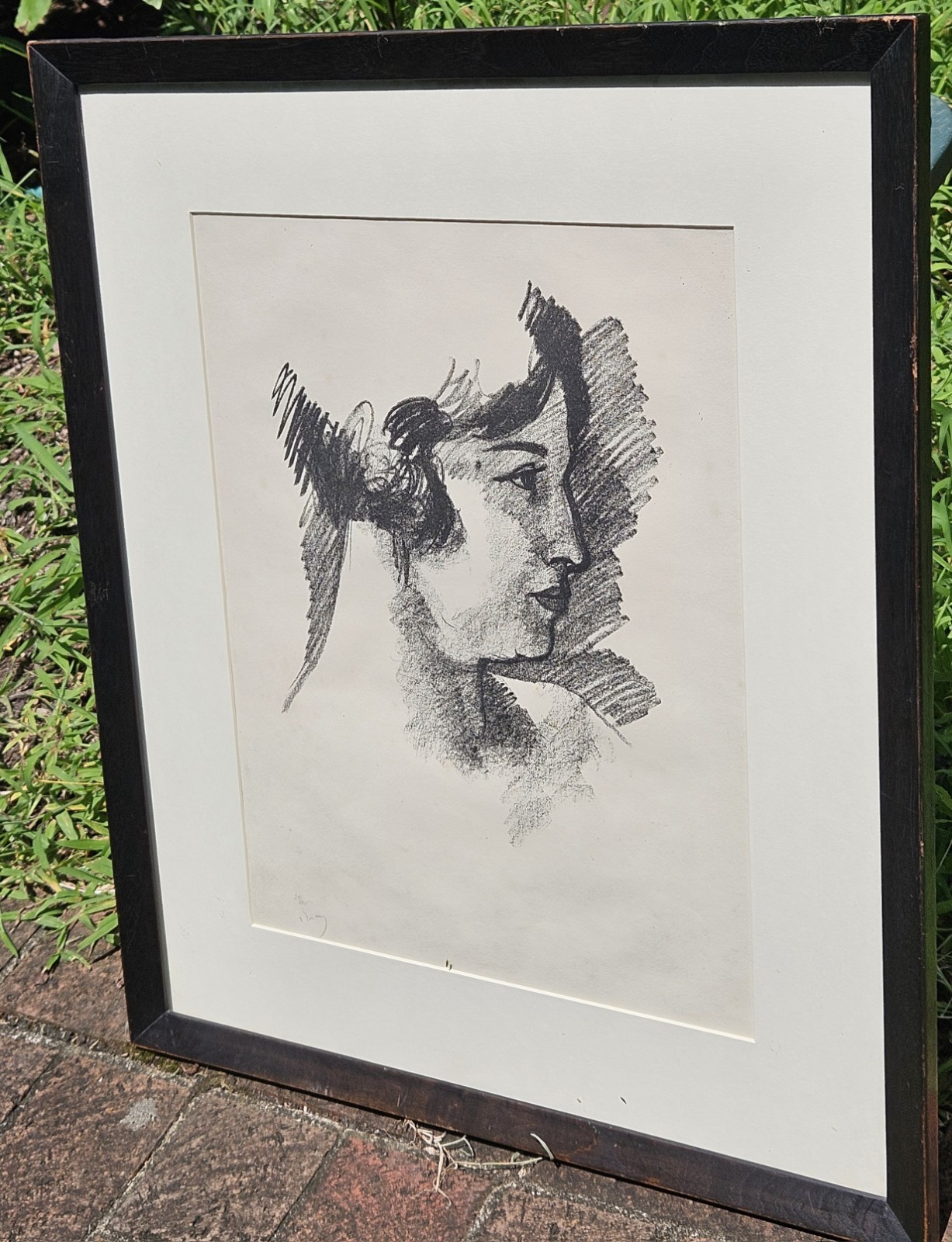
Presenting an original lithograph print by French Fauvist founder, Andre Derain, signed by the artist himself.
Andre Derain
(French, 1880-1954)
Tete de Femme en Profile
lithograph
\"27/100\", edition of 100, signed Derain (lower left)
12 x 10 inches.
original \"Head of a Woman in Profile\" lithograph from the portfolio Metamorphoses..
Medium: Original Lithograph
Note: Andre Derain: There is no doubt that Andre Derain was one of the most talented and influential artists of the twentieth century. He was also one of the most controversial. Somewhat of a recluse, he never invited contentions. Yet his continual, restless search for truth in art drew the ire first of traditional and then of modernist followers of art. Set apart from either cultural camp, Derain was never guided by fashionable dogma.
Andre Derain took his first private lessons in painting in 1895. In 1898, he enrolled in the Academie Carriere, in Paris. He became a close friend with a fellow student there, Henri Matisse. A year later, Derain rented a studio with another young artist, Maurice de Vlaminck. In 1900, however, Derain was drafted for military service and spent the following four years in this capacity. The following year, 1905, was important both for Derain and the development of modern art. An exhibition was organized in Paris at the Salon d\'Automne in which Derain, Matisse, Vlaminck and others were invited to show their recent paintings. The exhibition was promptly dubbed \'Cage aux Fauves\' (\'Cage of Wild Beasts\') by a critic, and the famous movement of Fauvism was officially born.
Yet Derain was content with Fauvism for only a short period of time. In 1908 and 1910 he went on extensive trips with Picasso to both Avignon and Spain and became interested in Cubism but never fully accepted it. It was at this time as well that Derain became a major artist of the book. In 1909 he supplied the illustrations for Apollinaire\'s first book of poetry, L\'Enchanteur pourissant, and illustrated a collection of poems by Max Jacob in 1912.
With the outbreak of World War One in 1914, Derain was again forced into service and remained in the army throughout the conflict, fighting in some of the bloodiest battles such as the Somme and Verdun. Upon his release in 1919, however, Derain had emerged as one of France\'s most famous artists. He was immediately commissioned by Diaghilev to design for the ballet, Le Boutique fantasque, and from 1920 to 1924, four individual books were published about his art. Derain\'s paintings, lithographs, etchings and woodcuts were now exhibited internationally in cities such as London, Berlin, Frankfurt and New York. In 1928 he was awarded the prestigious Carnegie Prize in the United States.
While the 1920\'s decade was for Derain the period of his greatest official recognition, it was also for his art the era of his greatest change. Almost oblivious to past modernist triumphs, Derain went to Italy in 1921 for the centenary celebrations of the art of Raphael. There he was deeply impressed with both High Renaissance painting and more directly classical sources such as the Fayum portraits and Roman mosaics which he studied at Pompeii and elsewhere.
This visit proved to be a catalyst for some of Derain\'s most personal and provocative art such as the 1927 set of twelve lithographs entitled, Metamorphoses. Published in Paris in a limited edition of 100 impressions, these lithographs were all stunning portraits of Derain\'s models and acquaintances. And one of the most famous from the 12 set is \"Tete de Femme en Profil\".
To say the very least, \"Tete de Femme en Profil\" is a work of timeless beauty from the hand of a master artist. Only a true artistic genius could convey such an image with such simplicity and honesty. And perhaps for this very reason, Derain\'s art now came under attack from abstract painters and critics. In 1931 the book Pour et Contre Derain put Derain at the centre of this storm of controversy. As was usual with Derain, he ignored any concerns from the avant-guarde or the traditionalists and remained true only to his art.
Official recognition continued when he was given a retrospective exhibition at the Kunsthalle in Bern in 1935, and was included in the important \'Exposition des Artistes Independants\' at the Paris Exposition Universelle in 1937. He continued to create his own unique masterpieces, not the least of which was his woodcut illustrations to the 1944 edition of Rabelais\'s Pantagruel.
Raisonne: Jean Adhemar, Derain, Peintre-Gravure: Catalogue de l\'exposition, Paris, Bibliotheque Nationale, 1955.
First and Only State as published in the signed, Limited edition of 100 impressions, numbered \"27/100\".
The large framed lithograph with handsome wooden frame measures a sizable 24 1/2\" x 20 3/4\" overall. And the lithograph itself, the portion visible within the mat portion, measures about 17\" x 8 13\"..
Framing appears Circa late 1930\'s..
Remains quite well preserved, as shown..
When viewed in direct light, very slight rippling is evident.. but this is not evident in most light settings at all..
Has not been examined out of frame.. but if you wish me to, I will be happy to...
Rarely encountered in such very good condition!!
$49 for secure s/h.. Best of Luck!!
And I make ultra secure packaging & shipping my #1 priority!!