When you click on links to various merchants on this site and make a purchase, this can result in this site earning a commission. Affiliate programs and affiliations include, but are not limited to, the eBay Partner Network.
In October 1929, Richard Whitney walked onto the floor of the New York Stock Exchange and attempted to stop a financial panic. Eight months later, now president of the Exchange, he told an audience of securities professionals what had happened.
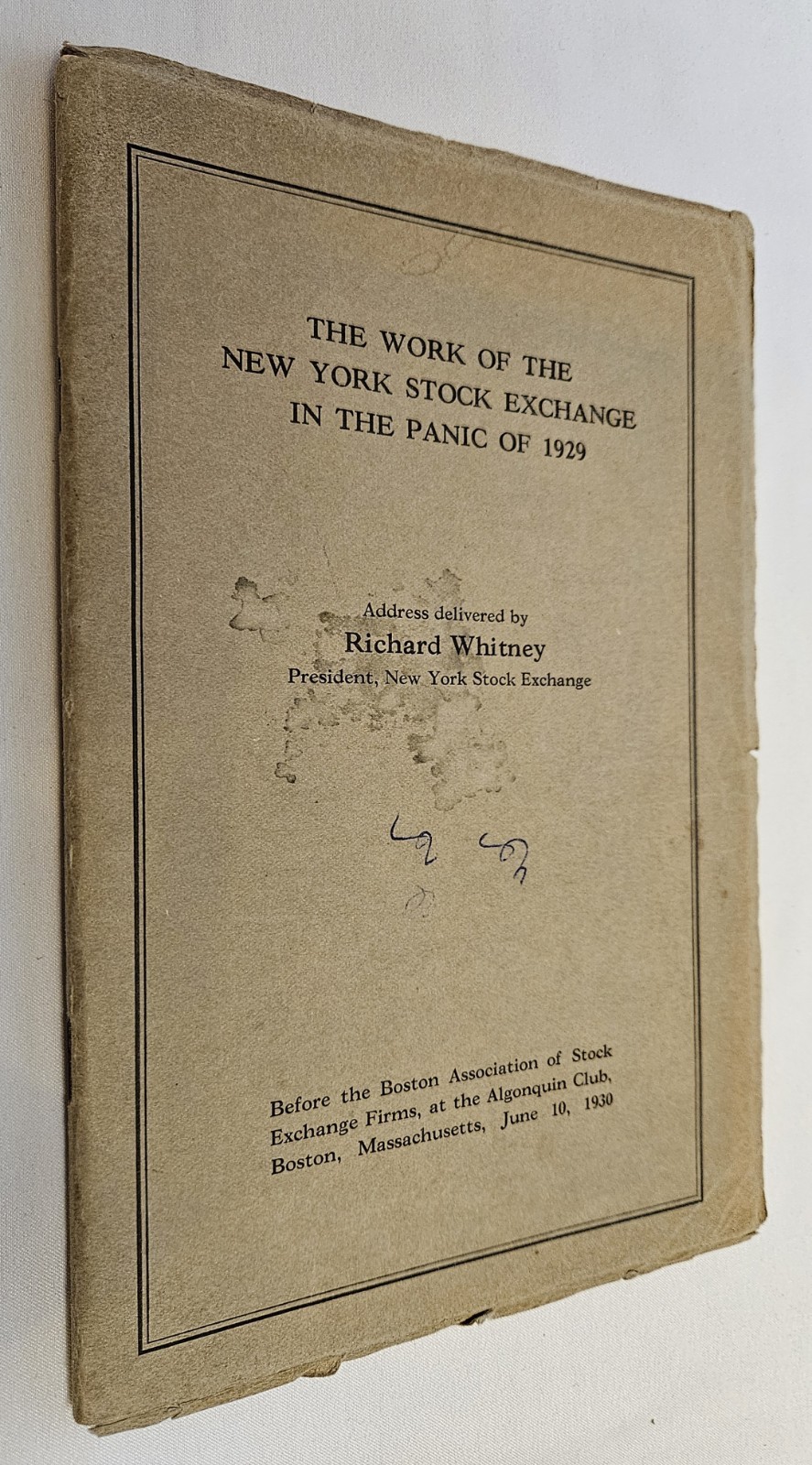
The Work of the New York Stock Exchange in the Panic of 1929 preserves Whitney’s address before the Boston Association of Stock Exchange Firms on June 10, 1930. Published as a slender 29-page pamphlet, it is an extraordinary contemporary account of the Wall Street Crash from one of the men standing at its center.
Whitney was vice president of the NYSE when the market began collapsing in October 1929. On October 24, Black Thursday, he famously appeared on the Exchange floor and placed conspicuous orders for major stocks at prices above the prevailing market, an organized attempt by leading bankers to restore confidence and arrest the selloff. The respite was temporary. Black Tuesday followed on October 29.
Here, only months afterward, Whitney describes the Exchange’s experience of the panic from inside the institution itself: the enormous volume of trading, the breakdown in communications, the measures taken by the Exchange, the initial belief that the decline represented a healthy market correction, and the eventual recognition that something far more serious was underway.
The historical hindsight is remarkable. Whitney delivered this address in June 1930, when the full dimensions of the Great Depression were not yet understood. He closes by expressing his confidence in American business and the country’s “inevitable onward economic progress.” What reads here as a postmortem of the crash was, in fact, written near the beginning of a catastrophe that would continue for years.
Whitney’s own story adds another extraordinary dimension. The apparent embodiment of Wall Street authority and respectability in 1930, he would later be exposed for extensive embezzlement, plead guilty to grand larceny, and serve time in Sing Sing. His downfall became a national scandal and helped destroy the old assumption that the Exchange could adequately police itself.
Whitney’s contemporary account of the crash subsequently became source material for John Kenneth Galbraith’s landmark history The Great Crash 1929.
An uncommon surviving primary document from one of the defining economic events of the twentieth century, written not by an observer looking backward but by a principal participant while the consequences of the crash were still unfolding.
Details
Title: The Work of the New York Stock Exchange in the Panic of 1929
Author: Richard Whitney
Publisher: Unknown
Place: Boston
Date: 1930
Edition: First edition
Format/Binding: Original printed gray wrappers; stapled pamphlet; housed in a custom clear protective poly wrapper
Pagination: 29 pages
Contents: Address delivered by Richard Whitney, President of the New York Stock Exchange, before the Boston Association of Stock Exchange Firms, June 10, 1930
Condition
Good, complete condition with substantial age and handling evident primarily to the original wrappers. Wrappers toned and soiled with edge wear, small chips and losses, creasing, and scattered marks. The front wrapper bears several old ink and pencil notations and doodles, apparently casual contemporary or later ownership marks. Stapled binding remains intact.
Interior leaves are substantially cleaner than the wrappers, with light expected toning and occasional minor marks. Text remains clear and complete throughout.
Please examine the photographs carefully, as they form an important part of the condition description.
Topic
Wall Street Crash of 1929; Great Depression; New York Stock Exchange; Financial History; Economic History; Stock Market; Banking; Richard Whitney; John Kenneth Galbraith; Primary Sources
Subject
Richard Whitney; New York Stock Exchange; Panic of 1929; Wall Street Crash; Black Thursday; Black Tuesday; Great Depression