When you click on links to various merchants on this site and make a purchase, this can result in this site earning a commission. Affiliate programs and affiliations include, but are not limited to, the eBay Partner Network.
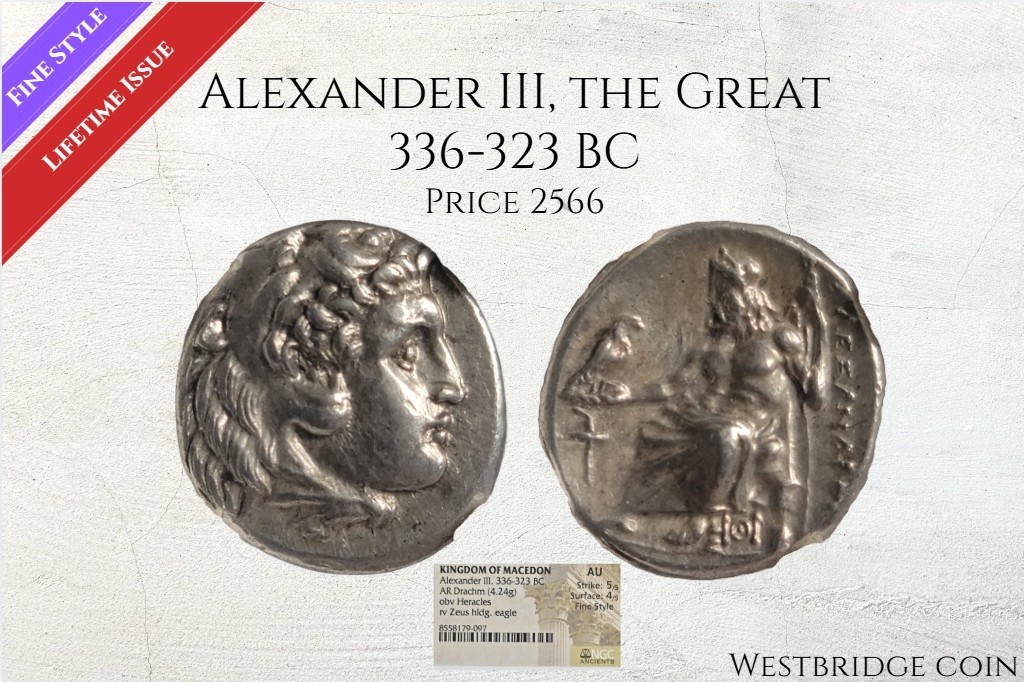
✦ KINGDOM OF MACEDON ✦ ALEXANDER III, THE GREAT Lifetime Issue | c. 324/3 BC Sardes | Silver Drachm | NGC AU Fine Style Alexander the Great in the famous Alexander Mosaic from Pompeii, a Roman copy of an earlier Hellenistic composition. A lifetime silver drachm of Alexander the Great, struck at Sardes in the closing years of his reign and distinguished by NGC with the designation Fine Style. ✦ ✦ ✦ ✦ LIFETIME ISSUE • NGC FINE STYLE Struck c. 324/3 BC — during Alexander's lifetime
Alexander died at Babylon in 323 BC. This Sardes issue is attributed to approximately 324/3 BC under Menander, placing its production within Alexander's own reign rather than among the vast posthumous coinage later struck in his name.
NGC has also awarded this example Fine Style, a designation used by NGC Ancients for coins displaying superior artistic style based on the quality of their hand-engraved dies and composition.
✦ Coin Details Ruler Alexander III “the Great” Kingdom Macedon Reign 336–323 BC Issue Date c. 324/3 BC — Lifetime Issue Mint Sardes Authority Struck under Menander Denomination AR Drachm Metal Silver Diameter 15 mm Weight 4.24 g Die Axis 11h Reference Price 2566; ADM I Series X NGC Certification 8558179-097 ✦ NGC Ancients AU • Strike 5/5 • Surface 4/5 • Fine Style
In addition to the AU grade, NGC awarded the highest available Strike rating of 5/5, a Surface rating of 4/5, and its Fine Style designation. Fine Style evaluates the artistry of an ancient coin's individually hand-engraved dies and is separate from the coin's grade, strike, and surface ratings.
The Design Obverse — Herakles Head of Herakles facing right, wearing the lion skin associated with his defeat of the Nemean Lion. Herakles was regarded as an ancestor of the Macedonian royal line. The image therefore combined heroic strength with the dynastic identity of Alexander's monarchy. Reverse — Zeus Aëtophoros Zeus Aëtophoros — Zeus the Eagle-Bearer — seated left on a throne, holding an eagle in his extended hand and a scepter. A torch appears in the left field and a monogram below the throne, identifying this particular issue within the Sardes series. ✦ A Lifetime Issue Struck While Alexander Still Lived
Alexander-type silver coins continued to be produced in enormous numbers after his death. His name and designs remained trusted throughout the Hellenistic world for generations.
This drachm belongs to a different historical setting. The Sardes issue is dated to approximately 324/3 BC, while Alexander himself remained alive until June of 323 BC.
It is therefore attributed as a lifetime issue — coinage produced under Alexander's living authority rather than a later ruler continuing his famous types.
Sardes A Royal Mint in Western Asia Minor
Sardes had been the ancient capital of Lydia and later became an important administrative center of the Persian Empire.
After Alexander defeated Persian forces at the Battle of the Granicus in 334 BC, Sardes surrendered to him along with its important treasury.
This drachm was struck there roughly a decade later under Menander, an officer of Alexander who governed Lydia. Its date places it near the end of Alexander's reign.
✦ Alexander the Great 336–323 BC
Alexander became king of Macedon in 336 BC, following the assassination of his father, Philip II. He was approximately twenty years old.
In 334 BC he crossed into Asia and began the campaign against the Achaemenid Persian Empire. Victories at the Granicus, Issus, and ultimately Gaugamela broke Persian power.
Alexander went on to control an empire stretching from the Greek world through Egypt, Persia, and deep into Central and South Asia, transforming the political and cultural geography of the ancient world.
324–323 BC The Final Chapter of Alexander's Reign
The dating of this drachm is particularly significant. Alexander returned to Susa in 324 BC after years of campaigning farther east.
His empire now stretched across territories that had once belonged to very different kingdoms and peoples. Alexander spent his final period reorganizing his forces and administration while planning additional campaigns.
In June 323 BC, Alexander became ill at Babylon and died at only 32 years old. His death left his enormous empire without an uncontested adult heir and opened the age of the Successors.
✦ Alexander's Empire The empire near its greatest extent around the time this drachm was struck Historical map showing the broad extent of Alexander's empire near the end of his reign. Alexander the Great Timeline 336 BC — Alexander becomes King of Macedon.
334 BC — He crosses into Asia and defeats Persian forces at the Granicus; Sardes subsequently surrenders.
333 BC — Alexander defeats Darius III at Issus.
332 BC — Tyre falls; Alexander enters Egypt.
331 BC — Victory at Gaugamela decisively breaks Persian imperial power.
326 BC — Alexander campaigns in India and defeats Porus at the Hydaspes.
324 BC — Alexander returns to Susa.
c. 324/3 BC — This lifetime drachm is struck at Sardes.
323 BC — Alexander dies at Babylon at age 32. ✦ Condition NGC AU • Strike 5/5 • Surface 4/5 • Fine Style
NGC Certification Number: 8558179-097
This coin has been certified and encapsulated by NGC Ancients. Please review all listing photographs carefully for the exact coin and holder included, including strike, surfaces, centering, toning, and overall appearance.
✦ Struck During the Lifetime of Alexander
Alexander's Herakles-and-Zeus coinage would continue long after his death, becoming one of the enduring monetary types of the Hellenistic world. This Sardes drachm belongs to the earlier and more immediate story. Struck around 324/3 BC, it was produced while Alexander himself was still alive and his empire remained under his personal rule. Combined with its NGC AU grade, perfect 5/5 Strike, 4/5 Surface, and Fine Style designation, the coin preserves both the history and the hand-engraved artistry of Alexander's own age.
WESTBRIDGE COIN ✦ ✦ ✦ Historical images are included for educational and historical context and are not part of the item offered. Alexander Mosaic: House of the Faun, Pompeii / Wikimedia Commons, public domain.
Alexander's Empire map: George Willis Botsford, A History of the Ancient World, 1913 / Wikimedia Commons, public domain.