When you click on links to various merchants on this site and make a purchase, this can result in this site earning a commission. Affiliate programs and affiliations include, but are not limited to, the eBay Partner Network.
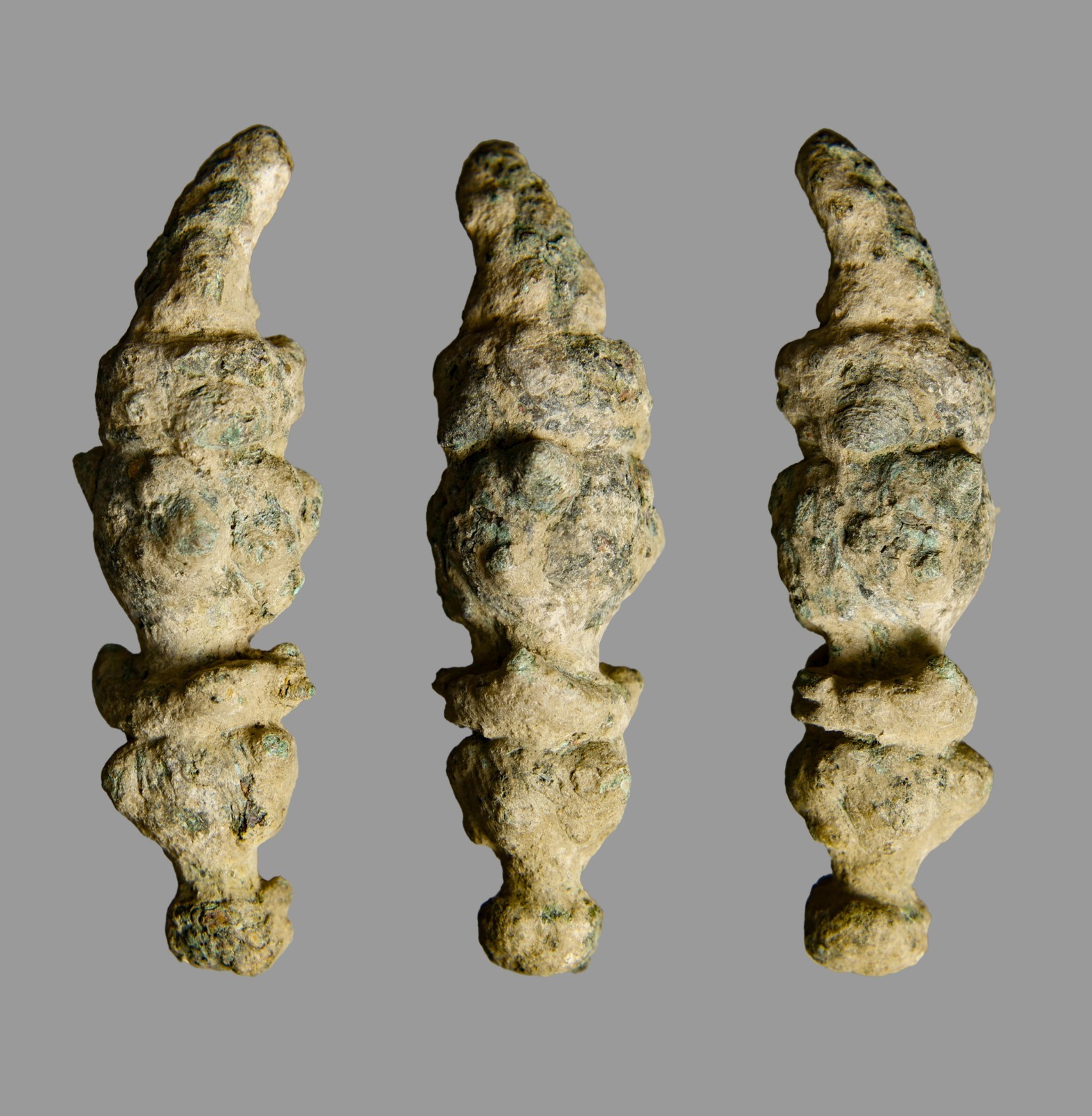
Ancient Levantine / Canaanite Cast Bronze Votive Deity Idol — Conical Crown & Tiered Body (4.2 cm — c. 18th–12th Century BC)
Authenticity & Guarantee
Item Specifications & Exact Dimensions
Object: Solid Cast Bronze Votive Deity Figurine / Ritual Idol / Scepter Finial
Culture / Period: Levantine Canaanite / Syro-Palestinian Middle to Late Bronze Age
Date Range: Circa 18th Century BC – 12th Century BC (c. 1800 – 1200 BC)
Exact Height: 4.2 cm (42 mm)
Material: Solid Cast Bronze (Copper Alloy)
Form & Architecture: Solid-cast schematic anthropomorphic votive figurine featuring a curved conical headpiece (representing the high conical cap or horned helmet of Levantine deities); tiered, knobbed torso with stylized anatomical and garment bulges; terminates in a tapered basal tang/peg engineered to mount into a stone votive base, wooden shrine, or ritual staff
Condition: Exceptional, 100% complete ancient condition. Intact structural core and mounting peg; preserved under an authentic thick -tan to pale-sand calcareous burial crust over a dark charcoal-olive bronze matrix. Free of modern restoration or tooling.
HISTORICAL CONTEXT & TYPOLOGICAL LORE
Canaanite Votive Cults & Divine Iconography
In the Bronze Age city-states of the Levant—including Ugarit, Byblos, Megiddo, and Hazor—small bronze idols representing storm and warrior gods such as Baal, Resheph, or El were cast as sacred votive offerings. Worshippers deposited these statuettes in temple sanctuaries, high places (bamot), and family shrines to invoke divine protection, fertility, and victory in battle.
Schematic Design & Mounting Mechanics (4.2 cm)
At 4.2 cm, this figurine exhibits the schematic, highly stylized reduction characteristic of Levantine Middle and Late Bronze Age votive bronzes. The curved conical cap is a defining iconographic attribute associated with Canaanite deities in local metalwork. The tapered peg at the base allowed the figurine to be anchored into a small limestone altar socket or mounted atop a wooden ceremonial staff.
Typological Analysis & Exact Classification
Comparable Archaeological Examples & Museum Accession Numbers
Israel Museum, Jerusalem: Middle and Late Bronze Age Canaanite bronze votive figurines and deity idols excavated from Megiddo and Hazor strata.
Louvre Museum (Inv. No. AO 22211): Bronze Age Levantine cast bronze votive figurines of Baal and Canaanite deities from Ugarit (Ras Shamra).
British Museum (Accession No. 1880,0503.125): Canaanite bronze votive idol and ritual staff fitting.
TRN-1-9