When you click on links to various merchants on this site and make a purchase, this can result in this site earning a commission. Affiliate programs and affiliations include, but are not limited to, the eBay Partner Network.
KELEKET SWEET EYE LOCALIZER — EARLY X-RAY INSTRUMENT
Imagine arriving at a doctor’s office after a tiny piece of metal struck your eye. The new X-ray machine could reveal its shadow—but a surgeon needed to know exactly where it was. Was it inside the eye or behind it? How deep? A fraction of an inch could determine the next move.
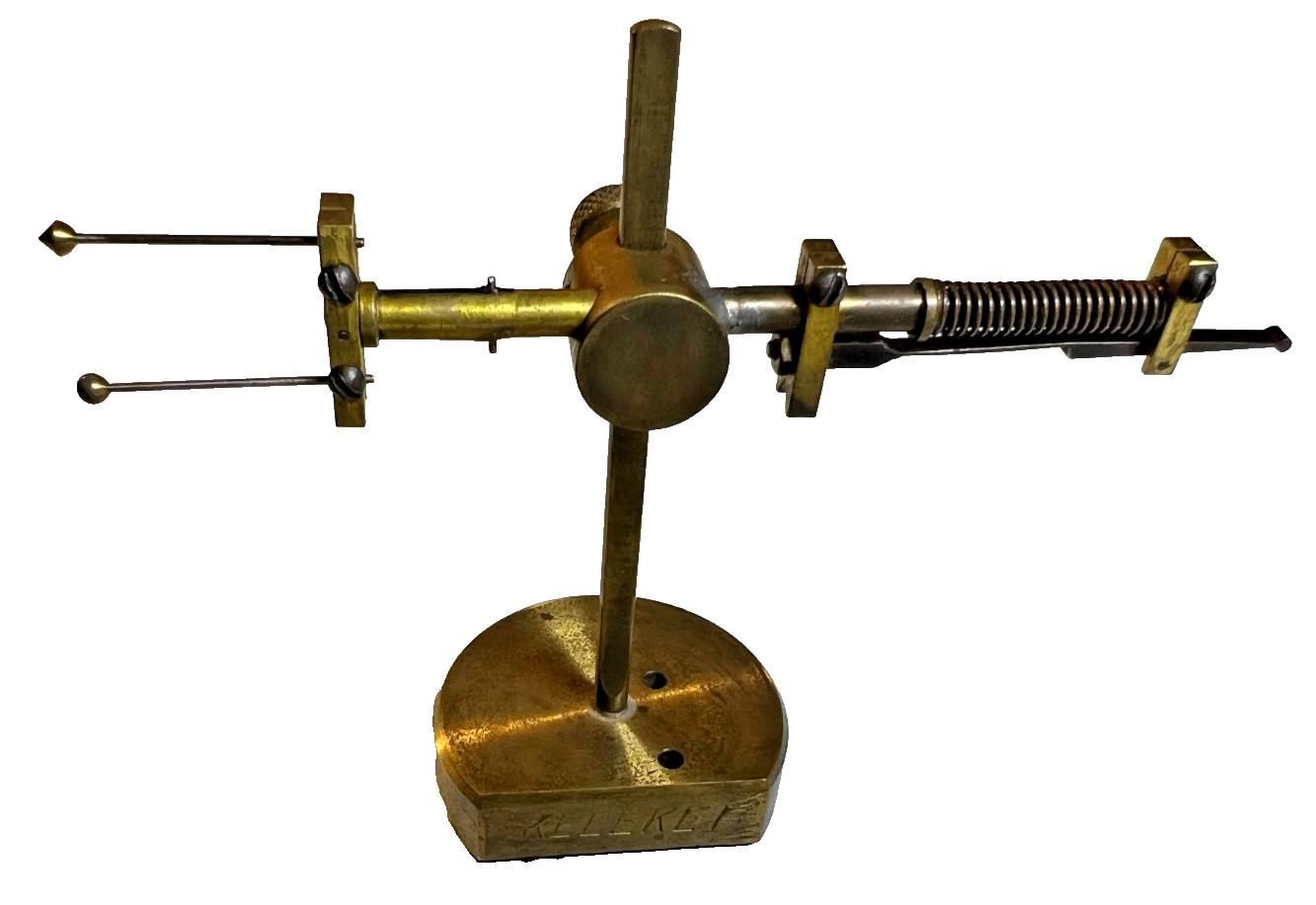
This finely made Keleket instrument helped answer those questions. It is a Sweet eye foreign-body localizer, manufactured by the Kelley-Koett company of Covington, Kentucky. Its compact brass body, adjustable upright, spring mechanism, and two delicate markers turn what looks like an intriguing scientific curiosity into a remarkable piece of early medical technology.
How it was used
The patient lay on their side with the injured eye nearest a photographic X-ray plate. The operator adjusted the localizer until its small ball-shaped marker aligned with the center of the cornea. With the eye closed, the ball was brought gently against the eyelid; the spring mechanism then drew the markers back a measured distance before the exposures.
The second marker has a cone-shaped tip. Ball and cone were set 15 millimeters apart, giving the doctor two known reference points that would appear as distinct shadows on an X-ray. The first image was taken with the markers’ shadows aligned. The X-ray tube was then moved to take a second image at an angle, separating those shadows. Using the images and a prepared chart, the doctor could plot the metal fragment’s position in relation to the eye. It was careful geometry put to work in an urgent medical setting.
Look closely at the base: its two small holes were part of the instrument’s precision. Period instructions describe using them to check the spacing of the two markers. Every small feature had a purpose.
A documented piece of medical history
The Smithsonian National Museum of American History holds a Keleket eye localizer in its collection and identifies it as an apparatus for locating foreign bodies in the eye by X-ray. A medical textbook published in 1912 also illustrates a “Keleket localizer and head-rest.” Those records establish this as an early 20th-century design; they do not establish an exact manufacture year for this individual example.
Kelley-Koett began in Covington, Kentucky, in 1903. The KELEKET name is prominently engraved across the front of this instrument’s substantial base—a wonderful detail for display.
Picture the world around it
This was the era when the X-ray was moving from a startling discovery into practical medicine. Doctors still worked with photographic plates and carefully positioned apparatus. Finding the shadow of a fragment was only the beginning: they needed measurements precise enough to help a surgeon preserve an injured eye.
Beyond the examination room, Americans were watching the extraordinary 1912 presidential contest between Woodrow Wilson, Theodore Roosevelt, William Howard Taft, and Eugene Debs. In 1913, Ford introduced its moving automobile assembly line. Then World War I brought an immense need to locate metal fragments in injured patients. This little instrument belongs to that period of rapid change, when brass hardware, photography, and geometry could help a physician see what the unaided eye could 4⅛″ tall
Approximately 5″ wide across the instrument
Base approximately 1⅝″ wide
Condition and contents
Clearly engraved KELEKET base
Attractive aged metal surfaces with wear consistent with age and use; please examine the photographs
The localizer shown is the item offered; the separate period headrest, X-ray equipment, photographic plates, and plotting chart are not included
Offered as a historical collectible and display piece; its original calibration and medical function have not been tested
An arresting addition to a collection of medical antiques, ophthalmology, early radiology, scientific instruments, or industrial-era craftsmanship. Small enough to display on a shelf, with a history far larger than its footprint.