When you click on links to various merchants on this site and make a purchase, this can result in this site earning a commission. Affiliate programs and affiliations include, but are not limited to, the eBay Partner Network.
Condition description
Height 17.5”, Base 13.5”
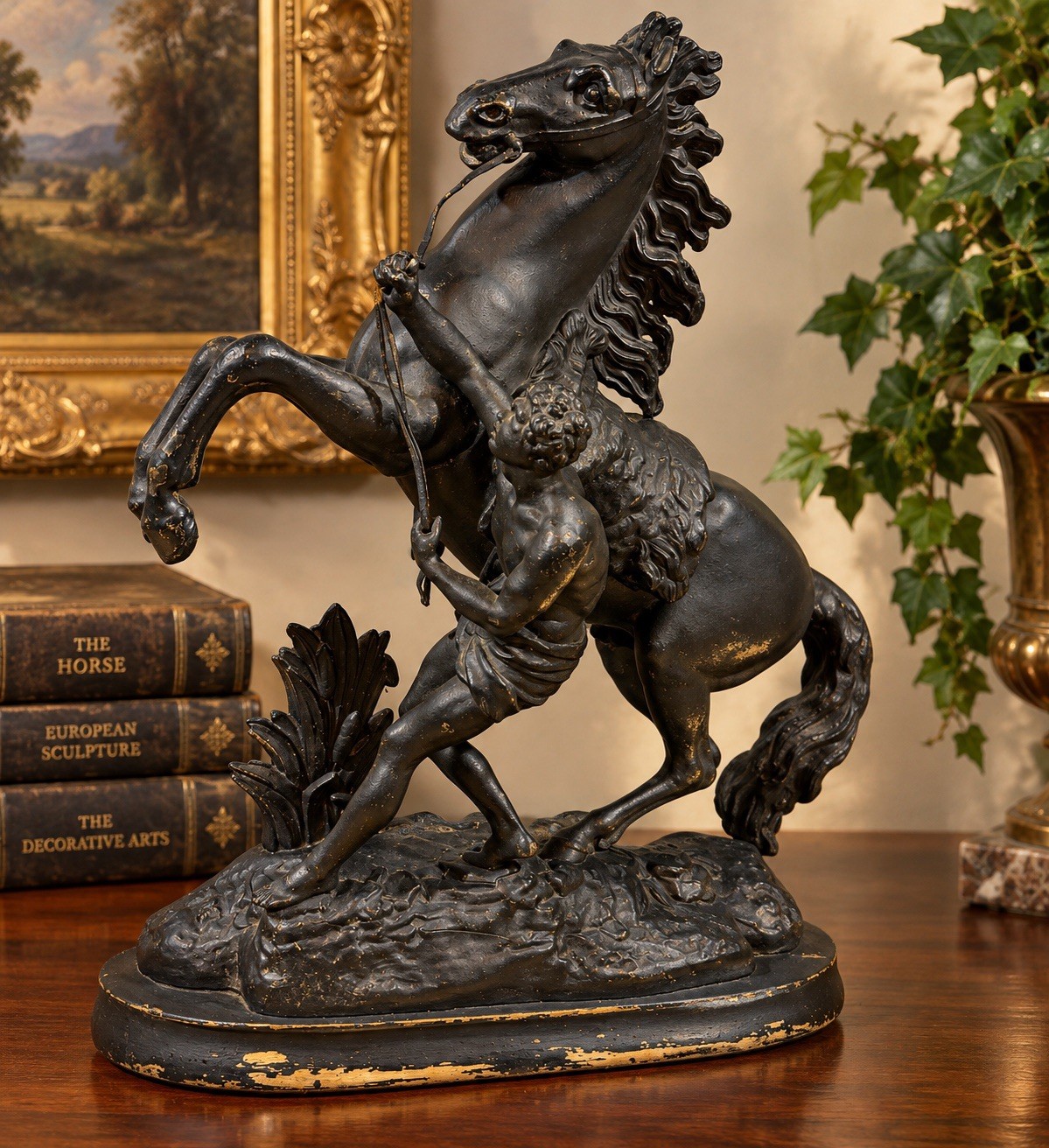
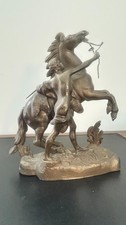
Very good antique condition for this type of sculpture, with the principal figures and delicate projecting details unusually intact. Horse, groom, legs, tail, flowing pierced mane and reins/bridle are present with no obvious structural breaks or major repairs observed. Considerable age-related loss to the dark surface finish reveals remnants of an earlier gold/gilt-colored finish. Original-appearing black-painted wooden plinth shows age and finish wear; one small wooden support/foot is missing from the underside. Underside of sculpture shows oxidation, casting texture and age-related surface deposits. Metal composition has not been laboratory tested and is described conservatively as cast metal, likely zinc/spelter. Please examine all photographs closely.
Description
Antique Marly Horse and Groom Sculpture
After Guillaume Coustou – Chevaux de Marly
Circa 1890–1910
Offered is an impressive antique decorative reduction of one of Guillaume Coustou’s celebrated Marly Horses, depicting a powerful rearing horse being restrained by its groom.
The composition is based upon Coustou’s monumental Chevaux de Marly, completed in 1745 for the Château de Marly during the reign of Louis XV. The original marble sculptures are now preserved at the Louvre in Paris and became one of the most widely admired equestrian compositions of the French Baroque period.
This antique version appears to date from approximately the late 19th to early 20th century, when decorative reductions of the Marly Horses were particularly popular for mantels, libraries and formal interiors.
The sculpture is a hollow cast metal construction mounted on a substantial black-painted wooden plinth. Examination of the underside shows gray/silvery exposed metal and age-related oxidation consistent with the zinc-based alloys commonly referred to as spelter, although no laboratory metallurgical testing has been performed.
Especially interesting are the surviving areas of gold-colored finish visible through and beneath areas of the present dark surface. These suggest that the sculpture originally had a gilt, gold-bronzed or similarly decorative metallic finish. Such finishes were frequently employed on high-quality decorative metalwork of the period.
What makes this example particularly appealing is its completeness. The composition contains numerous vulnerable projecting elements, yet the horse, groom, legs, tail, dramatically pierced flowing mane and reins/bridle all remain present. Many surviving examples of this model have lost one or more of these details.
The modeling is excellent throughout, particularly the musculature of the horse and groom, the expressive horse’s head, flowing mane, drapery, reins and rocky/foliate ground.
The sculpture sits on what appears to be its original black-painted or ebonized wooden base. One small wooden support/foot is missing from underneath the base, as photographed.
There is expected surface wear, oxidation and loss to the original decorative finish consistent with an object approximately 115–135 years old. I have intentionally not polished, stripped, refinished or restored the sculpture, preserving its surviving historic surfaces.
A very attractive and unusually complete antique example of one of the most recognizable equestrian sculptural compositions of the 18th and 19th centuries.
Please review all photographs carefully, as they form an important part of the description and clearly document the sculpture, surviving finish, underside, casting and condition.