When you click on links to various merchants on this site and make a purchase, this can result in this site earning a commission. Affiliate programs and affiliations include, but are not limited to, the eBay Partner Network.
TWO JULES VERNE ADVENTURES. ONE BREATHTAKING VICTORIAN COVER.
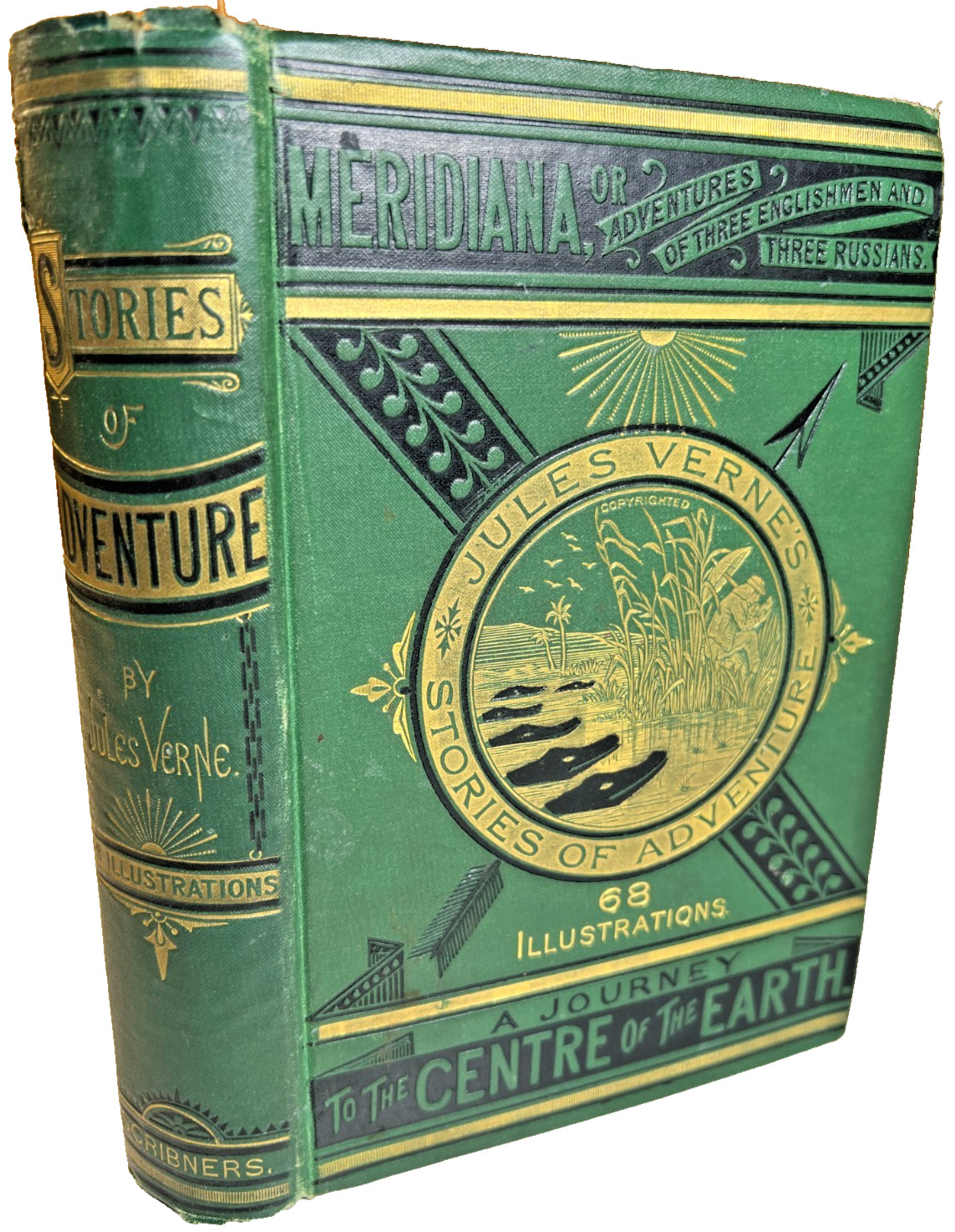
Published in New York by Scribner, Armstrong & Co. in 1874, this is the first American edition of Stories of Adventure, the early two-in-one volume pairing Meridiana: The Adventures of Three Englishmen and Three Russians in South Africa with A Journey to the Centre of the Earth. Open the illustrated green cloth boards and you have two very different journeys: one across a continent, the other deep beneath your feet.
The cover alone deserves a long look. Rich green cloth carries an elaborate design in black and gilt, with a sunburst, landscape, and bold lettering worked into an almost theatrical composition. The front remains bright and vibrant after more than 150 years. This is the sort of nineteenth-century book that looks as adventurous on the shelf as it reads.
Inside the two stories:
In Meridiana, three Englishmen and three Russians set out across southern Africa to measure an arc of the earth’s meridian. It sounds like a precise scientific undertaking—and it is—until difficult terrain, danger, and the outbreak of war between their countries put both the expedition and their cooperation under strain. Verne turns surveying and geography into an adventure with human stakes.
In A Journey to the Centre of the Earth, an ancient message points the way into an Icelandic volcano. A professor, his nephew, and their guide descend into an imagined world of vast caverns, an underground sea, prehistoric life, and hazards no map could prepare them for. It is one of Verne’s great feats: he makes the impossible feel just plausible enough that you want to follow them down.
How far ahead of his time was Jules Verne?
Imagine reading this book in 1874. The telephone was still new, powered flight lay decades away, and no human had seen Earth from space. Yet Verne was already building adventures around a question that would define the next century: What could people do if they pushed science and engineering further?
The most startling example comes from another of his novels, From the Earth to the Moon. Verne pictured three travelers inside a capsule, departing from Florida, circling the Moon, and returning to Earth with a splashdown in the Pacific Ocean. More than a century later, Apollo 8 carried three astronauts from Florida around the Moon and back to a Pacific splashdown. Apollo 11 followed a similar route and landed people on the Moon. Verne’s launch mechanism was a giant cannon, of course—NASA wisely chose rockets—but the crew size, departure point, journey around the Moon, and ocean recovery make for an astonishing comparison.
In Twenty Thousand Leagues Under the Sea, he imagined Captain Nemo’s Nautilus as a vessel capable of extended voyages beneath the ocean. Submarines existed in experimental forms during Verne’s lifetime; he took a developing technology and envisioned what it might become. That was his particular genius: he did not simply conjure up wonders. He read about the science of his day, then gave it room to grow.
That same imagination powers the two stories in this 1874 volume. Meridiana turns the measurement of Earth into an expedition strained by danger and international conflict. A Journey to the Centre of the Earth takes contemporary fascination with geology and asks what an explorer might find beyond the reach of any instrument. Neither story needs to predict a machine to feel ahead of its time. Verne saw science as the beginning of an adventure—and made generations of readers want to see what came next.
The Moon voyage and the Nautilus are examples from Verne’s other books; the two works included in this volume are Meridiana and A Journey to the Centre of the Earth.
Condition
- The green front cover remains notably bright and vibrant, with strong gilt and black decoration.
- There are professional green-cloth repairs at the top of the spine, visible in the photographs.
- Hinge tape has been applied to both interior hinges.
- The pages show little to no foxing.
- There is age-related wear, including wear around the spine and board edges. Please review all photographs for the binding repairs and overall condition.