When you click on links to various merchants on this site and make a purchase, this can result in this site earning a commission. Affiliate programs and affiliations include, but are not limited to, the eBay Partner Network.
Antique Vion et Baury Style Bisque Porcelain Vase, 19th CenturyThis product data sheet is originally written in English.
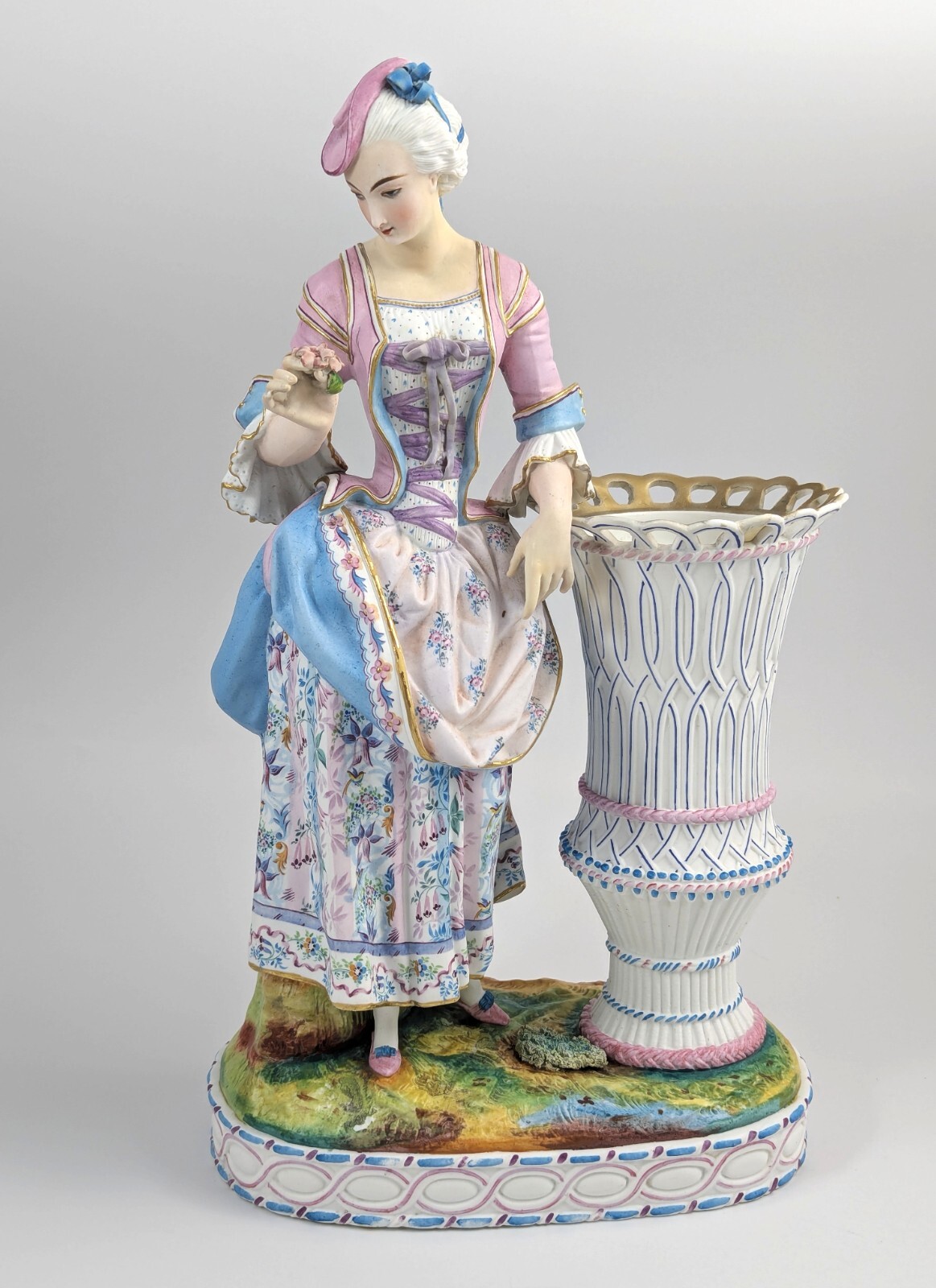
A French bisque porcelain vase, hand-painted in the style of Vion et Baury, created in the 19th century. The piece features a graceful sculpture of a young woman in rococo attire.
The sculpture is unmarked, but it is evident that the piece was crafted in the style of Vion et Baury. It is possible that this sculpture is an original work of this legendary manufactory, but over time, the blue embossed \'VB\' mark has worn off. Blue embossed marks were used on Vion et Baury products until the mid-1870s, after which the green anchor stamps became standard.
Another possibility is that a small French porcelain factory acquired an unpainted blank from Vion et Baury, and an artist from that factory hand-painted the figurine. This was a common practice among the many Parisian manufactories of the time. The figurine is flawlessly painted and exhibits exceptional craftsmanship, indicating the extraordinary skill of the artist, whoever they may have been.
In the 19th century, France had over 100 porcelain factories, ranging from large manufacturers to small workshops. Some of the most renowned included the Sèvres Manufactory (the royal factory), Limoges factories such as Haviland & Co., Bernardaud, and Royal Limoges, as well as Parisian makers like Vion et Baury and Jacob Petit. In Paris alone, there were between 20 and 40 small workshops producing \"Parisian porcelain,\" often referred to as \"Vieux Paris\" (Old Paris). The exact number is difficult to determine, as many workshops changed owners or names, and others were short-lived. Overall, France was one of the leading porcelain producers in Europe during the 19th 36.5 cm
Width: 21 cmDepth: 12.5 cmWeight: 2440 petal on the inner side of the vase has been restored (see photo).A small chip is present on the top rim.A minor paint chip is visible near her foot (see photo).There is a small internal firing crack inside the vase (not visible from the outside; it can only be seen when looking inside).Please examine the accompanying photographs carefully, as they form an integral part of this description. If you have any questions, we will be happy to assist you. The item will be shipped with full tracking and insurance.
Another possibility is that a small French porcelain factory acquired an unpainted blank from Vion et Baury, and an artist from that factory hand-painted the figurine. This was a common practice among the many Parisian manufactories of the time. The figurine is flawlessly painted and exhibits exceptional craftsmanship, indicating the extraordinary skill of the artist, whoever they may have been. In the 19th century, France had over 100 porcelain factories, ranging from large manufacturers to small workshops. Some of the most renowned included the Sèvres Manufactory (the royal factory), Limoges factories such as Haviland & Co., Bernardaud, and Royal Limoges, as well as Parisian makers like Vion et Baury and Jacob Petit. In Paris alone, there were between 20 and 40 small workshops producing Brand Unmarked Origin French Type Figurine Material Porcelain Production Technique Bisque Subject Women Colour Multicoloured