When you click on links to various merchants on this site and make a purchase, this can result in this site earning a commission. Affiliate programs and affiliations include, but are not limited to, the eBay Partner Network.
Offered here is an original late-medieval Latin liturgical manuscript fragment on parchment/vellum, dating approximately c. 1400–1500, preserving material from the medieval Divine Office. Written by hand in Gothic textualis script with striking red and black rubrication, the fragment combines a liturgical directory for the Friday Office with remnants of Gregorian chant notation on red staves.
This is genuine manuscript material from the period before—or around the earliest decades of—European printing, when liturgical books were painstakingly copied and decorated by hand for use in churches, monasteries, and other religious communities.
The Text
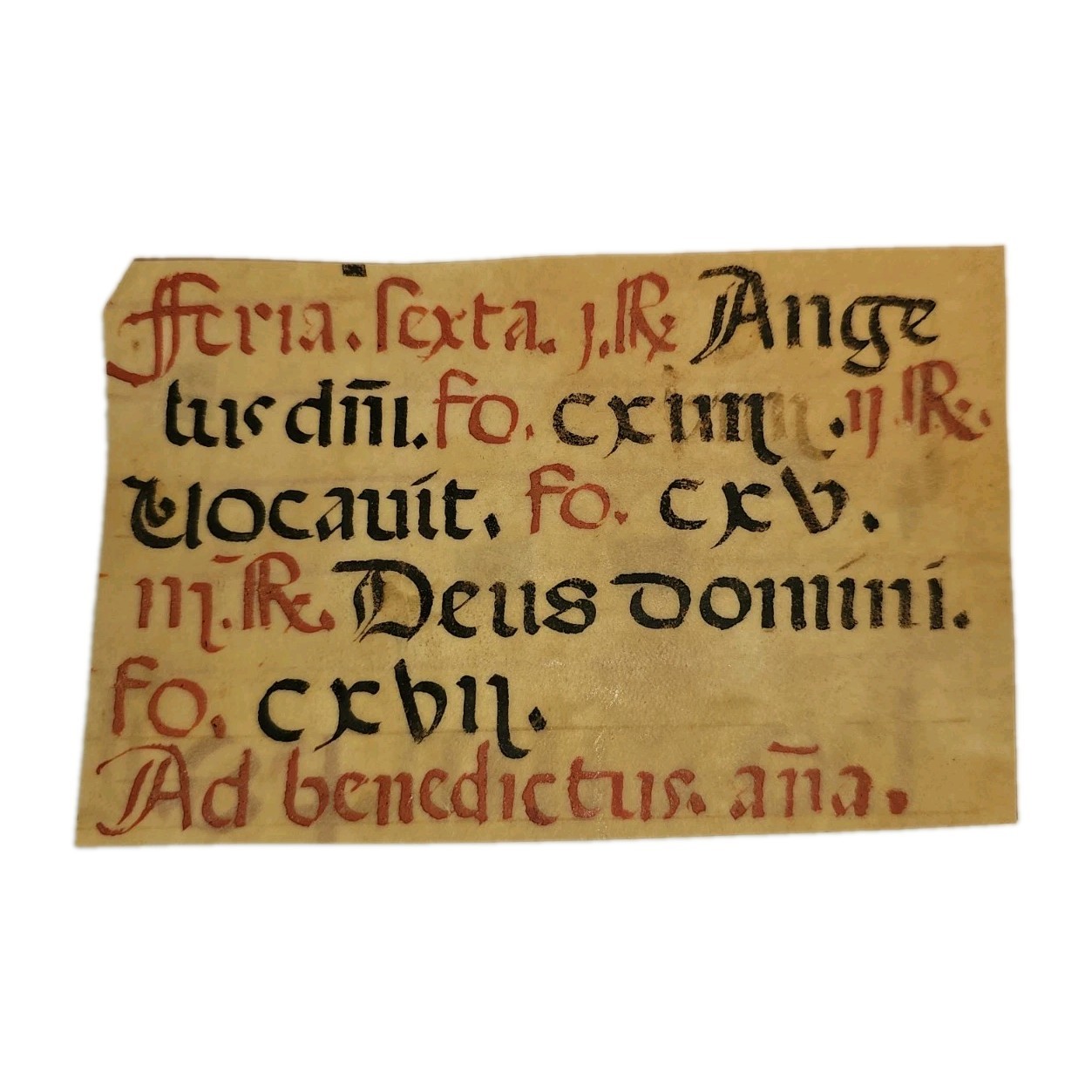
The principal side contains what appears to be a ferial finder or liturgical directory for Friday (Feria sexta), directing the singer or officiant to specific responsories elsewhere in the original manuscript.
The text can be expanded approximately as:
Feria sexta.
I. Responsorium: Angelus domini. Folio [cx…].
II. Responsorium: Vocavit. Folio cxv.
III. Responsorium: Deus domini. Folio cxvii.
Ad Benedictus. Responsory: “The Angel of the Lord…”
Second Responsory: “He called…”
Third Responsory: “God/Lord…”
At the Benedictus: Antiphon.
Rather than containing the complete chants, this section served as a medieval finding aid, telling the user which chants were required and where they could be found elsewhere in the manuscript. The Roman-numeral references point to folios within the original volume.
The alternating red and black writing is functional as well as decorative. Red rubrication identifies liturgical instructions, numbers and cues, while black ink records the opening words or incipits of the chants.
Gregorian Chant / Musical Notation
The other side preserves remnants of the manuscript\'s musical component, including red staff lines and square Gregorian notation, together with fragmentary Latin text.
A surviving abbreviation appears to include:
cum. ps.
with “ps.” serving as an abbreviation associated with psalmus (“psalm”), indicating the relationship between an antiphon and its accompanying psalm.
The combination of textual directions, responsories, antiphons, psalm references and musical notation strongly indicates that the parent manuscript was an antiphoner, noted breviary, or closely related book for the Divine Office.
Historical Importance
This fragment is particularly interesting because it preserves evidence of how medieval worship was actually organized and performed.
The reference to three responsories relates to the nighttime/morning Office of Matins, while:
Ad Benedictus antiphona
directs the reader to the antiphon associated with the Benedictus, the Gospel canticle Benedictus Dominus Deus Israel (Luke 1:68–79), traditionally sung at Lauds.
These features distinguish the fragment from a medieval Bible or Missal. It belonged to the tradition of books used for the Divine Office—the cycle of prayers, psalms, readings and chants performed throughout the ecclesiastical day.
The surviving Feria sexta heading identifies the material specifically with Friday.
Manuscript & Paleographical Features
The fragment displays several characteristics of a genuine late-medieval liturgical manuscript:
- Handwritten Latin text
- Gothic textualis script
- Red and black rubrication
- Medieval scribal abbreviations
- Roman-numeral folio references
- Square Gregorian musical notation
- Red musical staff lines
- Written on animal membrane parchment/vellum
- Evidence of trimming, wear and possible later reuse as binding material
The fragmentary form is itself part of its history. Medieval parchment manuscripts were expensive objects, and after older liturgical books became obsolete, their durable leaves were frequently cut apart and recycled by later bookbinders as covers, spine reinforcements, pastedowns and structural material. Many medieval manuscripts survive today only because pieces were preserved through precisely this type of secondary use.
Date & Origin
Date: Approximately 15th century, c. 1400–1500
Language: Latin
Material: Parchment / vellum
Script: Gothic textualis
Contents: Divine Office / Gregorian chant
Probable Original Manuscript: Antiphoner, noted breviary, or related liturgical Office book
The precise geographic origin has not been established. The script, rubrication and musical notation are consistent with late-medieval European ecclesiastical manuscript production, possibly Northern or Central European.
Summary of Importance
An evocative surviving piece of a roughly 500–600-year-old handwritten Christian liturgical book, produced during the final century of the medieval manuscript tradition.
Unlike a purely decorative manuscript fragment, this example retains enough information to reveal its original practical purpose: it helped a medieval singer or cleric navigate the chants required for the Friday Divine Office. The responsory incipits, folio references, Benedictus instruction, Gregorian notation, red rubrication and parchment support together provide a tangible record of medieval musical, scribal and religious practice.
A fascinating artifact for collectors of medieval manuscripts, illuminated and rubricated manuscripts, Gregorian chant, music history, Latin paleography, Catholic history, monastic history, early books, bookbinding fragments, and pre-modern European material culture.
Condition: Original fragment with expected age-related toning, staining, rubbing, ink loss, trimming and other wear associated with a medieval parchment fragment and its possible later reuse. Please examine all photographs carefully for exact condition. Sold as shown.