When you click on links to various merchants on this site and make a purchase, this can result in this site earning a commission. Affiliate programs and affiliations include, but are not limited to, the eBay Partner Network.
- Author/Subject: Eugène Delacroix
- Publisher: Les Beaux-Arts, Édition d\'études et de documents (sold by Éditions G. Van Oest), Paris
- Year: 1930
- Series: Les Albums des Beaux-Arts, vol. 3
- Language: French
- Special attributes: Limited edition, numbered — Limited to 310
Eugène Delacroix -Le Voyage au Maroc. Third volume in the series Les Albums des Beaux-Arts, published in Paris by Les Beaux-Arts, Édition d\'études et de documents, and sold through Éditions G. Van Oest, Rue du Petit-Pont. Copyright 1930.
Limited edition: only 310 numbered copies. Printing completed 30 May 1930 by Jacoub et Cie, Paris.
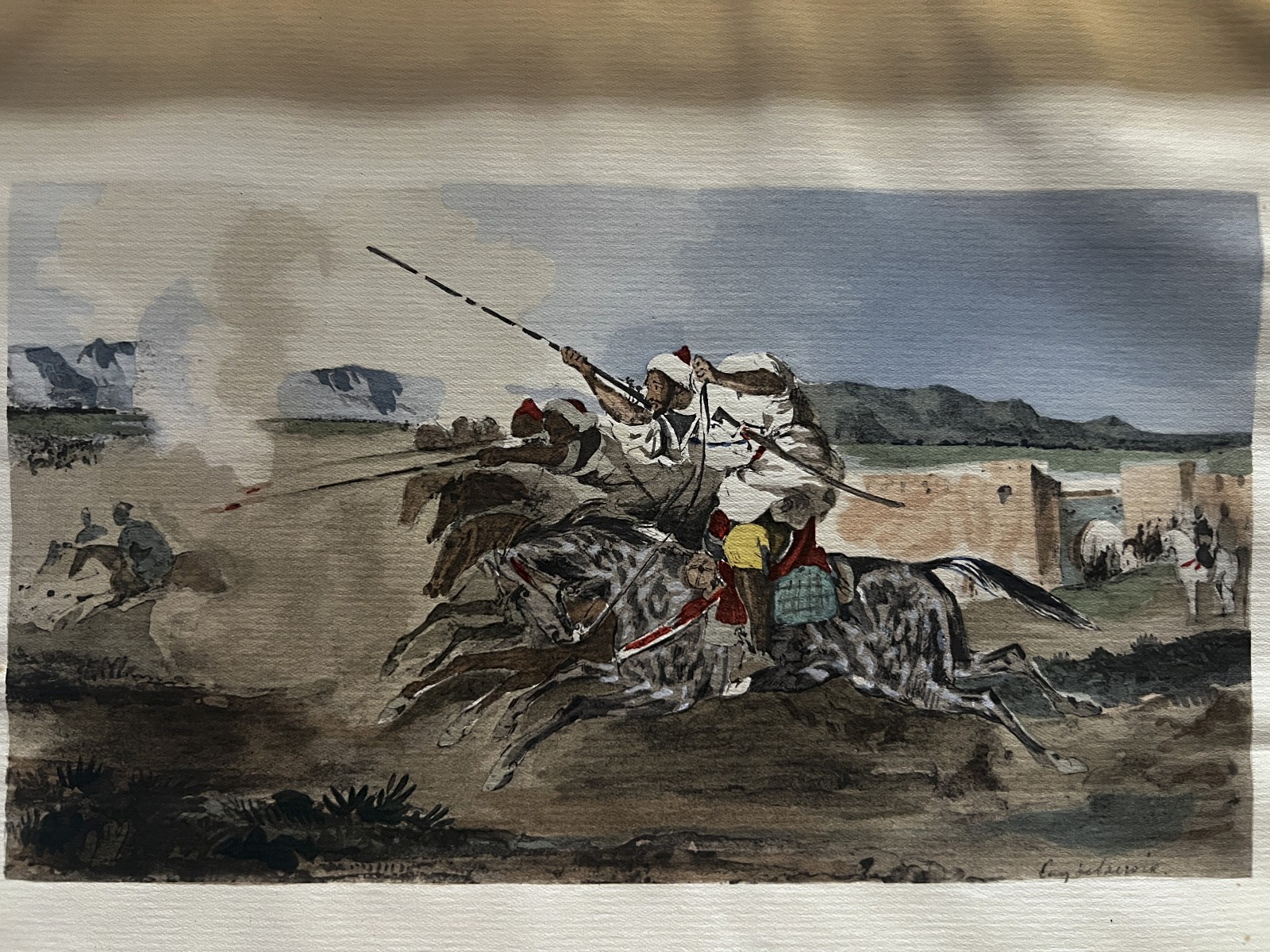
The plates are phototypie (collotype), executed by the celebrated Paris atelier Catala Frères — the finest photomechanical process of the period and the only one capable of true continuous tone. Because collotype uses a reticulated gelatin grain rather than a halftone screen, there is no dot pattern whatsoever: the color plates reproduce Delacroix\'s washes, transparent glazes, and opaque white gouache highlights with a fidelity that genuinely reads as original watercolor in hand. Each plate is tipped in and protected by a printed tissue guard bearing its caption.
Subjects include Delacroix\'s North African material — Plate 30 is Juives d\'Alger, the pastel study for Les Femmes d\'Alger (Musée du Louvre) — alongside Moroccan watercolor studies of seated figures, interiors, and textiles.
A scarce and unusually beautiful example of French interwar art publishing, and a serious reference for anyone working on Delacroix\'s Morocco and Algeria drawings.
The opening essay is byAndré Joubin — the editor of Delacroix\'s Journal and Correspondance, the leading Delacroix scholar of the period.The essay\'s argument is that Morocco gave Delacroix not the Orient but Antiquity — that he went looking for the picturesque and instead found living Romans, and that this, not the color, was the decisive revelation. Joubin\'s claim that \"the theory of reflected colour, the mother of Impressionism, came out of the Moroccan studies\" is a strong 1930 art-historical position, stated as settled fact. The passage on Ali Bey and \"Western ideas have all but ruined that civilisation\" is straightforwardly colonial-nostalgic.