Heat.net Store Home
|
Fort Leavenworth - 1908–1914 - U.S. Army Post Kansas -- 33 original photos For Sale

When you click on links to various merchants on this site and make a purchase, this can result in this site earning a commission. Affiliate programs and affiliations include, but are not limited to, the eBay Partner Network.

Fort Leavenworth - 1908–1914 - U.S. Army Post Kansas -- 33 original photos:
$225.00
The perfect giftfor Army personnel who have spent time at Fort Leavenworth-- one of a kind --- Fort Leavenworth Military Photo Album -- c. 1908–1914— 33 OriginalPhotographs of Army Officer Training, Early Machine-Gun Drill, MilitaryEngineering and Post Life. - A pathway along the Missouri — c. 1908–1914.
A wooded pathway near the Missouri River bluffs at Fort Leavenworth. It documents the post’s recreational landscape and its close physical relationship with the river. - The old College Building — c. 1908–1914.
Captioned, “The old College Building as I found it upon my arrival here,” this probably depicts Building 44, the original home of the School of Application for Infantry and Cavalry. Its autobiographical wording suggests that the album maker attended or served at the Army school. - The College Building as it appears today — c. 1908–1914.
The expanded Grant–Sherman–Sheridan Hall complex, including Grant Hall’s prominent clock tower. Paired with Photograph 2, it illustrates the rapid growth of professional officer education at Fort Leavenworth. - Merritt Lake, scene of bridge building — c. 1908–1914.
Merritt Lake served as an outdoor engineering laboratory where officers constructed pontoon, spar, trestle and pile-supported bridges. The view establishes the setting for the album’s later photograph of a student-built bridge. - The Hospital — c. 1908–1914.
Probably the third Fort Leavenworth post hospital, opened around 1902. Its long ward wings and porches reflect contemporary emphasis on ventilation, sanitation and organized military medical care. - Pope Hall — c. 1908–1914.
Captioned as the “Place of entertainments and hops,” Pope Hall hosted dances, receptions and theatrical or musical events. It documents the formal social life of student officers, instructors and military families. - Bridge built by one of the classes — c. 1908–1914.
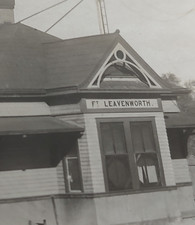
A timber through-truss bridge erected as a practical military-engineering exercise, probably near Merritt Lake. This is one of the album’s most important photographs because it directly records hands-on officer training. - Fort Leavenworth Railroad Station — c. 1908–1914.
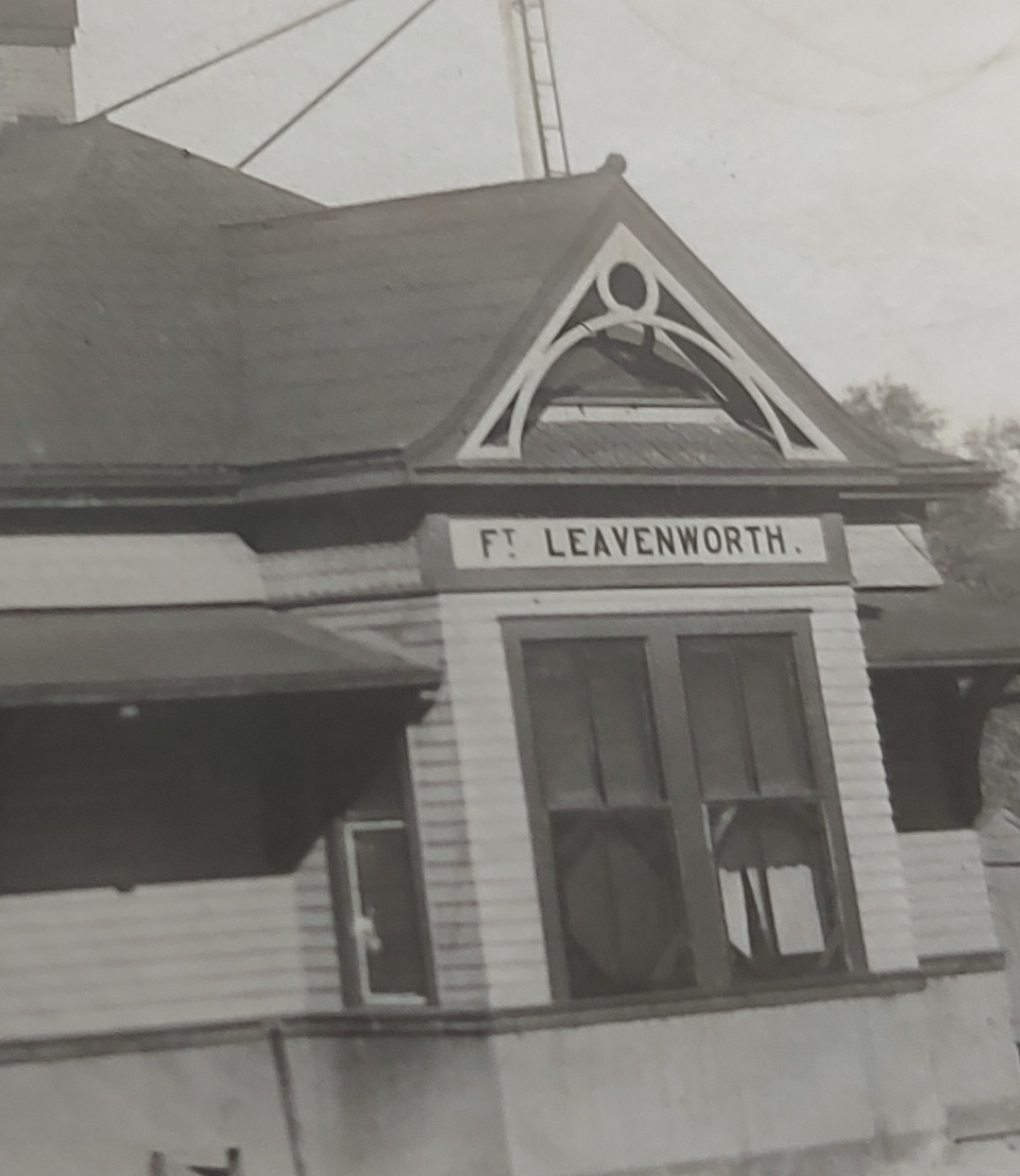
The post depot, tracks and overhead signal apparatus are clearly visible. It handled arriving student officers, troops, families, mail, baggage and military supplies. - YMCA and Catholic Church — c. 1908–1914.
The foreground building is the post YMCA, while the spire at left belongs to St. Ignatius Catholic Church. The image documents recreation, moral-welfare programs and religious life; St. Ignatius was destroyed by fire in 2001. - The old fortification wall — c. 1908–1914.
A surviving stone feature already promoted as a historic Fort Leavenworth landmark on postcards by 1904–1905. Its precise original defensive or boundary function requires additional research. - College tower, Riding Hall and stables — c. 1908–1914.
A broad view of the equestrian complex, with Grant Hall’s tower in the distance. The barns, begun in 1905, supported mounted training and housed horses and mules used for cavalry, artillery, engineering and transportation. - Episcopal Church — c. 1908–1914.
Probably Memorial Chapel, constructed in 1878 from locally quarried stone with military-prison labor. It documents Protestant worship, military memorial traditions and family ceremonies on the post. - Thomas Avenue officers’ residential district — c. 1908–1914.
A tree-lined avenue of officers’ family quarters, sidewalks and broad roadway. It records how military rank and domestic status were expressed through housing and neighborhood design. - Officers’ Club — c. 1908–1914.
The club provided dining, receptions, conversation and informal professional networking. The image contributes to the album’s strong record of the social institutions surrounding the Army school. - “Bachellors’ Hall” — c. 1908–1914.
The caption’s original misspelling is retained. This long residential building housed unmarried officers and reflects the Army’s separation of housing according to marital status as well as rank. - Augur Avenue officers’ residential district — c. 1908–1914.
A quiet avenue of detached or duplex officers’ quarters, probably named for General Christopher C. Augur. The lack of automobiles and horse-oriented road layout support an early twentieth-century date. - Grant Monument and fortification wall — c. 1908–1914.
The Ulysses S. Grant statue, unveiled in 1889, stands near the old stone wall. The photograph connects Civil War commemoration with the Fort Leavenworth school’s developing professional traditions. - The General’s Home — c. 1908–1914.
The large official residence of Fort Leavenworth’s senior commander or commanding general. It hosted high-ranking officers, visiting dignitaries, formal receptions and other official functions. - Meade Avenue officers’ residential district — c. 1908–1914.
A lively streetscape containing pedestrians and horse-drawn traffic among substantial family quarters. It is particularly useful for understanding everyday life in the officers’ neighborhood. - Pope Avenue officers’ residential district — c. 1908–1914.
A second labeled view of the post’s organized residential landscape. Together with the other avenue photographs, it forms a substantial architectural survey of military-family housing. - “A gatling gun detachment at drill” — c. 1908–1914.
Despite the caption, the weapon is almost certainly a water-cooled U.S. Maxim Automatic Machine Gun, Model of 1904, not a multi-barrel Gatling gun. This exceptionally important photograph shows an approximately six-man crew training with one of the Army’s first standard automatic machine guns. - A view of the Missouri River — c. 1908–1914.
A broad view over the river and floodplain from Fort Leavenworth’s elevated position. It documents the transportation corridor and strategic geography that led the Army to establish the post there in 1827. - A woods scene in the center of the post — c. 1908–1914.
A wooded ravine or natural drainage area within the developed reservation. Such terrain also offered opportunities for field sketching, map reading, riding and tactical exercises. - Another section of the post — c. 1908–1914.
A sloping, tree-covered area with portions of post buildings visible through the landscape. Its precise location remains unidentified, but comparison with contemporary maps may eventually resolve it. - Another view of the Missouri from the post — c. 1908–1914.
A scenic view from the Kansas bluff toward the opposite Missouri bank. It records the river before later channelization, bank stabilization and extensive modern development. - Troops marching on West End Parade — c. 1908–1914.
Several organized bodies of troops perform a close-order maneuver, with Sheridan Heights in the distance. The image illustrates training in discipline, formation changes and unit command. - Troops formed on West End Parade — c. 1908–1914.
Multiple companies, platoons or instructional sections stand separately across the parade ground. The panoramic composition documents the scale of the garrison and possibly a battalion drill or inspection. - A summer scene — c. 1908–1914.
A wooded part of the post photographed in full foliage. Paired with the winter scene, it suggests that the album maker remained at Fort Leavenworth through multiple seasons. - A winter scene — c. 1908–1914.
A snow-covered landscape with mature trees and tracks crossing the foreground. It documents the climate affecting training, transportation, horse care and everyday post life. - Officers’ horses on picket line — c. 1908–1914.
Approximately ten to twelve mounts are tethered beneath trees, possibly awaiting their riders or resting between exercises. The image records officers’ continued reliance on horses for training, transportation, ceremony and recreation. - Meade Avenue again — c. 1908–1914.
A second, distinct view of Meade Avenue showing large porches, formal yards and officers’ quarters on both sides. It complements Photograph 19 by providing clearer architectural detail. - Scott Avenue officers’ residential district — c. 1908–1914.
A long, nearly symmetrical view down an unpaved or lightly surfaced residential avenue. Sidewalks, open drainage and mature trees make it valuable for reconstructing the historic street plan. - Rock Island Bridge across the Missouri — probably c. 1908–1913.
The 1872 Kansas and Missouri Bridge connected Fort Leavenworth with Platte County and the national railroad system. Because the photograph appears to show the bridge intact before its damaging 1914 fire, it provides the album’s strongest probable latest-date limit.
|
|
Other Related Items:
Related Items:
Antique Fort Leavenworth Penitentiary Sterling Silver 925 Kansas Souvenir Spoon $125.00
1848 Notes Of A Military Reconnaissance From Fort Leavenworth To San Diego $325.00
Fort Leavenworth - 1908–1914 - U.S. Army Post Kansas -- 33 original photos $225.00
|