When you click on links to various merchants on this site and make a purchase, this can result in this site earning a commission. Affiliate programs and affiliations include, but are not limited to, the eBay Partner Network.
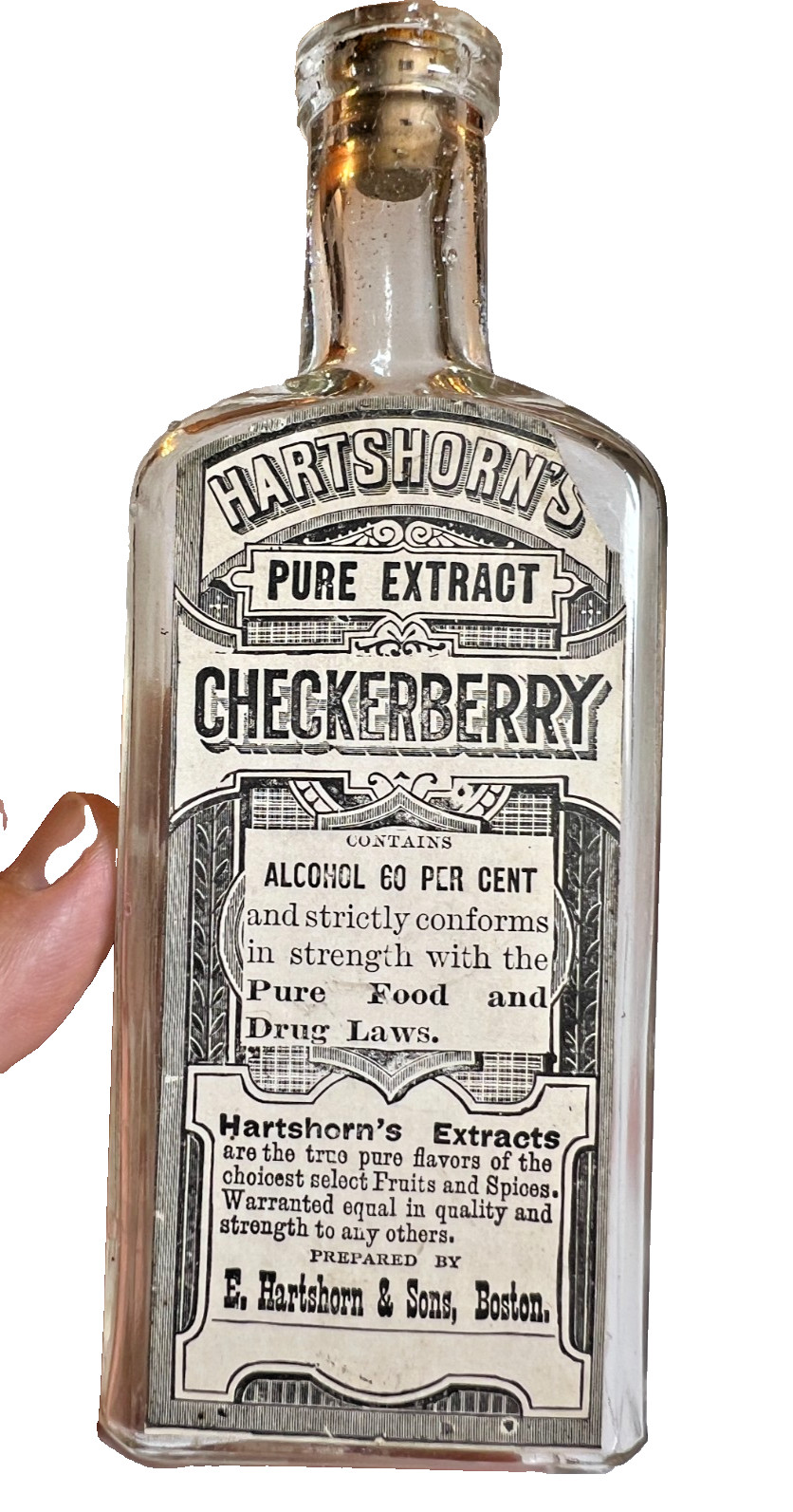
“Hartshorn’s Pure Extract Checkerberry”
Prepared by E. Hartshorn & Sons, Boston
This is an original E. Hartshorn & Sons flavoring extract bottle from Boston, Massachusetts, likely dating from circa 1906–1915 — just after the enactment of the Pure Food and Drug Act of 1906, which your label actually references (“conforms in strength with the Pure Food and Drug Laws”).
Historical Context
E. Hartshorn & Sons were established Boston chemists and flavoring manufacturers known for high-grade extracts, essences, and household chemicals from the late 19th century through the early 20th. “Checkerberry” (the old term for wintergreen) was a popular flavoring in candies, medicines, and even toothpaste of the era.
The bottle boasts that it contains “Alcohol 60 Per Cent” — perfectly legal back then, since alcohol was the solvent for flavor extracts.
That bold “Pure Food and Drug Laws” note dates it neatly to the decade after 1906, when labeling transparency became mandatory.
Dating and Characteristics
Era: ~1906–1915
Color: Clear flint glass (post-1890 industrial glass, machine-made or late mold-blown)
Shape: Rectangular with beveled corners and narrow neck
Closure: Cork top
Embossing: “E. HARTSHORN & SONS / BOSTON” on reverse panel
Label: Striking black-on-white typography with scrollwork, borders, and shaded fonts — textbook early 20th-century packaging design.
Condition
Superb overall with strong embossing and near-complete front label.
Label shows only light corner wear and mild age toning; glass is clean and clear with no cracks or chips visible.
A remarkably crisp survivor for its age.
Scene: A Boston Kitchen, circa 1910
The kitchen smells of coal smoke, yeast, and something faintly minty—the sharp sweetness of Hartshorn’s Checkerberry Extract just splashed into a bowl of dough. Sunlight filters through lace curtains, landing in geometric patterns on an enamel-topped table where a housewife in a long calico dress works briskly, sleeves rolled to her elbows, cheeks pink from the oven’s heat.
The extract bottle—your bottle—sits near the flour tin. Its black-and-white label, with its confident Victorian flourishes, catches the light each time she turns it. “Contains Alcohol 60 Per Cent,” it boasts in tiny letters, a quiet promise of potency in an age before decaf, diet, or moderation. She uses it sparingly, not only because it’s strong, but because it cost nearly fifteen cents, and fifteen cents bought a pound of sugar or a quart of milk.
Behind her, a cast-iron range hums softly with wood and coal, its stovepipe snaking upward like a black spine into the chimney. There’s a hand-cranked coffee mill on the counter, a butter churn in the corner, and a copper kettle steaming with the day’s washwater. On the table lies a copy of The Boston Cooking-School Magazine, open to a recipe for “Checkerberry Sponge Drops,” with a small ad in the margin for “Hartshorn’s Extracts—Boston’s Purest Flavors.”
Out the open window, you can hear horses clip-clopping down the cobblestone street, but the new sound that makes everyone pause is the stuttering cough of an automobile engine—a black Model T, recently purchased by the grocer’s son. The scent of exhaust mingles oddly with the aroma of cinnamon and wintergreen.
The walls are lined with jars—preserves, pickles, molasses—each sealed with wax or tin lids, each flavored, in some small way, by these same kinds of extracts: lemon, almond, vanilla, and checkerberry. The family’s oak icebox hums faintly from blocks delivered that morning. Over the sink, a window box of geraniums nods toward the Charles River, where trolleys rattle and smoke stacks lean into the industrial skyline.
When the cookies finally come out—round, pale, faintly pink from the checkerberry—they rest on a wire rack while the bottle is wiped clean and returned to its place on the shelf beside its cousins: E. Hartshorn & Sons Lemon, Almond, and Rose Extracts. The label, even then, looked slightly too ornate for its simple task—its scrolls and serifed letters designed to reassure, to make the ordinary act of baking feel modern, trustworthy, scientific.
The Broader World Outside
In 1910 Boston, the telephone was a new luxury, the electric light a modest miracle, and the automobile still an event. Radios hadn’t yet come to hum in kitchens; women still rolled pastry by hand; and even the most forward-thinking homemakers swore by the old Boston brands. Hartshorn’s was a mark of local pride—pure, potent, and respectably scientific, now that the government had cracked down on the snake-oil crowd.
To open that bottle today is to open a tiny time capsule of that world:
the mingled scents of coal smoke, flour dust, and optimism, and the steady hum of progress that turned the old kitchen into the heart of a new century.