When you click on links to various merchants on this site and make a purchase, this can result in this site earning a commission. Affiliate programs and affiliations include, but are not limited to, the eBay Partner Network.
NOTE: If you go into “Seller’s Other Items” you can find another listing like this, but with $5 off. A no advertising listing allows me to lower price. Another words, this item is $39.99 in my other listing, rather than $45 in this one.
This listing is for 1 Polyembryonic seedling clone, about 2 feet tall. Polyembryonic clones produce fruit in 2-3 years. Monoembryonic seedlings take 8-10 years. Read below.
Mango Master:
Captain L. L. Bucklew began planting mango trees in Encinitas, San Diego County, before World War II. By 1956, he was up to 172 trees. Bucklew’s grove was the first commercial planting of mangos in California, and today, fourteen of these historic trees are still growing and fruiting.
By 1940, he had 150 trees growing. Some were grafted trees while many others were seedlings. The varieties Bucklew had going included Haden, Cambodiana, Sandersha, Bombay, Gordon, Florida Apple, Johnson, Brooks Late, Caraboa, Filipino, and Manila. He had brought them in from all over the globe: Jamaica, India, Mexico, Florida, Honduras, Hawaii, etc.
And though he was trialling 32 varieties, “some varieties mature very slowly, or not at all,” he wrote. Their fruit grew so slowly without the required heat that they were barely ready to pick in December when the nights had cooled down or they never completely matured before winter arrived.
Bucklew realized that he needed “early” varieties. He sought varieties that matured in April and May in tropical locations. Bucklew then planted the first successful commercial mango tree grown in California, the Florigon.
Mangos are thought to have originated in or near India, and among those locals who bought mangos from Bucklew were immigrants from India. A couple miles from the grove in Encinitas is a Self-Realization Fellowship center on the bluff overlooking the Pacific Ocean, below which breaks a righthand surfing wave called Swami’s. It is named after the founder of the center, Paramahansa Yogananda.
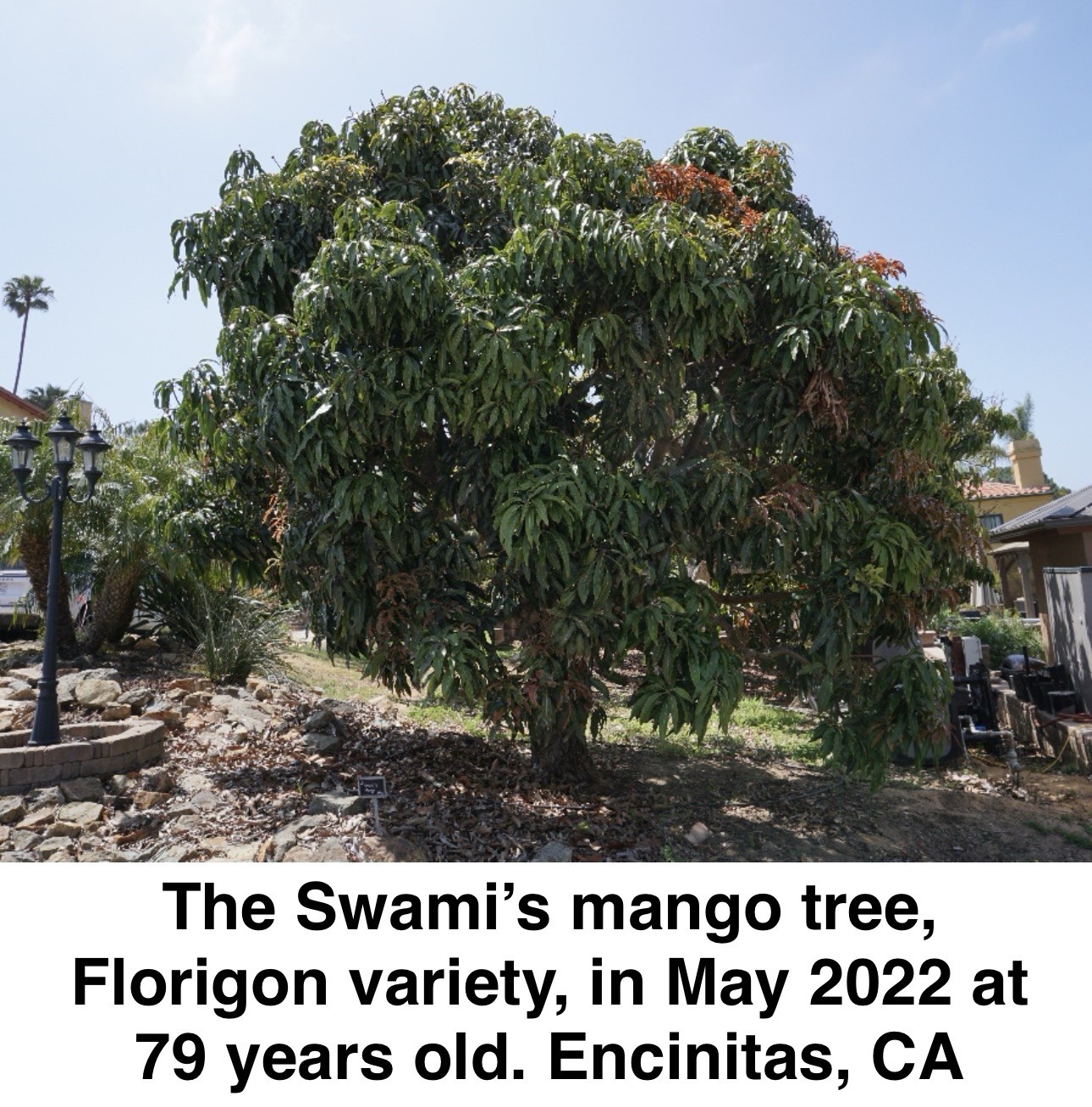
Bucklew kept notecards about all of his trees, and one of the cards reads that in 1943 he planted a seedling given to him by “the Swami.” The tree grew and was later grafted to a variety called Florigon.
Mango trees grow better from seed than from grafted trees:
The master mango Captain Bucklew said his most successful mango trees grew from seedlings. Bucklew’s view that mangos usually grow better if planted as seeds or small seedlings. This is opposed to planting grafted mango trees. The difficulty of planting grafted mango trees is that they immediately try to flower and make fruit rather than grow a framework of branches first (as seedlings do).
By the way, if you ask around today you’ll find that many experienced backyard mango growers in California still affirm Bucklew’s view that mangos here usually grow better if planted as seeds or seedlings.
People have planted mango trees in California that have not produced good fruit in 50 years. Don’t make the mistake of buying a name, rather than buying success. A lot of unmindful, uninformed, people will sell you a failure. Out of hundreds of mango varieties, only a handful will be successful outside of South Florida. Only a handful will be successful in a Mediterranean climate, most need sub tropical or tropical.
And when I say success, I mean hundreds of quality, great tasting fruit. I don’t mean a small box of mangoes, or a bland Kent mango. I mean top tier, shock you with awe, golden orange yellow flesh (not pale yellow), best fruit you ever tasted success. Make you look at store bought varieties with disgrace, saying to yourself, how could they sell such tasteless garbage to people. I’ll tell you why they sell the cardboard mangoes. It’s because they have thick skin, don’t rot, and transport cheap and easy. The incredible polyembryonic Indo-Chinese mango varieties have thin skin, and bruise easy. Not good for mass transport, but good for your backyard!
The Florida Mango connoisseur favorite strain, the Florigon!
Polyembryonic seeds produce perfect clones of mother tree. Polyembryonic clone will produce fruit bearing trees in 2 to 3 years. Regular monoembryonic seeds make one hybrid, not like the mother, take 8 to 10 years to fruit, and the fruit can come out stringy and sour.
Most Nursery people want to sell you multiple grafted trees so they can bank. They spread the false information that a mango tree from seed takes 8 to 10 years to fruit, and the fruit can end up being bad. This is the case for Monoembryonic seeds, but NOT Polyembryonic! I repeat myself, a mango tree grown from a Polyembryonic seed is an exact clone of mother tree, same vigor, disease resistance, and same delicious fruit being produced in 2-3 years. 2 years if you use fertilizer and know how.
I can’t believe people are buying mango seedlings off people who don’t even show actual pictures of the fruit they grew it from. Not even actual pictures of mother tree. People are stupid and getting scammed. Doesn’t not having a picture of actual mother tree raise suspicion. With all the scamming going on, why would you trust someone without real genuine actual pictures? If you know mango horticulture, you know most unknowns produce bunk fruit. Another words, where I live theirs mango trees on public lands. 9 out of 10 of these random trees produce subpar fruit and the one will be just fair. Genetics matter, and a clone secures success. Let me try to help you understand with this comparison. You want an Einstein. Would you take his son, or do you want a clone. A Einstein is rare, so is a phenomenal mango tree. Now imagine people selling you an Einstein, when it is his son or daughter, not nearly as good as a clone. People selling mango seeds and trees from Monoembryonic seeds and naming it by the parent tree are scammers, knowingly or unknowingly. The mango tree is no longer the mango variety they got the seed from.
This is the Florigon mango. Best tasting mango grown in Florida. I have Kent, it’s not even close. I have Nam Dok Mai, not even close. The Nam Doc Mia might be better in other countries, but here in Florida, with sandy soil, it gets watered down with all the rain. It tastes like watered down sugar. The Florigon is sweet with a peach apple flavor, with the strong mango flavor. It has a little spice to it and a nice little tang. It is very floral, more than any other mango I’ve ever had. Smells like flowers while you eat it. The Florigon has a very complex taste.
If the Florigon mango is so much better than all the other Florida grown mangos, why are they not grown and sold commercially? The answer is in the skin. Florigon mangos have thin skins, not good for mass transport. The business people decided they can make more money with thick skinned, easy to transport, subpar mangoes.
Lots of fancy named mango trees are just not going to produce that much fruit, never. You just get a fancy name. For instance, a coconut cream is a popular sold tree. People are buying this lousy producing tree because they want a coconut flavored mango, then they don’t get mangoes for 8 years. When they finally get a coconut cream mango they only get one box full. Are the sellers disclosing how awful the tree is, or they just want to make money. The Florigon will produce copious amounts of peachy apple mangoes to fill dozens of boxes. The Florigon was a commercial prospect. Growing the Florigon you can open a farm stand, make mango ice cream, mango pancakes, and give boxes of mangoes to friends. It’s weird watching YouTube people with their fancy named mango trees, having bunk harvest, and thinking they are doing good. The Florigon will stock up your freezer, get you canning, or using a food dehydrator. You can even do what they do in Asia and Hawaii, make mango pickles out of unripe mangos. Mango pickles are so good if you like sour. Mango pickles are so popular outside of the US. Some Indian households use them as daily condiment. The best pickles I ever had, especially with sandwiches. Cheers.
I just had a dozen Fruit Punch mangoes. I put them in box next to a box of Florigons. I ate one before fully ripe, tasted bland. Sure is a pretty mango, perhaps it’s named after looks and not taste. So I let them fully ripen to try. They all got rotten before they got fully ripe. The Florigons got perfect. You ask why? The answer is Anthracnose and Black Spot. The Fruit Punch Variant is acceptable to the disease. The Florigon is highly resistant to Anthracnose and Black Spot. This is what these people are selling you, mango trees that only do good in their parent native lands. Mango trees that produce mangos that rot before fully ripening. I give some credit to breeders, they bred the Florigon, but the greed to patent another failed product to make money is mind boggling. I would have destroyed the tree. And the greed of nurseries to sell trees promising good fruit, and having the audacity to only show a picture of an opened unripe Fruit Punch mango is crazy. Why won’t they show an actual pick of a golden flesh ripe Fruit Punch mango on their property? The answer is they all get rotten. All these greedy nurseries care about is to sell someone with property 10 different graft trees so they can make 1k+ profit. Welcome to false advertising and false promises. I wouldn’t sell you any of my bunk mango strains, that I would not want myself, even though I could sell them with their names alone. I am not some unmindful nursery worker. I practice mindfulness and do to others as I would want them to do for me. Florigon mango trees are not just disease resistant, but cold hardy, and have been successfully grown in California. Invest in a guaranteed delight. Cheers
I have a huge Kent mango tree. I would feel ashamed of myself if I was selling this variety. I have eaten California store bought Kent’s too. The only way you could think they are good is if you never had a good variety off a backyard tree to compare. They are only good for commercial purposes because they transport easy without bruising or rotting. Kent’s a true disgrace to the glory of mangos.
Golden fiberless fruit that ripens excellent off the tree. This is not the case for many mango varieties. Some mango varieties taste bland ripened off tree, like a US store bought mango, yuck! This means you can eat fruit for months every year, not just at once when all the animals are eating them. Just put in box or bag and wait 3 to 7 days, checking on them. Sweet as better than candy.
Sellers are selling all different varieties of mangos. Some of these varieties may be better than the Florigon in other countries. Remember they just want to sell you a bunch of different grafts. You have to realize that in Florida we have different soil, different pests, different weather patterns, and different fungi. What is the good in having a tree that only produces a few handfuls of mangos. For instance, the Nam Doc Mia is the most popular in Thai. And in a jungle atmosphere with rich soil it probably tastes amazing. However in Florida sandy soil with heavy rains during fruiting, it gets “watered down.” The Nam Doc Mia grown in Florida has barely any taste. Some sellers are selling Tommy Atkins and other commercial strains. I would not wish these bland mangos on anyone. Also, remember vigor, pest, and disease tolerance. I grew up in Florida, I have never seen anything as good as the Florigon. Remember, most of these people don’t care about you. All they care about is making money. I do care, and want you to be enlightened.
I know of no Florida grown mango variety that is as vigorous, disease resistant, and as tasty. The Turpentine Mango is as vigorous and disease resistant, but it is stringy and only can be used for juice. This Florigon produces copious amounts of mangos, and grows so big and fast. I don’t even eat my Kent’s or my Nams. Every time I try a different kind around town I am NOT impressed. I do eat my Sugarloafs, I like them, but it simply doesn’t produce as many mangos as the mighty Florigon.
Warning: is full of mango tree and seed scammers. Here are some warning flags. Shipping is coming from northern area like Brooklyn. These are coming from imported fruit from Asian grocery store. These foreign varieties have proven to be failures in the US. They are not acclaimed to the USA. Theirs a reason for breeding programs and University studies in breeding mango trees, to make them successful in the US. Some successful bred mango tree varieties are then patented. The next problem with these seeds being sold is tropical fruit seeds have a short lifespan. It is common in the forums for someone who buys tropical fruit seeds that end up not growing. These northern area sellers who store mango seeds end up sending you expired seeds. I am shipping from South Florida fresh. The next scam is people selling trees and not posting genuine actual pictures of mother tree. These scammers post obviously fake photo shop pictures. Tiny tree with doctored huge mangos coming off it like bananas. Come on people, If the guy won’t show you an actual picture of mother tree but resorts to a fake picture doesn’t that raise suspicion. The mother tree must look like bad genetics or he just doesn’t have it. A subpar seedling named whatever will make him money. It is mind boggling to see all the victims of these scammers, and to not be able to stop them. All I can do to help is try to spread awareness.
Dairy free and no added sugar mango ice cream:
1 quart of fresh mango
1 can of coconut milk or cream
1/2 teaspoon of salt
(Optional) Stevia
(Optional) pistachios chopped in coffee grinder
(Optional) one lemon
(Optional) one pinch of cayenne pepper
Blend all then put in ice cream machine. If no ice cream machine just freeze in bowl. Before fully frozen solid cut into pie slices, as it will be harder to scoop without sugar added, but still delicious.