When you click on links to various merchants on this site and make a purchase, this can result in this site earning a commission. Affiliate programs and affiliations include, but are not limited to, the eBay Partner Network.
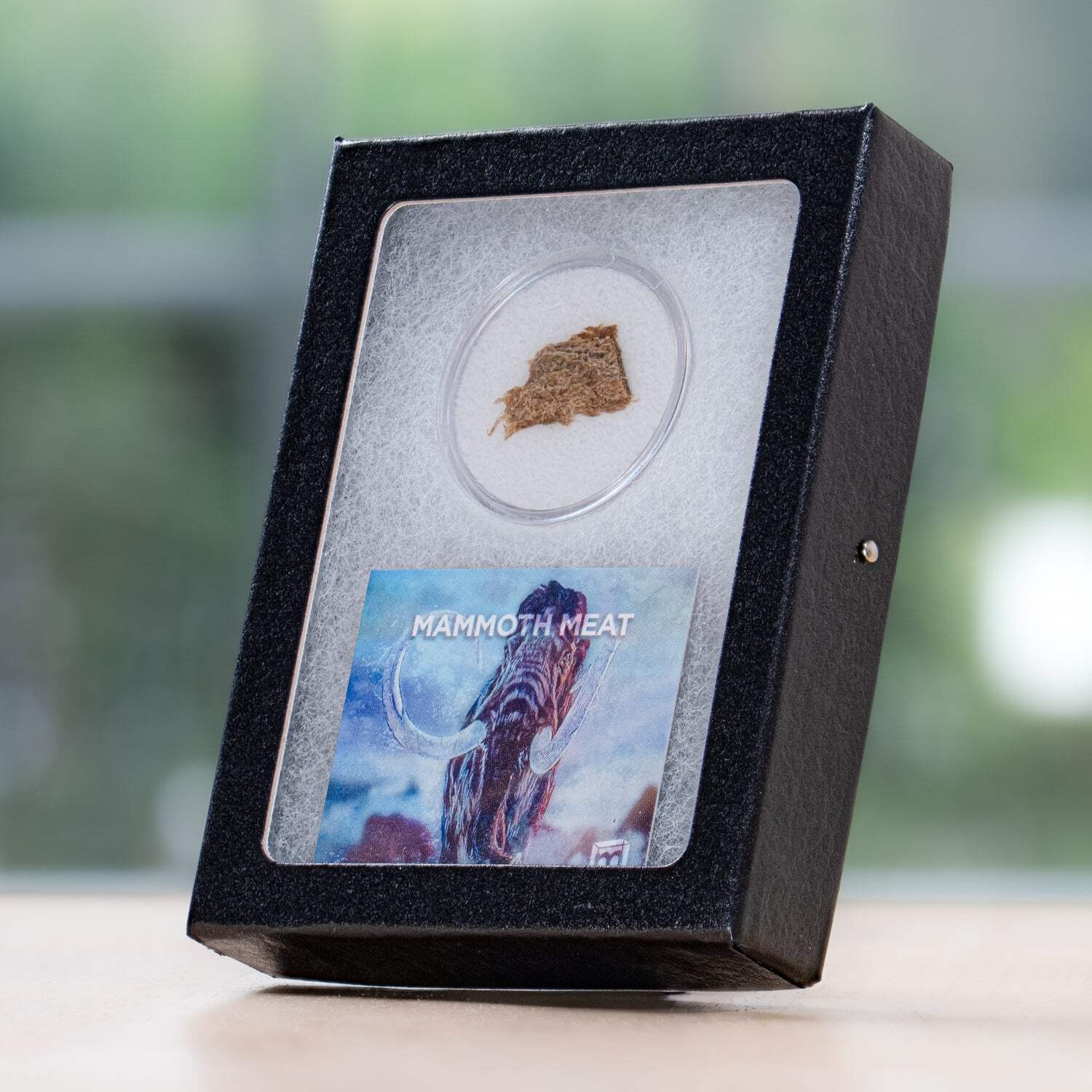
Mammoth MeatRadiocarbon-dated to 19,551 years old! Above: Front of Specimen Card "Various legends exist about frozen mammoths. It has been said that the scientists who excavated the Beresovka mammoth, discovered in the year 1900, enjoyed a banquet on mammoth steak. What really appears to have happened is that one of them made a heroic attempt to take a bite out of this meat but was unable to keep it down, in spite of a generous use of spices." ~ Björn Kurtén in "How to Deep Freeze a Mammoth" This specimen is a fragment of a woolly mammoth muscle tissue, radiocarbon dated to 19,551 years old. The specimen comes from a well-preserved wooly mammoth leg discovered near the Indigkra River in Siberia, Russia. It first appeared in the Second Edition of the Mini Museum. We're pleased to offer it once again as a single specimen. Above: The original leg as discovered in Siberia. This piece is now displayed in a museum in Japan. As you might expect, each tissue fragment is unique. The pieces vary widely in size, shape, color, and texture. We do not recommend or endorse the consumption of this item. It is not food. It is a display piece. Above: A close-up of a large section of mammoth muscle tissue. The specimen comes in an acrylic jar, which housed inside a glass-topped Riker display box measuring 4x3x1 (inches). A small information card accompanies the specimen and serves as the certificate of authenticity. Please Note: We have not stabilized this material with resin. It is very firm, like leather, but we recommend treating it as fragile as it can shed dusty bits. For this reason, we've placed each specimen in an acrylic specimen jar. We recommend keeping it in the jar at all times as it can be fragrant when exposed. About the Woolly Mammoth Roughly the mass of a modern African elephant, the woolly mammoth evolved some 400,000 years ago in Siberia from the steppe mammoth widespread on that continent, and ultimately spread westward into Europe and eastward into North America via the Beringian land bridge that once connected modern-day Russia and Alaska. This event may have been the second mammoth invasion of the New World, as the steppe mammoth forayed to North America about 1.5 million years ago and evolved there into the endemic (and enormous) Columbian mammoth. In Pleistocene North America, woolly mammoths primarily roamed the cold, treeless tundra-grasslands immediately below the continental ice sheets—the American reach of the mammoth steppe—while Columbian mammoths occupied a more southerly, temperate range encompassing most of today's Lower 48 States and which extended deep into Mexico.They shared this territory with fellow Pleistocene grazers, subsisting mainly on grasses and sedges along with willows, alders, and other stunted trees that grew sparsely in the high-latitude steppe lands, far more diverse biomass than the modern Arctic tundra. After disappearing from continental ranges roughly 10,000 years ago, small, isolated populations of woolly mammoth survived on Alaska's St. Paul Island until about 5,600 years ago and on Russia's Wrangel Island until perhaps 4,000 years ago. All of these pockets eventually died out due to the lack of genetic diversity that comes from metropolitan interactions with larger populations. Above: Back of Specimen Card Mammoth Meat
Radiocarbon-dated to 19,551 years old!
Above: Front of Specimen Card
"Various legends exist about frozen mammoths. It has been said that the scientists who excavated the Beresovka mammoth, discovered in the year 1900, enjoyed a banquet on mammoth steak. What really appears to have happened is that one of them made a heroic attempt to take a bite out of this meat but was unable to keep it down, in spite of a generous use of spices." ~ Björn Kurtén in "How to Deep Freeze a Mammoth"
This specimen is a fragment of a woolly mammoth muscle tissue, radiocarbon dated to 19,551 years old. The specimen comes from a well-preserved wooly mammoth leg discovered near the Indigkra River in Siberia, Russia. It first appeared in the Second Edition of the Mini Museum. We're pleased to offer it once again as a single specimen.
Above: The original leg as discovered in Siberia. This piece is now displayed in a museum in Japan.
As you might expect, each tissue fragment is unique. The pieces vary widely in size, shape, color, and texture. We do not recommend or endorse the consumption of this item. It is not food. It is a display piece.
Above: A close-up of a large section of mammoth muscle tissue.
The specimen comes in an acrylic jar, which houséd inside a glass-topped Riker display box measuring 4x3x1 (inches). A small information card accompanies the specimen and serves as the certificate of authenticity.
Please Note: We have not stabilized this material with resin. It is very firm, like leather, but we recommend treating it as fragile as it can shed dusty bits. For this reason, we've placed each specimen in an acrylic specimen jar. We recommend keeping it in the jar at all times as it can be fragrant when exposed.
About the Woolly Mammoth
Roughly the mass of a modern African elephant, the woolly mammoth evolved some 400,000 years ago in Siberia from the steppe mammoth widespread on that continent, and ultimately spread westward into Europe and eastward into North America via the Beringian land bridge that once connected modern-day Russia and Alaska. This event may have been the second mammoth invasion of the New World, as the steppe mammoth forayed to North America about 1.5 million years ago and evolved there into the endemic (and enormous) Columbian mammoth.
In Pleistocene North America, woolly mammoths primarily roamed the cold, treeless tundra-grasslands immediately below the continental ice sheets—the American reach of the mammoth steppe—while Columbian mammoths occupied a more southerly, temperate range encompassing most of today's Lower 48 States and which extended deep into Mexico.They shared this territory with fellow Pleistocene grazers, subsisting mainly on grasses and sedges along with willows, alders, and other stunted trees that grew sparsely in the high-latitude steppe lands, far more diverse biomass than the modern Arctic tundra.
After disappearing from continental ranges roughly 10,000 years ago, small, isolated populations of woolly mammoth survived on Alaska's St. Paul Island until about 5,600 years ago and on Russia's Wrangel Island until perhaps 4,000 years ago. All of these pockets eventually died out due to the lack of genetic diversity that comes from metropolitan interactions with larger populations.
Above: Back of Specimen Card
× × × × × ×
Buy now and save! Shipping info
Click the Shipping & Payments tab above the listing description for more info
Price: $7.00 (local shipping)
Click the Shipping & Payments tab above the listing description for more info!
Additional delivery notes
PICK UP OPTION
Sorry, our items are NOT available for pick-up.
PAYMENT
Immediate payment is required upon selecting "Buy It Now" or upon checking out through the cart.
We accept payment via U.S. PayPal accounts and all Major Credit Cards, Debit Cards & Google Pay.
We are legally required to collect sales tax in those states and localities where we maintain a physical presence (nexus).
The applicable amount of sales tax charged to an order will be calculated based on the shipment destination's state and local sales tax laws.
Thank you for shopping with us on !
Additional Information
No additional information at this time
Ask seller a question
You might also like Space Shuttle Columbia - Flown Nose Landing Gear Tire Dracula Soil 🦇 - Cetatea Poenari Soil Sample - Vlad Tepes III - Halloween Decor Beatles Brick Fragment - The Cavern Club 25 Upton Green - The Beatles George Harrison House Contact
To contact our Customer Service Team, simply click the button here and our Customer Service team will be happy to assist.
Ask seller a question
© Mini Museum
Shipping & Payments
Shipping is a flat rate across US at a rate of $7.00
Payment
Accepted Payment Methods
Immediate payment is required upon selecting "Buy It Now" or upon checking out through the cart.
We accept payment via U.S. PayPal accounts and all Major Credit Cards, Debit Cards & Google Pay.
We are legally required to collect sales tax in those states and localities where we maintain a physical presence (nexus).
The applicable amount of sales tax charged to an order will be calculated based on the shipment destination's state and local sales tax laws.
Thank you for shopping with us on !
Returns
Returns are accepted
Items must be returned within 30 days of the sale ending
Buyer will pay for return shipping.
integration by