When you click on links to various merchants on this site and make a purchase, this can result in this site earning a commission. Affiliate programs and affiliations include, but are not limited to, the eBay Partner Network.
Overview:Bibliographic Details
Title: Untitled Legal and Parliamentary Commonplace Book
Date: Early 19th century, Possibly Sir George Chetwynd, 2nd Baronet Armorial bookplate attributed to Sir George Chetwynd, 2nd Baronet
Language: English
Pages: Approximately 300 manuscript pages
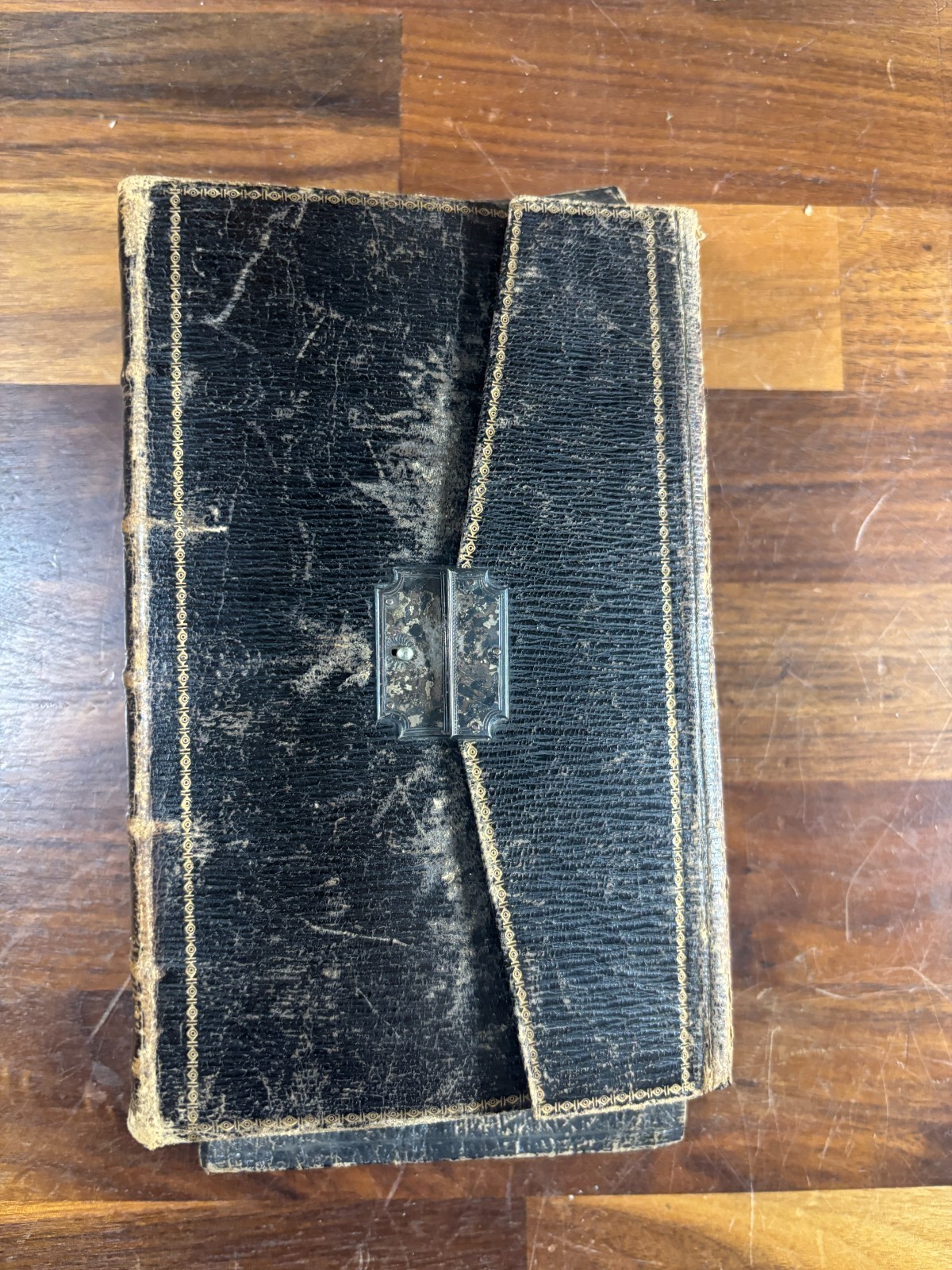
Binding: Black gilt-tooled leather with protective fore-edge flap and metal locking mechanism
Description
An extensive early nineteenth-century English legal manuscript, comprising approximately 300 handwritten pages in a consistent hand. The volume contains a carefully organised collection of judicial precedents, parliamentary proceedings, statutory references and legal commentary, together with contemporary printed newspaper extracts.
The manuscript covers numerous aspects of English law, including the independence and appointment of judges, the powers of justices of the peace, rules of evidence, registers, Poor Laws and constitutional matters. References include Lord Mansfield, the King\'s Bench and legislation dating back to at least 1777.
The volume appears to have been compiled as a private legal reference work, potentially by a practising barrister, magistrate or individual involved in parliamentary affairs.
Provenance: Sir George Chetwynd, 2nd Baronet
Of particular interest is the armorial bookplate attributed to Sir George Chetwynd, 2nd Baronet, a British barrister, politician and Member of Parliament for Stafford.
Chetwynd studied at Brasenose College, Oxford, and was called to the Bar at Lincoln\'s Inn in 1813. He subsequently served in Parliament and inherited the family baronetcy in 1824.
The manuscript\'s legal and constitutional subject matter closely corresponds with Chetwynd\'s professional background, raising the possibility that the volume was personally compiled or used by him. Although ownership is suggested by the bookplate, authorship has not been conclusively established.
The Chetwynd family was an established English landed family with roots in medieval Shropshire and Staffordshire. Family histories traditionally trace its ancestry to the Norman period, although direct descent from an individual accompanying William the Conqueror remains unproven.
Additional collector\'s bookplates are present, including one for Samuel Henry Hamer.
Historical Significance
Legal commonplace books were important working tools for barristers, magistrates and political figures throughout the eighteenth and nineteenth centuries. They enabled their compilers to collect relevant legislation, judicial decisions and constitutional arguments for future consultation.
This example is particularly interesting for its substantial manuscript content, consistent handwriting, contemporary printed extracts and possible association with a practising barrister who also served in Parliament.
Unlike a printed legal treatise, the volume offers a personal record of the legal subjects and precedents considered important by its compiler.
Binding and Condition
Bound in decorative black leather with gilt borders and an elaborately gilt-tooled spine, lettered \"MSS G.C.\" The binding incorporates an unusual protective fore-edge flap and metal locking mechanism.
Marbled endpapers are present, together with several historical bookplates.
The binding exhibits age-related rubbing, scuffing and general wear, particularly to the extremities. The manuscript leaves show expected age toning and occasional marks. The handwritten text remains generally legible.
The functionality of the locking mechanism has not been established.
Why Buy This Manuscript?
An unusual and substantial surviving example of an early nineteenth-century English legal commonplace book, containing approximately 300 pages of original handwritten legal research.
Its particular appeal lies in the combination of extensive legal and parliamentary material, an attractive locking binding, and provenance associated with Sir George Chetwynd, a barrister and Member of Parliament.
A fascinating historical manuscript for collectors of English legal history, parliamentary history, Georgian manuscripts and aristocratic - 614g
Height - 18cm
Width - 12cm
Thickness - 5.2cm