When you click on links to various merchants on this site and make a purchase, this can result in this site earning a commission. Affiliate programs and affiliations include, but are not limited to, the eBay Partner Network.
Medieval History France Political Theory & Philosophy of Christine de Pizan
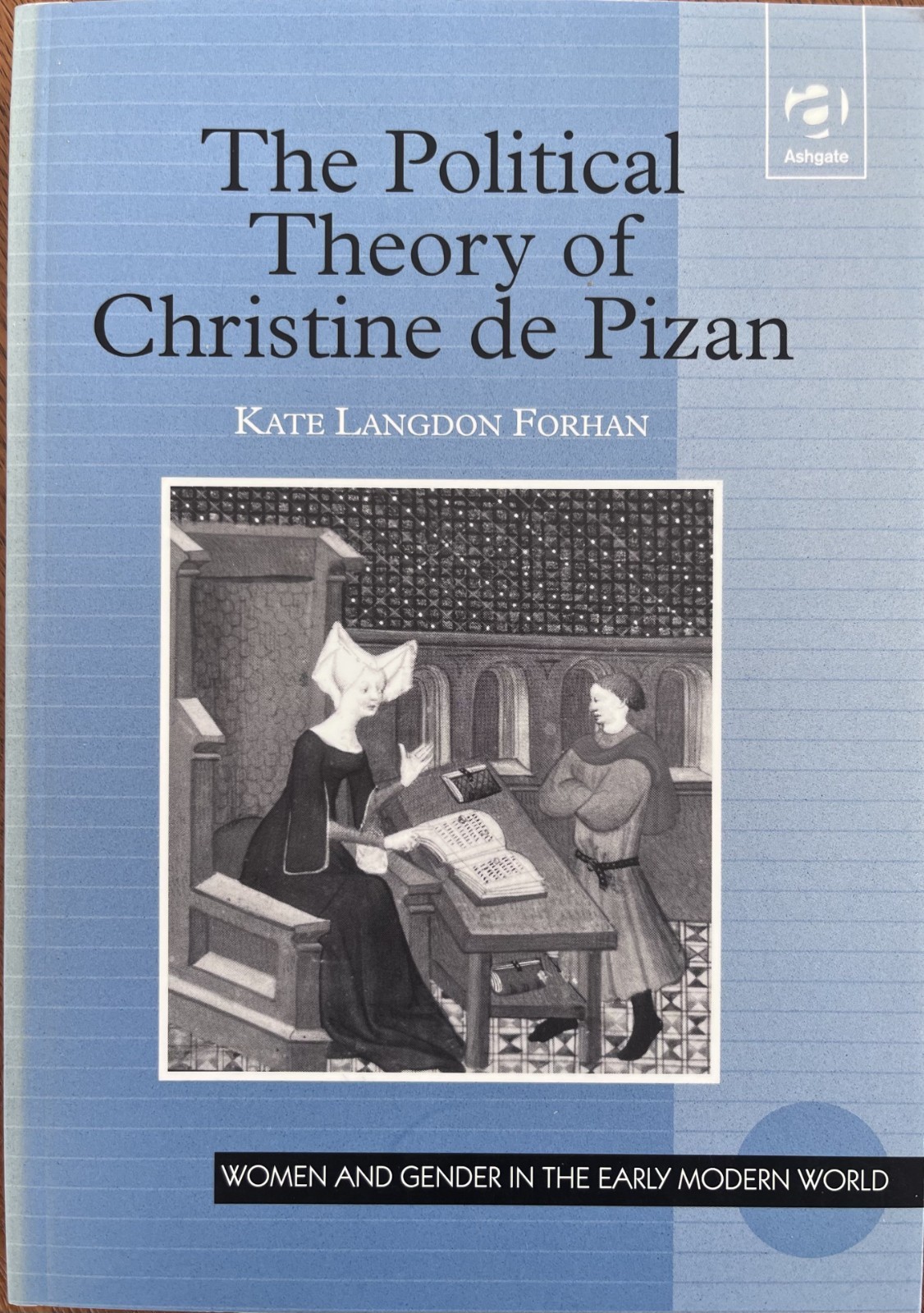
The Political Theory of Christine de Pizan by Kate Langdon Forhan is a comprehensive reinterpretation of the political thought of Christine de Pizan, positioning her as one of the most original and systematic political theorists of the late Middle Ages. Rather than treating Christine primarily as a literary figure or an early feminist anomaly, Forhan argues that she developed a coherent and sustained political philosophy that engaged directly with the crises of governance, justice, and authority in late medieval France. The book situates Christine’s work in the turbulent historical context of the late fourteenth and early fifteenth centuries, marked by the reign of Charles V of France, the mental illness of Charles VI, factional conflict between Armagnacs and Burgundians, and the wider devastation of the Hundred Years’ War between France and England.
Forhan begins by reconstructing Christine de Pizan’s intellectual and historical formation, emphasizing her position as an outsider within the French court: an Italian-born woman, the daughter of Tommaso di Benvenuto da Pizzano, a court astrologer to Charles V, and later a widowed mother supporting her family through professional writing. This social position, Forhan argues, sharpened Christine’s sensitivity to political instability, corruption, and moral failure. The early chapters explore Christine’s engagement with the mirror-for-princes tradition, particularly through dialogue with John of Salisbury and Giles of Rome, showing how she adapted classical and medieval political authorities to address the urgent problems of her own time rather than merely reproducing inherited doctrines.
Central chapters examine Christine’s conception of the body politic, kingship, and law. Forhan shows how Christine articulated a vision of political community grounded in justice, mutual obligation, and moral responsibility rather than brute force or hereditary entitlement alone. Kingship, in Christine’s view, demanded ethical self-discipline, attentiveness to counsel, and an obligation to the common good. These arguments are traced across her political treatises and advisory texts written for both princes and princesses, revealing a consistent concern with social harmony, equity, and institutional legitimacy in a period of profound political fragmentation.
A major contribution of the book lies in its treatment of Christine de Pizan’s writings on justice, law, and war. Forhan devotes sustained attention to Christine’s reflections on warfare, particularly in relation to the Hundred Years’ War and the internal violence tearing apart France. Christine’s views on just war, military discipline, and the moral limits of violence are shown to anticipate later political debates more commonly associated with early modern thinkers such as Niccolò Machiavelli, while remaining deeply rooted in medieval ethical and theological frameworks. Forhan argues that Christine’s treatise on warfare represents one of the most sophisticated medieval attempts to reconcile political necessity with moral restraint.
The concluding chapters and epilogue address the paradox of Christine de Pizan’s reception. Although widely read in manuscript and early print during the fifteenth and sixteenth centuries, especially works such as Le Livre de la cité des dames and Le Trésor de la cité des dames, Christine’s explicitly political writings gradually faded from prominence. Forhan surveys manuscript circulation, early translations, and later scholarly rediscovery, engaging with modern commentators including Charity Willard, Margarete Zimmermann, Angus Kennedy, and Glenda McLeod. The book argues that recognizing Christine de Pizan as a political theorist resolves many contradictions in her reputation, revealing her not as a marginal curiosity but as a thinker whose work speaks directly to enduring problems of governance, legitimacy, and moral authority in times of political crisis.
Christine de Pizan’s corpus of works, as outlined and discussed in the book, is extensive and varied. Her writings include Une Epistre à Eustache Morel; Le Livre des fais et bonnes meurs du sage roy Charles V; Le Livre du duc des vrais amants; Le Livre de la cité des dames; Le Livre des trois vertus, also known as Le Trésor de la cité des dames; L’Avision Christine; Le Livre de la prod’homie de l’homme or Le Livre de prudence; Le Livre du corps de policie; Epistre à Isabeau de Bavière, reine de France; Le Livre de la paix; Le Livre des fais d’armes et de chevalerie; Le Livre du chemin de longue étude; Le Livre de la mutation de fortune; Le Livre des epistres sur le Roman de la Rose; Le Dit de la rose; L’Epistre d’Othéa; Enseignemens à son filz; Proverbes moraux; Les Heures de la contemplation; and La Ditié de Jehanne d’Arc, her final poetic work celebrating Joan of Arc. Together these texts span poetry, allegory, moral instruction, political theory, and historical commentary, forming one of the most substantial authorial bodies of work produced by any medieval European writer.
The Political Theory of Christine de Pizan was published by Ashgate Publishing Limited in the Women and Gender in the Early Modern World series. The book was published in 2002 and includes a preface, bibliography, and index. It is printed on acid-free paper and was produced in Great Britain. ISBN9780754601746