When you click on links to various merchants on this site and make a purchase, this can result in this site earning a commission. Affiliate programs and affiliations include, but are not limited to, the eBay Partner Network.
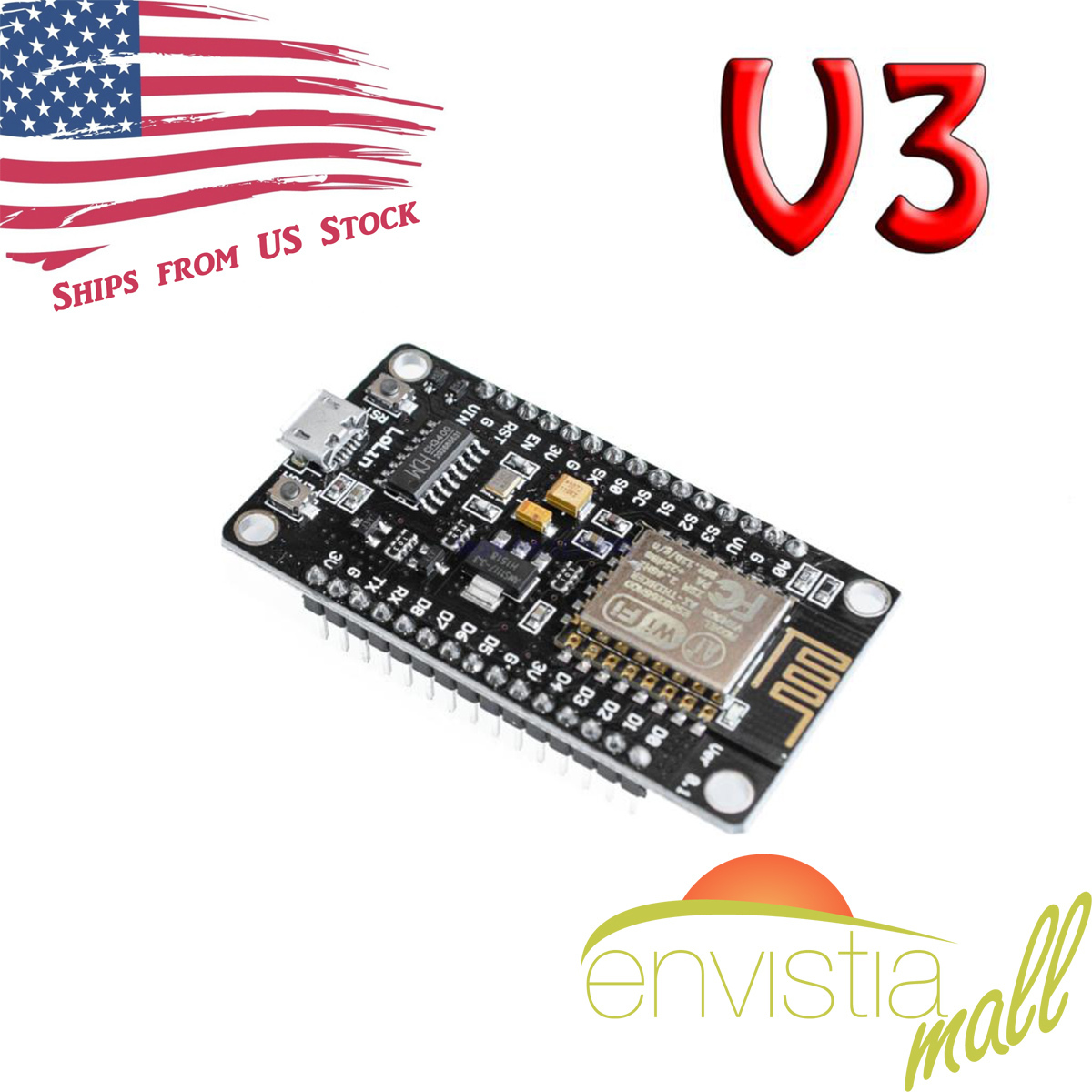
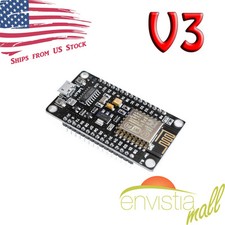
NodeMCU V3 ESP8266 WiFi IoT Board. 3.3V LOGIC -- do NOT apply 5V to any GPIO pin or it will be destroyed. Use a level shifter for 5V devices. WiFi is 2.4GHz ONLY -- no 5GHz support.
ESP-12E module with built-in 802.11 b/g/n WiFi. Program with Arduino IDE, NodeMCU/Lua, MicroPython, or PlatformIO. CH340G USB-to-serial chip.
Key Specs:
• MCU: ESP8266 (80MHz, 4MB flash)
• GPIO: 10 digital + 1 analog (A0, 3.3V max)
• WiFi: 802.11 b/g/n, 2.4GHz, STA/AP/STA+AP
• Power: Micro USB 5V or VIN 4.5-9V (10V max)
• Current: ~70mA typical, 200mA max (WiFi TX)
• USB Chip: CH340G
• Size: 58x31mm (2.3x1.2in)
Safe pins: D1, D2, D5, D6, D7. Pins D3, D4, D8 have boot restrictions. SD1/SD2/SD3 reserved -- do not use. USB data cable required (not included).
Ships from USA. Fast free shipping, hassle-free returns.
Electronics for IoT, Prototyping & DIY
NodeMCU V3 ESP8266 WiFi IoT Board. 3.3V LOGIC -- do NOT apply 5V to any GPIO pin or it will be destroyed. Use a level shifter for 5V devices. WiFi is 2.4GHz ONLY -- no 5GHz support.
ESP-12E module with built-in 802.11 b/g/n WiFi. Program with Arduino IDE, NodeMCU/Lua, MicroPython, or PlatformIO. CH340G USB-to-serial chip.
Key Specs:
• MCU: ESP8266 (80MHz, 4MB flash)
• GPIO: 10 digital + 1 analog (A0, 3.3V max)
• WiFi: 802.11 b/g/n, 2.4GHz, STA/AP/STA+AP
• Power: Micro USB 5V or VIN 4.5-9V (10V max)
• Current: ~70mA typical, 200mA max (WiFi TX)
• USB Chip: CH340G
• Size: 58x31mm (2.3x1.2in)
Safe pins: D1, D2, D5, D6, D7. Pins D3, D4, D8 have boot restrictions. SD1/SD2/SD3 reserved -- do not use. USB data cable required (not included).
Ships from USA. Fast free shipping, hassle-free returns.
NodeMCU V3 WiFi IoT Development Board – ESP8266 ESP-12E – CH340G USB – Breadboard Friendly
The NodeMCU V3 is an open-source WiFi development board based on the ESP8266 ESP-12E module. It features built-in 802.11 b/g/n WiFi (2.4 GHz), 10 digital GPIO pins, 1 analog input, CH340G USB-to-serial programming, and a compact breadboard-friendly form factor -- making it ideal for IoT projects, home automation, web servers, and wireless sensor networks.
⚠️ Important: This is a 3.3V logic level board. All GPIO pins operate at 3.3V. Applying 5V to any GPIO pin will permanently damage the ESP8266 chip. If connecting 5V sensors or modules, you must use a level shifter. The analog input (A0) has a maximum input voltage of 3.3V. WiFi supports 2.4 GHz only, not 5 GHz.⚡ Key Features
- Built-In WiFi: ESP8266 ESP-12E module with 802.11 b/g/n WiFi (2.4 GHz)
- Three WiFi Modes: Station (STA), Access Point (AP), and STA+AP combined
- Built-In TCP/IP Stack: Supports up to 5 simultaneous TCP client connections
- Arduino IDE Compatible: Program using the familiar Arduino IDE with the ESP8266 board package
- Multi-Platform Support: Also supports NodeMCU/Lua, MicroPython, and PlatformIO
- 10 Digital GPIO Pins: D0–D8 plus D9/D10 (shared with TX/RX), supporting interrupt, PWM, I²C, and one-wire (except D0)
- 1 Analog Input: 10-bit ADC on pin A0 (3.3V max input)
- CH340G USB-to-Serial: Reliable USB programming and serial communication via Micro USB
- OTA Support: Over-The-Air firmware updates via WiFi after initial upload
- Breadboard Friendly: Compact form factor fits on a standard solderless breadboard
- 80 MHz Processor: ESP8266 running at 80 MHz with 4MB flash memory
📐 SpecificationsMicrocontrollerESP8266 (Tensilica L106 32-bit)WiFi ModuleESP-12E (802.11 b/g/n, 2.4 GHz)Board VersionLoLin NodeMCU V3Clock Speed80 MHz (configurable to 160 MHz)Flash Memory4 MBSRAM64 KB instruction / 96 KB dataDigital I/O Pins10 usable GPIO (D0–D8, plus SD1–SD3 reserved)Analog Input1 (A0, 10-bit ADC, 3.3V max)GPIO Drive Capability15 mA per pinOperating Voltage (Logic)3.3VPower Input4.5V – 9V (10V max) via VIN, or 5V via Micro USBOperating Current~70 mA typical, 200 mA max (WiFi transmission)Standby Current<200 µAUSB-to-Serial ChipCH340GSerial Baud Rate110 – 460,800 bpsWiFi ModesSTA / AP / STA+APTCP ConnectionsUp to 5 simultaneous clientsBoard DimensionsApprox. 58 × 31 mm (2.3 x 1.2 inches) L × W📌 Pinout Quick ReferenceBoard PinESP8266 GPIOFunctionNotesD0GPIO16Digital I/ONo interrupt/PWM/I²C. Deep sleep wake.D1GPIO5Digital I/O, SCL✅ Safe for general useD2GPIO4Digital I/O, SDA✅ Safe for general useD3GPIO0Digital I/O⚠️ Must be HIGH at bootD4GPIO2Digital I/O, LED⚠️ Must be HIGH at boot. On-board LED.D5GPIO14Digital I/O, SCLK✅ Safe for general useD6GPIO12Digital I/O, MISO✅ Safe for general useD7GPIO13Digital I/O, MOSI✅ Safe for general useD8GPIO15Digital I/O, CS⚠️ Must be LOW at bootD9 / TXGPIO1UART TXUsed during uploadD10 / RXGPIO3UART RXUsed during uploadA0ADC0Analog Input10-bit ADC. Max 3.3V input.📦 What\'s in the Box
- 1× NodeMCU V3 ESP8266 WiFi IoT Development Board
USB cable is not included. A Micro USB data cable is required for programming and power (charge-only cables will not work).
🛒 What You\'ll Need
- Micro USB Data Cable -- for programming and power (must be a data cable, not charge-only)
- Arduino IDE -- free download from arduino.cc, with the ESP8266 board package installed
- CH340G USB Driver -- usually included with Windows 10/11, macOS, and Linux; manual install if needed
🔌 Compatible With
- Arduino IDE (with ESP8266 board package)
- NodeMCU / Lua solderless breadboards (via header pins)
🎯 Typical Applications
- IoT devices and smart home automation
- WiFi-connected web servers and dashboards
- Wireless sensor nodes (temperature, humidity, motion, light)
- MQTT clients for Home Assistant, Node-RED, and other platforms
- Remote data logging and monitoring
- WiFi-controlled relays, LEDs, and actuators
- Weather stations and environmental monitors
- WiFi Access Point and Smart Config provisioning
🚀 Quick Setup
- Install the CH340G USB driver if your computer doesn\'t recognize the board when plugged in
- Open the Arduino IDE, go to File > Preferences, and add the ESP8266 board manager URL
- Go to Tools > Board > Boards Manager, search for esp8266, and install the package
- Select Tools > Board > \"NodeMCU 1.0 (ESP-12E Module)\"
- Connect the board via Micro USB, select the correct COM port, and upload the Blink example
💡 Tip: The built-in LED on the NodeMCU V3 is active LOW -- writing LOW turns it ON, and writing HIGH turns it OFF. This is the opposite of most Arduino boards. Also, the ESP8266 only supports 2.4 GHz WiFi -- it cannot connect to 5 GHz networks. Pins SD1, SD2, and SD3 are connected to the internal SPI flash -- do not use them for general I/O.⚠️ Important Notes
- 3.3V Logic Level: All GPIO pins are 3.3V -- applying 5V to any pin will permanently damage the ESP8266 chip. Use a level shifter for 5V devices.
- Analog Input Limit: Maximum input voltage on A0 is 3.3V -- exceeding this can damage the ADC
- VIN Voltage Limit: The VIN pin accepts 4.5V–9V (10V absolute max) -- do not exceed 10V
- Boot Pin Restrictions: D3 (GPIO0), D4 (GPIO2), and D8 (GPIO15) have specific state requirements during boot -- connecting peripherals that pull these pins to the wrong state will prevent the board from starting
- Reserved Pins: SD1, SD2, and SD3 (GPIO8, 9, 10) are connected to the internal SPI flash -- do not use them for general I/O
- WiFi is 2.4 GHz Only: The ESP8266 does not support 5 GHz WiFi networks
- GPIO Current Limit: Each pin can source/sink approximately 15 mA -- use a transistor or MOSFET for higher-current loads
- Use a Data USB Cable: Many Micro USB cables are charge-only -- if the board isn\'t recognized, try a different cable with data lines
🏪 About Envistia Mall
Envistia Mall is a US-based electronics retailer specializing in development boards, sensors, modules, and components for makers, engineers, and educators. We ship from the United States with fast handling times. Product documentation and technical support are available at our dedicated support site.
📦 Fast Free US Shipping | 🔄 Hassle-Free Returns | 📧 Responsive Customer Support
Visit our store for more ESP8266 and ESP32 boards, Arduino-compatible development boards, WiFi modules, sensors, relay modules, jumper wires, breadboards, and other essential components for your IoT and electronics projects.
Featured Products
WeMos D1 CH340 WiFi Arduino UNO R3-Compatible Development Board ESP8266 ESP-12F
$9.49
Teensy 4.1 ARM Cortex-M7 Microcontroller Development Board w/, w/o Soldered Pins
$37.50
Audio Adapter Shield 4.0 for Teensy 4.0 & 4.1 w/ Male & Female Headers
$14.89
MEGA2560 PRO MINI ATmega2560-16AU CH340G Development Board
$18.89
PJRC Teensy 4.1 iMXRT1062 Microcontroller Development Board w/ SD Card, Ethernet
$37.50
MEGA2560 R3 ATmega2560-16AU CH340G Development Board with or without Cable
$22.49
PJRC Teensy 4.1 iMXRT1062 Microcontroller Development Board w/ 2X 8MB PSRAM ICs
$39.50
Digispark ATtiny85 USB-C Development Board Arduino Compatible Microcontroller
$8.29 Add suggested items to your listings - Check it out on 3Dsellers.com
· All Rights Reserved to My Store ·
listing template by 3Dsellers.com - Try for Free!