When you click on links to various merchants on this site and make a purchase, this can result in this site earning a commission. Affiliate programs and affiliations include, but are not limited to, the eBay Partner Network.
His Story Collections PresentsQing Dynasty Square Chaoguan-Ear Censer朝冠耳四方兽炉 | Chinese Bronze Incense Burner | Certified Antique Attribution
Carry History With You
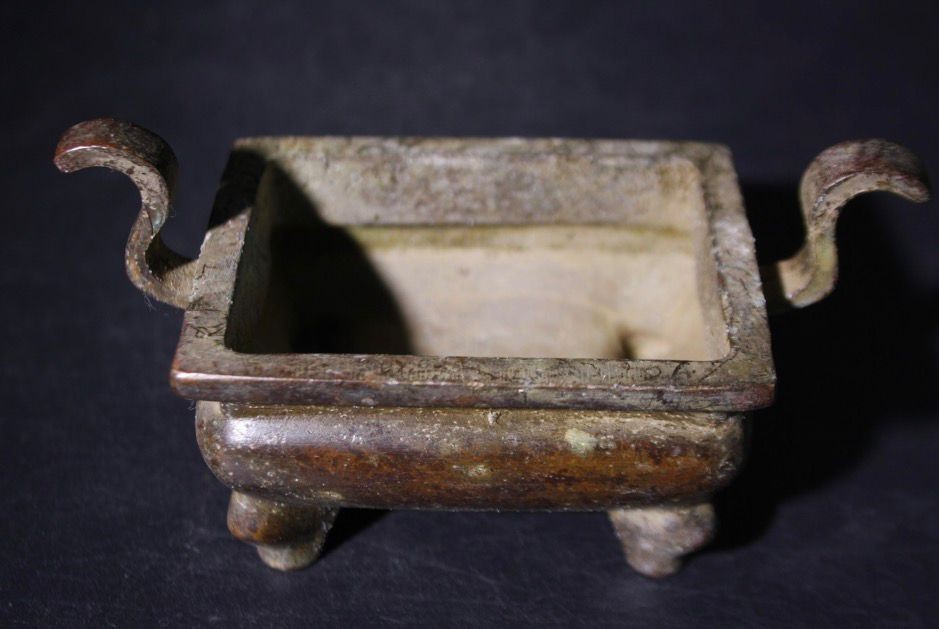
At first glance, it is a remarkably restrained object.
A square vessel.
Four short feet.
Two strange, elegantly curved handles rising from either side.
But those handles reveal its identity.
They are known in Chinese decorative art as:
朝冠耳 — Chaoguan Ears
And they transform this small vessel into part of a centuries-old Chinese tradition of incense culture.
The Story — A Censer Inspired by the Scholar\'s World
According to its accompanying certification, this artifact is attributed to the Qing Dynasty (1644–1912) and identified as a:
朝冠耳四方兽炉
A square censer with chaoguan handles and beast-form feet.
The Chinese character 炉 (lú) tells us immediately that this is not simply a container.
It is a censer.
An object created around the ancient practice of burning incense.
For centuries in China, fragrance occupied many different worlds.
Incense could accompany Buddhist and Daoist worship.
It could form part of ritual practice.
But it could also inhabit a quieter environment—
the scholar\'s desk.
The study.
The private room.
There, fragrance became part of contemplation, reading, painting and cultivated life.
Why Are the Handles Shaped Like This?
The unusual handles are perhaps the vessel\'s most distinctive feature.
They sweep outward from either side before turning upward like hooks.
This form has a specific name:
朝冠耳
The Palace Museum explains that 朝冠耳 is the name given to this handle style because the paired projections resemble the wings of traditional official headwear. DPM
That association gave the form an unmistakably formal appearance.
It is why even a relatively small vessel such as this can possess an architectural, almost ceremonial silhouette.
Historical examples survive in many materials.
The Palace Museum preserves Qing chaoguan-ear censers in glass and precious metal, demonstrating how widely the form was interpreted by Qing craftsmen. DPM
Four Sides, Four Feet
Unlike the more familiar circular tripod censer, this vessel adopts a compact four-sided architectural form.
Each corner is supported by a short foot.
That combination is significant.
Published examples of Qing bronze 四方朝冠耳炉 similarly combine a square body, four feet and the distinctive paired chaoguan handles. Artron sale
The result feels remarkably balanced.
The four feet visually anchor the object.
The square body gives it mass.
Then the two handles sweep upward, breaking the otherwise horizontal geometry.
It is an excellent example of how Chinese craftsmen could turn a functional object into a carefully proportioned sculptural form.
Incense and the Chinese Interior
Imagine this vessel not in a museum cabinet, but within the environment for which objects of its general type were created.
A small quantity of aromatic material burns inside.
Smoke rises slowly above the square mouth.
The bronze warms.
The fragrance spreads into the room.
Objects such as censers became part of a much larger Chinese material culture surrounding incense.
They could be functional.
They could be ritual.
They could be decorative.
And increasingly, finely made censers became collectible objects in their own right.
The form was important enough that later Qing artisans continued to reinterpret archaic and earlier bronze traditions rather than abandoning them.
The Mark Beneath the Vessel
Turn the censer over and a single character appears within a circular reserve:
清
Qīng
It is the same character found in 大清 — Great Qing, the dynastic name of China\'s final imperial dynasty.
It is an intriguing feature and deserves to be shown prominently in the listing photographs.
But responsible attribution requires an important distinction:
A mark is not the same thing as independent proof of age.
The object\'s accompanying certification attributes the censer to the Qing Dynasty.
His Story Collections therefore presents the artifact according to that certified attribution while describing the 清 mark separately as a physical feature of the object.
We do not independently claim that the mark itself proves Qing-period manufacture.
Certification & Specifications
Attributed period: Qing Dynasty (1644–1912)
Chinese identification: 朝冠耳四方兽炉
English: Square Beast-Foot Censer with Chaoguan Handles
Object type: Censer / incense burner
Form: Four-sided body
Handles: Paired 朝冠耳 / chaoguan-style handles
Feet: Four short beast/hoof-form feet
Base mark: 清 within circular reserve
Material: Copper alloy / bronze-type metal, subject to certification description
Certification: Accompanying Chinese third-party certification/display case
Attribution Notice
The Qing Dynasty attribution and identification follow the accompanying certification.
His Story Collections has not independently performed metallurgical analysis, thermoluminescence testing or other scientific dating of this object.
The 清 character on the underside is described as a physical mark and is not independently represented as proof of Qing-period manufacture.
Condition
The censer displays substantial surface coloration, oxidation, deposits and wear visible throughout the photographs.
The interior retains lighter-colored deposits/residue, while the exterior exhibits predominantly brown and darker metallic tones.
The feet and exposed edges show additional surface variation.
The object has not been aggressively polished or restored by His Story Collections.
Please examine all photographs carefully. They form an important part of the description.
The artifact shown is the exact item offered for sale.
Why His Story Collections Chose This Piece
A censer is an unusual historical object because its purpose was never entirely visual.
It was created for something ago, incense smoke disappeared almost as quickly as it was created.
The room changed.
The fragrance faded.
The people eventually disappeared as well.
But the vessel remained.
Its four feet still support it.
Its strange court-hat-shaped handles still rise from its sides.
And beneath it remains a single character:
清.
It is a small surviving object from a culture in which fragrance, ritual, craftsmanship and contemplation intersected.
That is exactly the kind of object His Story Collections exists to preserve and share.
Carry History With You.
His Story Collections