When you click on links to various merchants on this site and make a purchase, this can result in this site earning a commission. Affiliate programs and affiliations include, but are not limited to, the eBay Partner Network.
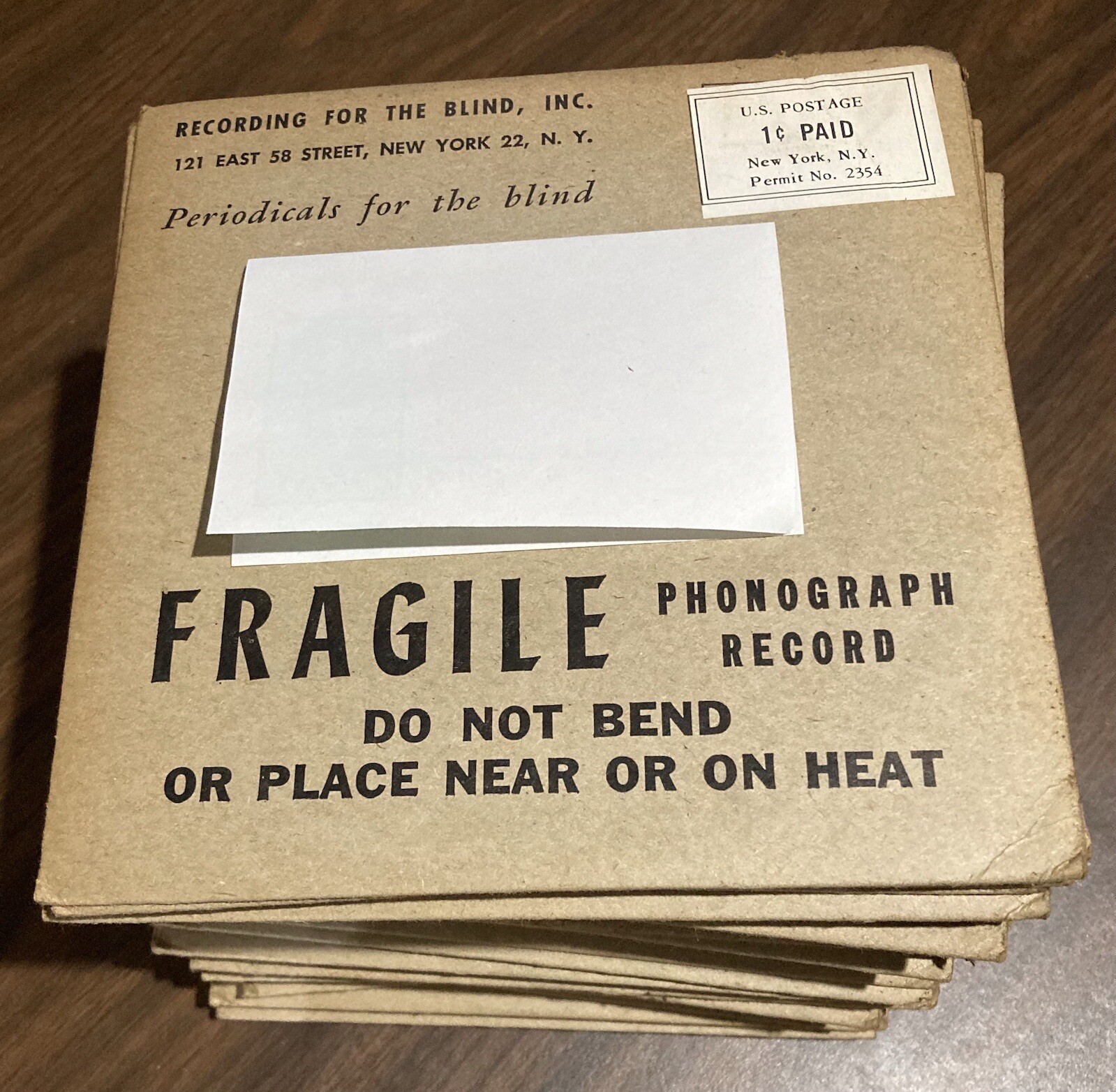
This is an EXTREMELY RARE find - a set of 1963 New York Times "News of the Week In Review" audio recordings. The recordings were produced by the American Foundation for the Blind. This is a unique opportunity to own a piece of history created with the specific purpose of providing news and information to the blind and visually impaired community. The recordings would make a great addition to any collection.
There are 50 records/recordings still available for the years 1963 and 1964. This listing sells one record at the list price.
Each record comes in a record jacket and the address of the original recipient will be blacked out on each cover jacket. Have not played the records - do not know their playability or audio condition.
Number sold: 2
A history of records for the blind:
In the 1930s, records weren’t played on the radio or at concerts. They didn’t flood people’s homes with music. The first long-playing records, now commonly known as LPs, weren’t for music at all: they were audiobooks designed for the blind.
Record companies hadn’t yet figured out how to make music sound good on LPs. But they did discover that they could make long voice recordings of just someone talking. Which made the technology perfect for blind people and audio books. And in 1932, the American Foundation for the Blind licensed Frank L. Dyer’s “talking machine record” technology for that purpose.
According to the American Foundation for the Blind, the demand for talking books increased dramatically after the war, as soldiers came home with damage to their eyes. After licensing Dyers technology and working with the Carnegie Corporation to develop a disk that could be durable, affordable and easy to listen to, the foundation came up with the first modern LP. Here’s the American Foundation for the Blind:
The outcome of this research and development effort was a 12-inch 33 1/3 rpm disc made out of a synthetic material called Vinylite. The disc was both durable and flexible and therefore suitable for transporting. It had many more grooves per inch than the traditional 78 rpm record and rotated at a far slower speed, allowing for larger amounts of material to be stored on a single side. Regarding the development of a “reproducer” as the Talking Book machines were called, AFB devised two — one electric, the other spring-driven. The former cost approximately thirty dollars and the latter, designed for those without access to electricity, cost twenty dollars.
In 1933, the Talking Books program was allotted $10,000 (worth $175,000 today).
One of the most prominent blind advocates, Helen Keller, was opposed to the Talking Books program at first. She thought that the money would have been better spent elsewhere, writing in Matilda Ziegler Magazine:
Furthermore, I told them I thought the blind could live without talking-books and radios at a time when millions of people are out of work and in the bread-line. Last winter in Pennsylvania alone five hundred blind people ate the bread of charity! Will radios and talking-books take the place of food, shelter and clothing? Naturally I am not willing to divert the attention of the public to talking-books while more urgent needs of the sightless demand first service.
But later that year Keller changed her mind. No one really knows what happened, but in March of 1935 she wrote a letter in support of the Talking Books project. Keller was quite an influential person, and after she threw her support behind the program, Talking Books was allotted another $211,500.
So, finally, in 1935, production of the records began. In 1936, the foundation and its partners began producing audiobooks for children. The New York Public Library still has some of the first talking books recorded:
Historical documents such as the Declaration of Independence and the Constitution, a number of Shakespeare’s plays and poems, and a variety of fictional works were among the first talking books issued. In order to meet the public’s hungry demand for a broader selection of reading materials, the Library of Congress came up with a mechanism for obtaining permission from publishers to record printed works “royalty free.”
And the “talking book machines” were distributed across the country. The American Foundation for the Blind estimates that by 1942 they had distributed “23,505 Talking Book machines, 7,000 pickup arms, 69.5 million needles, 130,000 record envelopes and 40,500 record containers.”