When you click on links to various merchants on this site and make a purchase, this can result in this site earning a commission. Affiliate programs and affiliations include, but are not limited to, the eBay Partner Network.
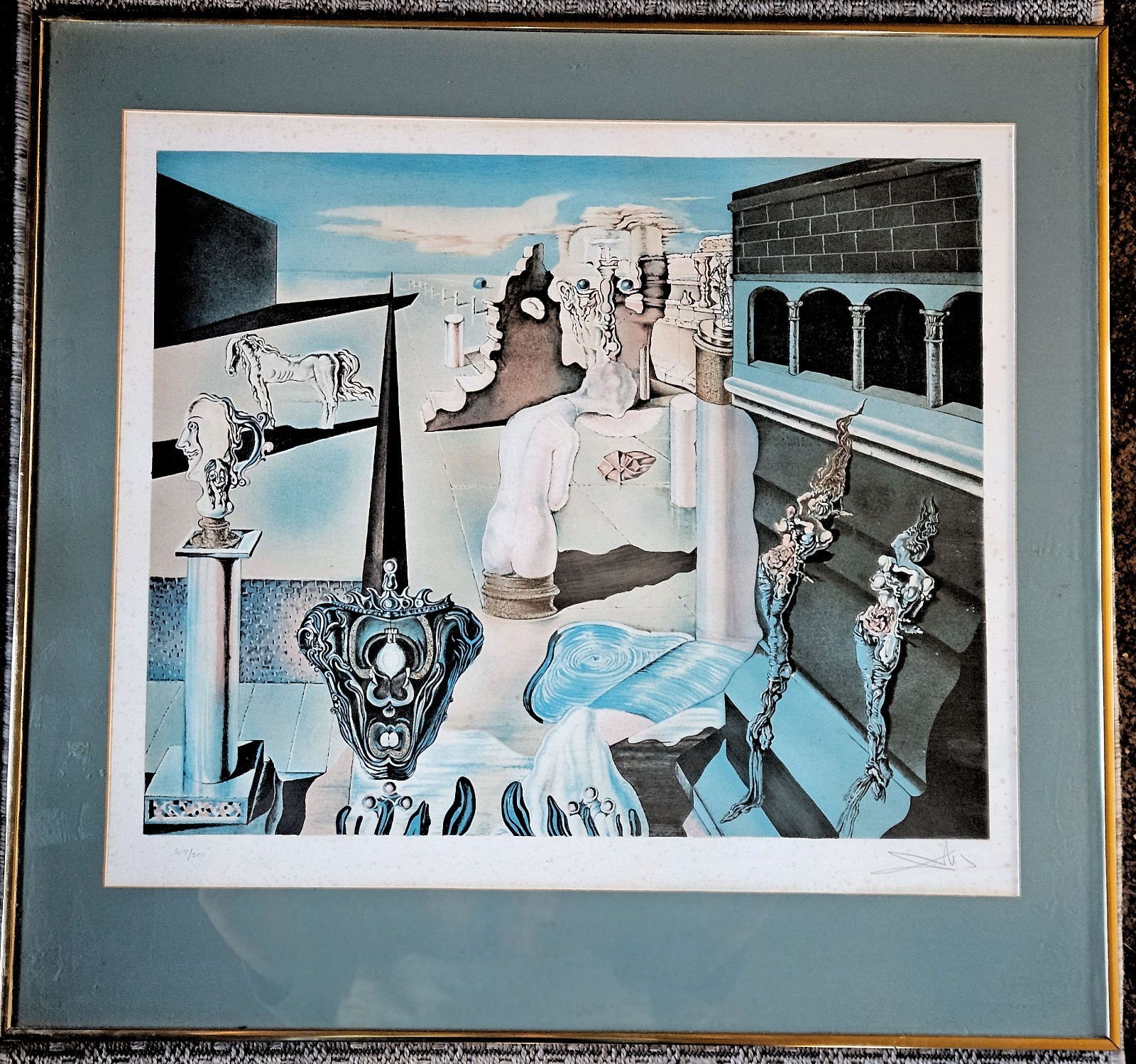
This wonderful piece is an original limited edition lithograph hand signed in pencil by Dalí.The piece is numbered 207/300, printed on Arches paper and comes nicely framed. It is from a private collection and is well preserved. A unique and wonderful example of Dali's surrealistic talent.
SALVADOR DALI (Spanish 1904-1989)
MEDIUM: LITHOGRAPH - FRAMED 30in x 28in
TITLE: SURREALIST LANDSCAPE
HAND-SIGNED AND NUMBERED BY SALVADOR DALI.
LIMITED EDITION: 207/300
MADE IN FRANCE.
CIRCA 1967
EXCELLENT OVERALL CONDITION.- FRAMED
DIMENSIONS INCLUDING THE FRAME: 30" W x 28” H
DIMENSIONS WITHOUT THE FRAME: 28” W x 26”
Salvador Dalí's 1937 painting surrealist masterpiece that depicts a dreamlike landscape with distorted human figures containing hidden messages. The painting is an iconic image in art history, influencing popular culture through movies, music, fashion, and video games. The hands placed at bottom hint they're placed on the keys of a piano and are one of the painting's most recognizable features along with the distorted human figure in the center symbolize the fluidity and impermanence of that period.
Salvador Dali
Born: 1904 - Figueras, Spain
Died: 1989 - Figueras, Spain
Known for: Surrealist painting, drawing, photography, sculpture
Salvador Dali was born in May 11, 1904 in the small agricultural town of Figueres, Spain, located in the foothills of the Pyrenees, only sixteen miles from the French border in the principality of Catalonia. The son of a prosperous notary, Salvador Dali spent his boyhood in Figueres and at the family's summer home in the coastal fishing village of Cadaques where his parents built his first studio. As an adult, he made his home with his wife Gala in nearby Port Lligat. Many of his paintings reflect his love of this area of Spain.
The young Salvador Dali attended the San Fernando Academy of Fine Arts in Madrid. Early recognition of Salvador Dali's talent came with his first one-man show in Barcelona in 1925. He became internationally known when three of his paintings, including The Basket of Bread (now in the Museum's collection), were shown in the third annual Carnegie International Exhibition in Pittsburgh in 1928.
The following year, Dalí held his first one-man show in Paris. He also joined the surrealists, led by former Dadaist Andre Breton. That year, Dali met Gala Eluard when she visited him in Cadaques with her husband, poet Paul Eluard. She became Dalí's lover, muse, business manager, and chief inspiration.
Dalí soon became a leader of the surrealist movement. This painting, A surrealist Landscape with many distorted figures carrying hidden messages, the hands placed as if they are playing a piano is still one of the best-known surrealist works. But as the war approached, the apolitical Dalí clashed with the surrealists and was "expelled" from the surrealist group during a "trial" in 1934. He did however, exhibit works in international surrealist exhibitions throughout the decade but by 1940, Dali was moving into a new style that eventually became known as his "classic" period, demonstrating a preoccupation with science and religion.
Dalí and Gala escaped from Europe during World War II, spending 1940-48 in the United States. These were very important years for the artist. The Museum of Modern Art in New York gave Dali his first major retrospective exhibit in 1941. This was followed in 1942 by the publication of Dali's autobiography, The Secret Life of Salvador Dali. Spanish painter, sculptor, graphic artist, and designer. After passing through phases of Cubism, Futurism and Metaphysical painting, he joined the Surrealists in 1929 and his talent for self-publicity rapidly made him the most famous representative of the movement. Throughout his life he cultivated eccentricity and exhibitionism (one of his most famous acts was appearing in a diving suit at the opening of the London Surrealist exhibition in 1936), claiming that this was the source of his creative energy. He took over the Surrealist theory of automatism but transformed it into a more positive method which he named `critical paranoia'.
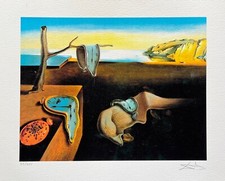
According to this theory one should cultivate genuine delusion as in clinical paranoia while remaining residually aware at the back of one's mind that the control of the reason and will has been deliberately suspended. He claimed that this method should be used not only in artistic and poetical creation but also in the affairs of daily life. His paintings employed a meticulous academic technique that was contradicted by the unreal `dream' space he depicted and by the strangely hallucinatory characters of his imagery. He described his pictures as `hand-painted dream photographs' and had certain favorite and recurring images, such as the human figure with half-open drawers protruding from it, burning giraffes, and watches bent and flowing as if made from melting wax (The Persistence of Memory, MOMA, New York; 1931).
In 1937 Dalí visited Italy and adopted a more traditional style; this together with his political views (he was a supporter of General Franco) led Breton to expel him from the Surrealist ranks. He moved to the USA in 1940 and remained there until 1955. During this time he devoted himself largely to self-publicity; his paintings were often on religious themes (The Crucifixion of St John of the Cross, Glasgow Art Gallery, 1951), although sexual subjects and pictures centering on his wife Gala were also continuing preoccupations. In 1955 he returned to Spain and in old age became a recluse.
As Dali moved away from Surrealism and into his classic period, he began his series of 19 large canvases, many concerning scientific, historical or religous themes. Among the best known of these works are The Hallucinogenic Toreador, and The Discovery of America by Christopher Columbus in the museum's collection, and The Sacrament of the Last Supper in the collection of the National Gallery in Washington, D.C.
In 1974, Dalí opened the Teatro Museo in Figueres, Spain. This was followed by retrospectives in Paris and London at the end of the decade. After the death of his wife, Gala, in 1982, Dali's health began to fail. It deteriorated further after he was burned in a fire in his home in Pubol in 1984. Two years later, a pace-maker was implanted. Much of this part of his life was spent in seclusion, first in Pubol and later in his apartments at Torre Galatea, adjacent to the Teatro Museo. Salvador Dalí died on January 23, 1989 in Figueres from heart failure with respiratory complications.
As an artist, Salvador Dalí was not limited to a particular style or media. The body of his work, from early impressionist paintings through his transitional surrealist works, and into his classical period, reveals a constantly growing and evolving artist. Dali worked in all media, leaving behind a wealth of oils, watercolors, drawings, graphics, and sculptures, jewels and objects of all descriptions. Apart from painting, Dalí's output included sculpture, book illustration, jewellery design, and work for the theatre. In collaboration with the director Luis Buñuel he also made the first Surrealist films---Un chien andalou (1929) and L'Age d'or (1930)---and he contributed a dream sequence to Alfred Hitchcock's Spellbound (1945). He also wrote a novel, Hidden Faces (1944) and several volumes of flamboyant autobiography. Although he is undoubtedly one of the most famous artists of the 20th century, his status is controversial; many critics consider that he did little if anything of consequence after his classic Surrealist works of the 1930s. There are museums devoted to Dalí's work in Figueras, his home town in Spain, and in St Petersburg in Florida.